
Lotion hydrates; oil seals. Use lotion first, then oil, and you cover both jobs your skin actually needs done. Lotion is a water-based emulsion that delivers moisture with humectants, while oil is a pure occlusive that locks that moisture in without adding any of its own. If your skin is prone to breakouts or easily irritated, patch-test any oil before you spread it over your whole body.
TL;DR:
- Applying lotion before oil ensures proper hydration, as lotion delivers water and oil seals it without blocking absorption.
- For dry or cold weather, layering lotion then oil significantly reduces water loss and maintains skin moisture more effectively.
- Oily or acne-prone skin benefits from lightweight, non-comedogenic lotions, while thick creams or oils suit those with severe dryness or hormonal skin.
- Patch-testing new oils on the inner arm for a few days helps prevent irritation or breakouts, especially with comedogenic or fragranced products.
- Proper layering, starting with damp skin and waiting a few minutes between steps, maximizes hydration benefits and prevents oil from blocking lotion absorption.
Table of Contents
- Body Oil vs. Lotion: The Quick Comparison
- What Are Emollients, Humectants, and Occlusives, and How Do They Work?
- Which Should You Use for Your Skin Type and Season?
- How Do You Layer Lotion and Oil Correctly?
- What Ingredients Should You Look For or Avoid?
- Quick Routines by Skin Type
- Why The Infinite Bath Backs the Layering Approach
- Why the "Which Is Better" Debate Misses the Point
- Complete Your Routine with a Body Oil Built to Seal, Not Just Shine
- Sources
Body Oil vs. Lotion: The Quick Comparison
Before you dig into the mechanics, here's how the two feel and behave on your skin day to day.
- Lotion: lightweight, spreads easily, absorbs fast, leaves a matte-to-satin finish.
- Body oil: silkier and denser, takes longer to sink in, leaves a soft sheen behind.
- Hydration vs. sealing: lotion delivers water to the skin; oil traps that water rather than adding its own.
- Best in humid weather: lotion alone often does the job when the air already holds moisture.
- Best in dry, cold weather: oil earns its place by reducing water loss through the skin's surface.
- Massage or quick fix: oil glides longer under your hands; lotion is the faster, no-fuss option when you're rushing out the door.
Neither one wins outright. They solve different problems, which is exactly why so many people who swear off one or the other end up frustrated by results that never quite stick.
What Are Emollients, Humectants, and Occlusives, and How Do They Work?
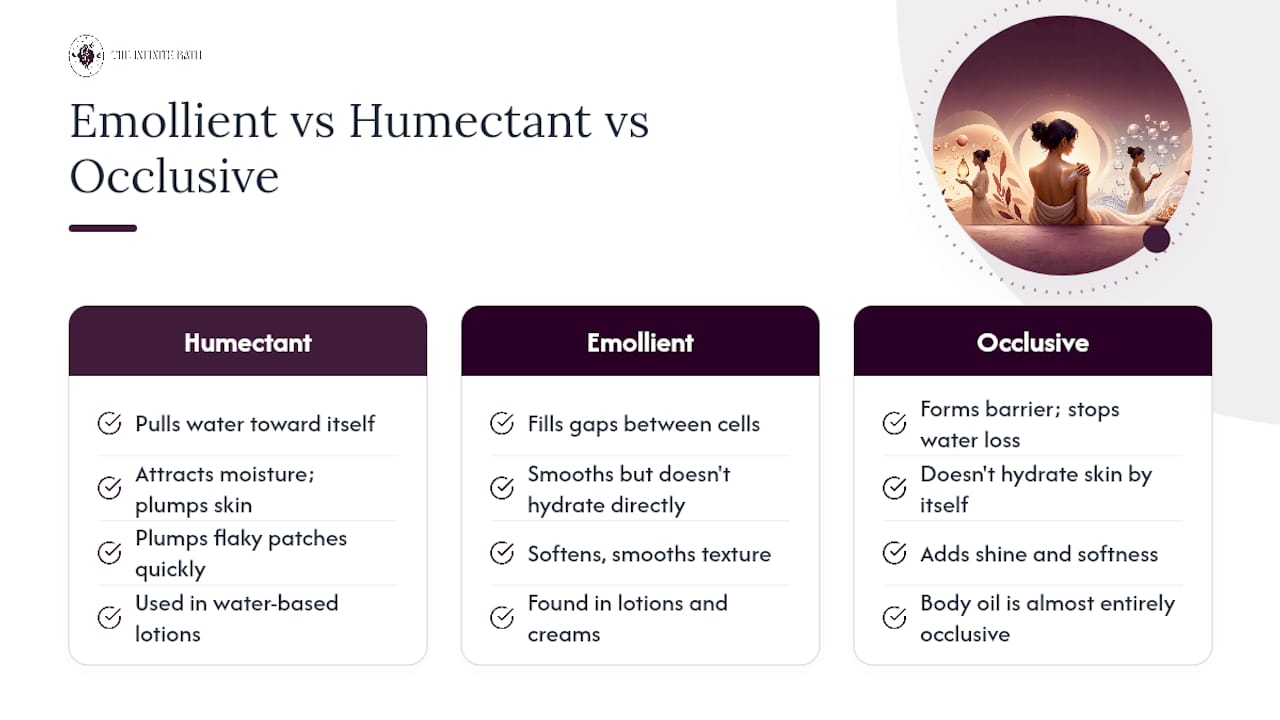
Three terms explain almost everything about why your skin drinks up lotion but seems to sit under a layer of oil. A humectant pulls water toward itself, which is how lotion plumps up dry, flaky patches so quickly. An emollient smooths and softens skin texture by filling in tiny gaps between skin cells. An occlusive does neither of those things; it simply forms a physical barrier that keeps water from escaping.
Body oil is almost entirely occlusive. It adds shine and softness, but it cannot hydrate skin that has no water to begin with. Lotion, being a water-based emulsion, delivers hydration directly and absorbs quickly, which is why the American Academy of Dermatology points people toward the right texture based on how dry their skin actually is, recommending lotion for typical seasonal dryness and reserving richer creams for more stubborn cases.
Which Should You Use for Your Skin Type and Season?
The right pick depends less on preference and more on what your skin is dealing with right now.
- Oily or acne-prone skin: lightweight, non-comedogenic lotion; skip heavy oils on the back and chest where breakouts tend to form.
- Normal skin: lotion covers most days; add oil after a long shower or during dry spells.
- Dry skin: lotion first, oil second, every time you bathe.
- Very dry skin: the same layering routine, but consider a thicker cream on elbows and shins.
- Sensitive skin: fragrance-free lotion, then a minimal, single-ingredient oil like squalane.
- Mature or hormonal dryness: creams or ointments with higher oil content often outperform standard lotions or oils used alone.
Climate matters as much as skin type. Warm, humid months usually call for lighter lotion alone, while cold air and indoor heating strip moisture fast enough that oil becomes worth the extra step.
Pro Tip: If your skin still feels tight an hour after moisturizing no matter how much lotion you apply, that's a sign you need an occlusive layer on top, not more lotion underneath.
How Do You Layer Lotion and Oil Correctly?
Order matters more than most people realize. Oil applied before lotion just sits on top and blocks the water-based product from soaking in at all, which is why professional hydration treatments like a HydraFacial MD in Stony Brook NY emphasize proper layering for optimal skin hydration.
- Step out of the shower and pat your skin so it's damp, not dry.
- Apply lotion first, focusing on rougher spots like knees, elbows, and feet.
- Give it a minute or two to absorb fully.
- Follow with a small amount of oil, just enough to leave a light sheen rather than a greasy film.
- Wait a few minutes before dressing, especially with lighter fabrics, since oil can transfer onto clothing before it fully sets.
Applying moisturizer to damp skin and using oil to seal it in is a method dermatologists commonly recommend, and it works because damp skin holds onto the water-based product more effectively than dry skin does. If you ever mix lotion and oil in your palm rather than layering them, only mix what you'll use immediately since premixed batches don't store well.
What Ingredients Should You Look For or Avoid?
Not every oil behaves the same way on skin, and the wrong pick can undo an otherwise solid routine.
- Look for: squalane, jojoba, and non-comedogenic argan oil, all of which tend to sit lightly on skin without clogging pores.
- Avoid on acne-prone areas: heavy, comedogenic oils like coconut oil, especially on the back and chest.
- Watch for: added fragrance and certain preservatives, which are common triggers for sensitive skin.
- Read labels: choose fragrance-free formulas if you've reacted to scented products before.
Checking for non-comedogenic labeling and steering clear of heavily fragranced formulas matters most for anyone prone to breakouts or irritation. Patch-test any new oil on your inner arm for two to three days before using it elsewhere, and if a rash, persistent redness, or breakouts show up, stop and check with a dermatologist rather than pushing through it.
Quick Routines by Skin Type
Sometimes you just want to know what to do tonight, not a full explainer. Here's the short version.
- Minimalist: pick lotion alone if your skin rarely feels tight; pick oil alone only if you're already well hydrated and just want the glow.
- Dry or winter skin: lotion everywhere, then oil layered on top, with a thicker cream reserved for elbows and heels.
- Acne-prone skin: a lightweight, non-comedogenic lotion daily; oil only on rough patches like elbows or knees, never on the back or chest where breakouts form.
- Sensitive skin: fragrance-free lotion with a short ingredient list, then a small amount of a single-ingredient oil like squalane, added gradually.
Why The Infinite Bath Backs the Layering Approach
The Infinite Bath built its three-step skincare regimen around the same logic: cleanse, hydrate with a gentle lactic acid serum, then seal with a renewal step. The Body Oil follows that same idea for the body, formulated to layer over lotion rather than replace it, with gentle actives chosen for sensitive skin that doesn't tolerate heavy fragrance or harsh oils well.

Why the "Which Is Better" Debate Misses the Point
The oil-versus-lotion argument treats skincare like a competition with one winner, and that framing has done readers a disservice for years. Skin doesn't ask you to choose between water and lipids; it needs both, and most dermatologists and estheticians frame the real question as how to combine the two, not which one to crown superior.
Where the conventional advice falls short is in treating "body oil" and "lotion" as competing categories rather than sequential steps. That's how people end up disappointed in a $40 oil that never fixed their dry shins, when the oil was never designed to hydrate in the first place. It was designed to hold onto hydration that had to come from somewhere else.
If you take one thing from this, prioritize the order of operations over the product itself. A basic lotion and a basic oil, applied correctly, will outperform an expensive oil used alone every time your skin genuinely needs water. Get the sequence right before you upgrade the ingredients.
— Stella
Complete Your Routine with a Body Oil Built to Seal, Not Just Shine
Plenty of body oils are formulated to smell nice and photograph well on a bathroom shelf, but not all of them are built to actually finish a hydration routine the way dermatologists recommend. The Body Oil from The Infinite Bath is made for exactly the layering step this article walks through: applied after a water-based lotion, on damp skin, to lock moisture in rather than compete with it.

It's formulated with gentle, non-irritating actives, the same philosophy behind the brand's three-step skincare regimen, so sensitive skin doesn't have to sit out the sealing step. If your routine currently stops at lotion, browse The Infinite Bath's body care shop and add the piece that's been missing.
Sources
- Body Oil vs. Lotion: What's the Difference? — Healthline
- Body Lotion vs. Body Oil: Which Is Better? Derms Weigh In — Who What Wear
- Pick a moisturizer — American Academy of Dermatology
- How To Choose Between Body Oil And Lotion, According To A Professional — Southern Living