
Lactic acid smooths and hydrates from the surface; retinol works deeper to rebuild collagen and fade stubborn spots over time. If your skin flushes easily or feels tight after most active ingredients, lactic acid is the gentler starting point. If you're chasing long-term wrinkle and pigment correction and your skin can handle it, retinol earns its reputation. You can use both, just never in the same application.
TL;DR:
- Laic acid provides surface-level exfoliation and hydration, often showing visible improvements within weeks, making it ideal for sensitive or dry skin.
- Retinol acts deeper in the skin to stimulate collagen production and usually requires several months of consistent use for noticeable wrinkle or pigment corrections.
- Combining lactic acid and retinol in the same application can cause irritation, so alternating or phased schedules are recommended for tolerance.
- Starting with low concentrations, applying retinol at night, and always using daily SPF are crucial steps to minimize irritation and achieve results safely.
- A gentle, gradual approach with patience and proper scheduling outweighs intensity, especially for sensitive or reactive skin types.
Table of Contents
- How Lactic Acid vs Retinol Work in the Skin
- Which Ingredient Fits Your Skin Goals?
- How to Use Lactic Acid or Retinol Safely
- Can You Use Lactic Acid and Retinol Together?
- What Side Effects Should You Expect?
- Sample Routines for Sensitive, Aging, and Combination Skin
- How The Infinite Bath Approaches Gentle Resurfacing
- Why the Retinol-First Mindset Deserves a Second Look
- Where a Gentle Lactic Acid Routine Fits Your Next Step
- Sources
How Lactic Acid vs Retinol Work in the Skin
The difference between these two ingredients comes down to where they act, and that single fact explains almost everything else about how they feel on your skin. Picture your skin's outer layer, the stratum corneum, as a brick wall made of dead skin cells cemented together. Lactic acid is an alpha hydroxy acid that loosens the mortar holding those bricks in place, letting dull, rough cells slough off so fresher skin shows through. It works right at the surface, and because its molecule is larger than glycolic acid's, it doesn't penetrate as aggressively. That's part of why alpha hydroxy acids in dermatology are associated with real texture and radiance improvements alongside comparatively mild irritation when the formula includes emollients.
Retinol plays a different game entirely. It's a vitamin A derivative that has to convert to retinoic acid once it's in your skin, and that converted form actually communicates with your cells, switching on genes tied to collagen production and turnover. This happens deeper in the dermis, not just on the surface, which is why topical retinoids are backed by stronger evidence for long-term wrinkle and photoaging improvement.
What this means for your timeline:
- Lactic acid: visible smoothness and glow can often be seen in a few weeks
- Retinol: measurable collagen and fine-line changes typically require several weeks of consistent use
- Lactic acid resurfaces what's already there; retinol changes how your skin behaves going forward
Which Ingredient Fits Your Skin Goals?
Match the ingredient to what you're actually trying to fix, not what's trending. Lactic acid earns its keep as a gentle, hydrating exfoliant. Because it pulls double duty as a humectant, it draws moisture into skin while it resurfaces, which is why it's often the safer entry point for sensitive, dry, or reactive skin types. Retinol, meanwhile, has the clinical track record for deeper concerns: fine lines, uneven pigmentation, and loss of firmness that builds over months, not days.
Here's a practical way to sort it out:
- Choose lactic acid if: your skin reacts to most new products, you're dealing with dullness or rough texture, or you want hydration alongside gentle exfoliation
- Prioritize retinol if: your main concerns are established fine lines, sun-related dark spots, or sagging, and your skin has tolerated actives before without much fuss
- Consider a combined, alternating approach if: you want retinol's long-term benefits but need lactic acid's gentler nights to keep your barrier calm
One thing to keep in mind: retinol for acne-prone skin often gets recommended because it regulates cell turnover and can prevent clogged pores, but it's not the only option, and it's rarely the first one a dermatologist reaches for on visibly irritated skin. Lactic acid can be a genuinely useful long-term alternative for people who can't tolerate retinoids at all, even if it won't match retinol's depth of collagen stimulation. Neither ingredient is "better" in a vacuum. The better one is whichever matches what your skin can handle this month.
How to Use Lactic Acid or Retinol Safely
Going slow isn't a suggestion here, it's the entire strategy. Both ingredients reward patience and punish enthusiasm.
- Start low. If you're new to retinol, begin with a low concentration used a few nights a week. For lactic acid, start with gentle formulations usually around moderate percentage levels suitable for sensitive skin, increasing only after assessing tolerance.
- Apply at night. Both ingredients increase photosensitivity, so retinol belongs exclusively in your evening routine, and lactic acid is safest there too, even though some lighter lactic formulas are marketed for daytime use.
- Buffer if needed. Apply a plain moisturizer before your active ingredient on the nights irritation feels likely. This slightly dilutes penetration without canceling the benefit.
- Protect the next morning. Daily sunscreen isn't optional after either ingredient. Sun sensitivity increases with both AHAs and retinoids, and skipping SPF undoes a good chunk of the progress you're making.
- Watch and adjust. If you see persistent redness, flaking, or stinging that doesn't calm down within a few days, drop back to fewer nights per week before increasing strength again.
Pro Tip: Patch test any new lactic acid or retinol product on your inner forearm for three nights before applying it to your face. Your face reacts faster and harder than your arm, so this buys you an early warning without risking a visible flare-up.
Can You Use Lactic Acid and Retinol Together?
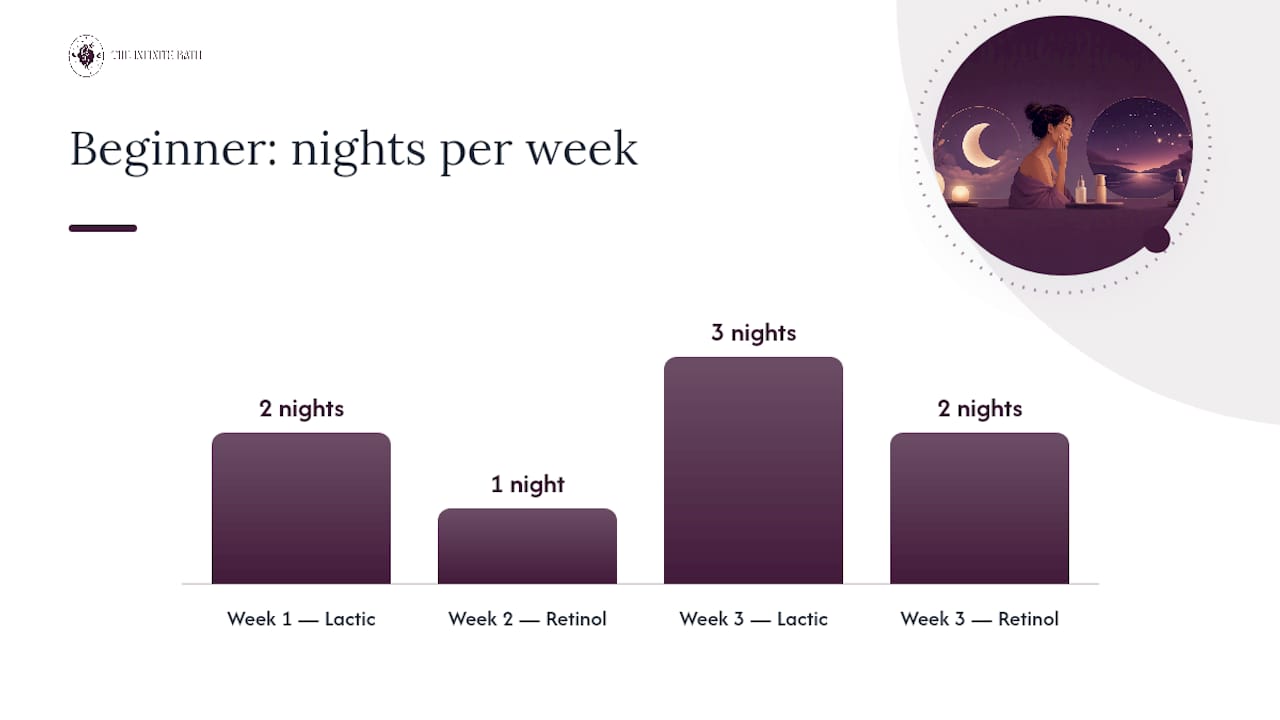
Layering both in the same application, same night, is where most irritation problems start. Combining an exfoliating acid with a cell-turnover accelerant asks your skin to handle two aggressive processes at once, and clinical guidance consistently favors alternating nights or phasing ingredients in rather than stacking them. That doesn't mean you can't use both. It means you schedule them like you'd schedule two intense workouts. Not back to back.
Two schedules to steal:
- Beginner, four weeks: Week 1, lactic acid two nights only. Week 2, add retinol one night, keeping three nights free of actives entirely. Week 3, alternate lactic acid and retinol nights (roughly three and two). Week 4, settle into a rhythm based on how skin responds, still leaving at least one bare night weekly.
- Tolerant user, eight weeks: Alternate lactic acid and retinol every other night from week one, monitoring for dryness. By week four, if skin has adjusted, retinol can move to four nights weekly with lactic acid filling the remaining nights or dropping to twice weekly for upkeep.
An AM/PM split, lactic acid in the morning and retinol at night, works for some tolerant skin types, but most dermatology guidance still favors nighttime for both given sun sensitivity concerns.
What Side Effects Should You Expect?
Redness, flaking, and a tight feeling in the first two to four weeks are common with retinol, and this adjustment period often gets confused with something worse.
- Purging is real and temporary: retinol speeds up cell turnover, which can push existing congestion to the surface faster, typically resolving within four to six weeks.
- True irritation looks different: persistent burning, visible cracking, or redness that worsens instead of settling signals you've gone too fast.
- Lactic acid rarely causes purging since it doesn't affect deeper cell turnover the same way, but overuse can still leave skin sensitized and prone to stinging.
If irritation doesn't improve after backing off frequency for two weeks, or if you're pregnant or trying to conceive, retinoids should be avoided entirely and a clinician consulted before adding potent actives.
Sample Routines for Sensitive, Aging, and Combination Skin
Pick the routine closest to your skin type, then adjust frequency as your tolerance becomes clearer over the following weeks.
- Sensitive skin: Cleanse, apply lactic acid three nights weekly, follow immediately with a barrier-supporting moisturizer rich in ceramides. Skip retinol initially, or introduce it at 0.25% only once lactic acid feels effortless, no more than one night a week to start.
- Anti-aging focus: Cleanse, apply retinol four to five nights weekly once tolerance builds, moisturize well. Use lactic acid on the remaining two or three nights instead of retinol, never combined, to maintain surface texture without overloading skin.
- Balanced or combination skin: Cleanse, alternate lactic acid and retinol nightly, moisturize according to how dry or oily your skin feels that evening. Every morning, regardless of the previous night's active, apply broad-spectrum SPF before anything else.
How The Infinite Bath Approaches Gentle Resurfacing
The brand has developed a three-step system, including a gel cleanser, a lactic serum, and a renewal cream, designed to meet the need for visible results without risking irritation. One product in the system is formulated to exfoliate and hydrate simultaneously, combining lactic acid with moisture-binding ingredients to help maintain skin's smoothness and hydration.
Skin doesn't need ten steps to look better. It needs the right two or three, used consistently, without a burn-and-recover cycle every time you try something new.
Why the Retinol-First Mindset Deserves a Second Look
The skincare industry has spent years pushing retinol as the non-negotiable anti-aging step, and for skin that tolerates it, the collagen evidence genuinely supports that push. But conventional advice rarely accounts for how many people quit actives entirely after one bad reaction, which helps nobody's skin in the long run.
What the research actually supports is a hierarchy based on tolerance, not trend cycles. Lactic acid deserves more credit than it gets as a legitimate long-term strategy, not a placeholder ingredient you outgrow. For sensitive or reactive skin, a consistent lactic acid routine that someone actually sticks with will outperform a retinol routine abandoned after three irritated weeks.
If you take one thing from this comparison, let it be sequencing over intensity. Start gentle, build slowly, and judge success by what your skin looks like in three months, not by which ingredient sounds more advanced on a label.
— Stella
Where a Gentle Lactic Acid Routine Fits Your Next Step
If you've read this far because retinol has never quite agreed with you, The Lactic Serum from The Infinite Bath was built for exactly that reader. It delivers the surface exfoliation and hydration lactic acid is known for without asking your skin to tolerate a harsher adaptation period first.

It slots directly into the sensitive-skin routine above: cleanse, apply the serum two to three nights a week, follow with a barrier-supporting moisturizer. For anyone building toward the balanced or combination routine later, it also works as your lactic acid night when alternating with a retinol product. The full three-step system, including The Gel Cleanser and a renewal cream, is available on the brand's skincare shop if you'd rather start with the complete routine than piece it together ingredient by ingredient. Browse the lineup and pick the entry point that matches where your skin actually is right now, not where you wish it was.
Sources
- Topical retinoids in dermatology: focus on mechanisms and clinical use
- Alpha hydroxy acids in dermatology
- Retinol: Overview and uses (Cleveland Clinic patient info)