
A sensitive skin routine that actually works comes down to three steps: a gentle cleanser, a barrier moisturizer, and mineral SPF, worn in that order every single day. This is a complete routine on its own, not a starter kit waiting for more products. Patch-test anything new before it touches your face, and if redness or burning persists beyond a few weeks, see a dermatologist. The Infinite Bath builds its own three-step system around this same logic.
TL;DR:
- Using a water rinse or a gentle, non-foaming cleanser in the morning preserves the skin's lipid barrier, especially if the evening routine already removed buildup.
- Applying humectant serum to damp skin enhances hydration, while a mineral SPF 30+ provides effective protection without irritating reactive skin.
- Nighttime cleansing should be gentle, with double cleansing only necessary when mineral sunscreen is used, and layering products from thinnest to thickest textures.
- Introducing new active ingredients requires patch testing over several days and starting with low frequency to avoid barrier damage and irritation.
- Adjust your routine seasonally by increasing moisturizer or using occlusive layers during dry winter months and reapplying mineral SPF more frequently in summer to prevent sensitivity flare-ups.
Table of Contents
- What does a sensitive skin routine look like in the morning?
- How should you cleanse and repair skin at night?
- How do you safely introduce new active ingredients?
- What ingredients and habits trigger sensitive skin?
- How do you choose gentle products for sensitive skin?
- What's the emergency routine when skin flares up?
- Why does pH balance matter for sensitive skin?
- Should your routine change with the seasons?
- A practical take on keeping sensitive skin routines simple
- Where The Infinite Bath fits into a minimal routine
- Sources
What does a sensitive skin routine look like in the morning?
Think of your morning routine as a shield-building exercise, not a cleaning ritual. Your skin barrier works like a brick wall: the skin cells are the bricks, and lipids like ceramides are the mortar holding everything together. Every product you apply either reinforces that wall or chips away at it, and mornings are where most people accidentally reach for the chisel.
Here's something that surprises a lot of people: you often don't need to cleanse in the morning at all. If your evening routine already removed the day's buildup, a water-only rinse in the morning is usually enough, and it removes one daily opportunity for irritation. This isn't laziness. The Skin Formulary's step-by-step approach specifically notes that reactive skin rarely needs a surfactant cleanse to start the day.
If you do want to cleanse, or your skin runs oilier by morning, choose a formula that doesn't foam aggressively and carries a short ingredient list. Foaming agents like sulfates strip the same lipids that hold your barrier together, which is exactly the mortar you're trying to protect.
After cleansing (or rinsing), hydration comes next, while skin is still slightly damp. A humectant like glycerin or hyaluronic acid draws water into the skin more effectively when it has moisture to grab onto. Applying serum to dry skin is a bit like trying to water a plant with a paper towel instead of a watering can. It won't fail completely, but it won't work as well either.
Then comes the step that does the most protective work of your entire day: mineral sunscreen with a sufficiently high SPF. UV exposure itself acts as an irritant for reactive skin, triggering inflammation that shows up as redness, stinging, or breakouts hours later. Mineral filters, primarily zinc oxide and titanium dioxide, tend to sit on top of the skin rather than absorbing into it, which dermatology-reviewed sources point to as the reason they're often better tolerated than chemical sunscreens.
Practical morning routine, start to finish:
- Rinse with water or use a gentle, non-foaming cleanser if needed
- Apply a humectant serum to damp skin
- Follow with a barrier-supporting moisturizer
- Finish with mineral SPF 30+, applied generously
Pro Tip: Reapply sunscreen every two hours if you're outdoors, but if you're mostly indoors, a mid-day reapplication over makeup using a mineral powder stick avoids disturbing your look while still protecting your barrier.
How should you cleanse and repair skin at night?
Evening is when your skin barrier does its actual repair work, which means your job is to remove the day without undoing that process. If you wore mineral sunscreen, a single gentle cleanser often won't fully dissolve it, since mineral filters are formulated to resist water and sweat. That's when a double cleanse (an oil or balm first, followed by a cream cleanser) makes sense. If you skipped SPF or wore a lighter formula, one gentle cleanse is usually plenty.
From there, layering follows a simple rule: thinnest texture to thickest.
- Cleanse (double cleanse only if wearing mineral sunscreen; otherwise, one gentle cleanser)
- Apply an optional treatment serum to slightly damp skin, following the same damp-skin logic as your morning humectant
- Layer a barrier moisturizer over the serum while skin still feels tacky
- On especially dry nights, seal it in with a richer cream or a thin layer of an occlusive like petrolatum over the worst-affected areas
Skipping straight to a heavy cream without the lighter layers underneath often leaves skin feeling coated rather than nourished, because thick moisturizers aren't built to penetrate. They're built to sit on top and lock in what's already there.
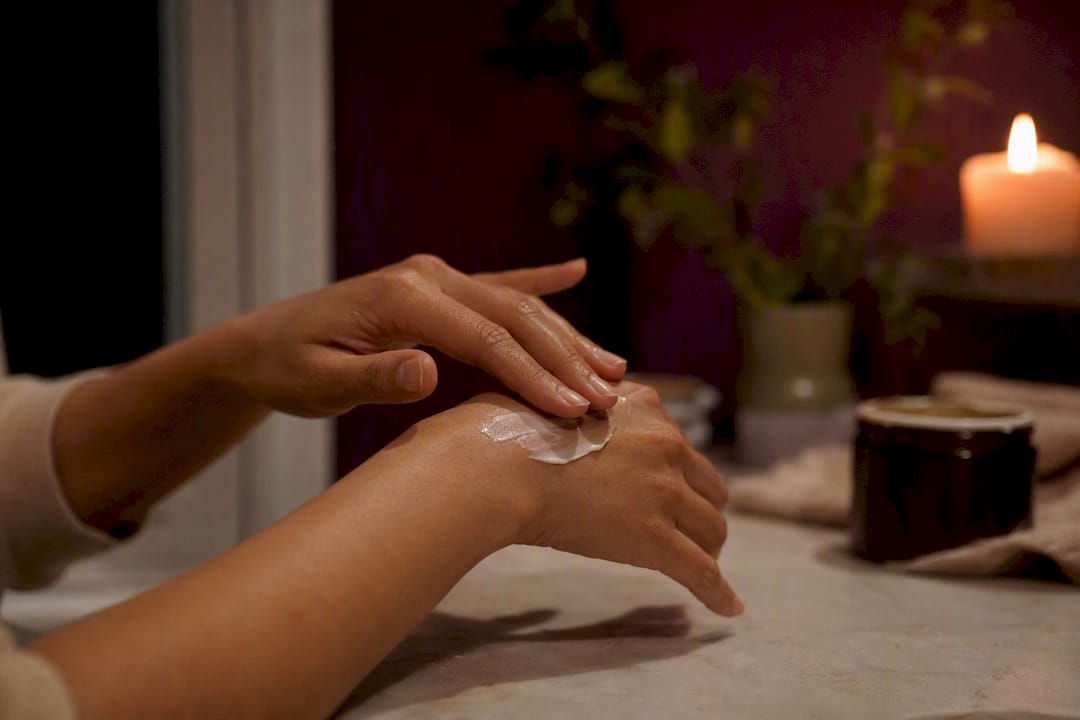
Some nights call for more than your standard moisturizer. If your skin feels tight, flaky, or unusually reactive after a long day outdoors or a stretch of dry weather, adding a short-term occlusive layer for one or two nights gives your barrier a chance to catch up. This isn't a nightly habit. It's a targeted repair tool, similar to how you'd apply extra caulk to a wall crack rather than recaulking the entire house.
Pro Tip: If your skin feels fine most nights but tight after specific activities, like swimming or a particularly windy commute, keep a richer cream on hand just for those days instead of upgrading your entire evening routine.
How do you safely introduce new active ingredients?
Adding an active ingredient to a sensitive skin routine should feel closer to defusing something carefully than diving in headfirst. Rushing this step is the single most common way people undo weeks of barrier progress.
Start with a patch test, and do it properly. Apply the new product to your inner forearm or the skin behind your ear, and leave it alone for three to five days before you even think about your face. If nothing happens there, move to a small area of your face, maybe a patch near your jawline, for another few days. Only after that double check should the product touch your whole face.
Frequency matters just as much as the test itself. Begin with one or two applications a week, never nightly. Give your skin two to four weeks at that frequency before increasing use or introducing anything else new. Adjusting two variables at once means you'll have no idea which one caused a reaction if something goes wrong.
Buffering is worth learning, too. Apply moisturizer first, let it absorb, then apply your active over it, followed by another light layer of moisturizer. This "sandwich" method dilutes the active's contact with skin just enough to reduce sting without canceling out its benefit.
Lower-risk actives to start with include niacinamide, azelaic acid, and mandelic acid. All three tend to be gentler on reactive skin than stronger acids or retinoids.
Watch for these warning signs that mean it's time to stop:
- Burning or stinging that lasts more than a minute after application
- Redness that hasn't faded by the next morning
- Small bumps, tightness, or flaking that wasn't there before
Give a well-run minimalist routine four to six weeks before judging whether it's working. That's the timeline most improvement shows up on, and bailing at week two often means abandoning something that just needed more time.
What ingredients and habits trigger sensitive skin?
A lot of irritation isn't caused by what's missing from a routine. It's caused by what's already in it. Fragrance, essential oils, alcohol denat, and menthol show up constantly in products marketed as "soothing" or "calming," which is almost backward once you know what those ingredients actually do to reactive skin. Look for fragrance-free (not just "unscented," which can still contain masking fragrance) formulas with short ingredient lists instead.
Habits matter as much as products. Hot water strips the same lipid barrier that gentle cleansers try to protect, so lukewarm water is worth the adjustment. Rough exfoliation with gritty scrubs creates micro-tears you can't see but definitely feel later. Rubbing your face dry with a towel does something similar. Patting skin dry, and swapping physical scrubs for a gentle chemical exfoliant used sparingly, removes both problems at once.
Environmental triggers deserve equal attention:
- UV exposure worsens redness and inflammation, even on cloudy days
- Cold, dry wind strips moisture faster than skin can replace it
- Chlorinated pool water disrupts the skin's natural pH
A hat and scarf in windy weather, a rinse immediately after swimming, and consistent SPF cover most of this. If you suspect a genuine allergy rather than general sensitivity, particularly with a specific reaction that recurs with one ingredient, a patch test through a dermatologist can confirm it far more reliably than trial and error at home.
How do you choose gentle products for sensitive skin?
Reading a label for sensitive skin is a skill, and it gets easier once you know what to look for. Start with ingredient lists that are short. A cleanser with forty ingredients has forty chances to include something your skin doesn't like. One with twelve has far fewer.
Look for these on the label:
- Fragrance-free (not just "unscented")
- Ceramides, panthenol, or glycerin near the top of the ingredient list
- Mineral SPF filters (zinc oxide, titanium dioxide) rather than a long chemical filter blend
- No essential oils or alcohol denat listed in the first half of the ingredients
Shopping smart matters just as much as reading labels. Buy trial or travel sizes whenever they're available, especially for anything new. Check a retailer's return policy before committing to a full-size product, and take advantage of sample programs when brands offer them. A $6 sample that causes a reaction is a far better outcome than a $60 bottle you can't return.
Pro Tip: If a product's marketing leans heavily on words like "detox," "purify," or "deep clean," that's often a signal it contains stronger surfactants or acids than a sensitive skin routine can handle comfortably.
What's the emergency routine when skin flares up?
When your skin flares, the instinct to add more products is exactly the wrong move. The right response is subtraction.
- Stop every active immediately, including exfoliants, retinol alternatives, and vitamin C
- Simplify to a single gentle cleanser, or water only if skin feels raw
- Apply a fragrance-free barrier cream generously, more than you'd normally use
- On the worst patches, a thin layer of petrolatum for one to three nights can lock in moisture while skin recovers, though skip this if you're prone to clogged pores or active breakouts
- Wait until skin looks and feels calm for several consecutive days before reintroducing anything, and bring back one product at a time with a fresh patch test
This stripped-down approach mirrors the same three-step logic that should be your daily baseline. A flare just means going back to the studs for a while.
Why does pH balance matter for sensitive skin?
Healthy skin sits at a naturally acidic pH, typically between 4.5 and 5.5, which forms what's often called the acid mantle. Think of it as a thin, protective coating of paint over your skin barrier's brick wall. It keeps beneficial bacteria in balance and keeps moisture locked where it belongs.

Many cleansers, especially bar soaps, sit at a pH closer to 9 or 10. Using one regularly nudges your skin's surface away from its natural acidity, and that shift alone can trigger dryness, sensitivity, and a weaker defense against irritants, even before you add any other product to the mix.
Choosing a pH-balanced cleanser, generally one formulated closer to skin's natural range, helps that acid mantle stay intact. This is one of those details that doesn't show up on flashy marketing but makes a real difference in how skin behaves day to day. You won't find a specific pH number on most labels, but terms like "pH-balanced" or "gentle" on a cleanser formulated for sensitive skin are worth trusting more than a bar of soap, no matter how nice it smells.
Should your routine change with the seasons?
Sensitive skin isn't static, and neither should your routine be. Winter air holds less moisture, indoor heating dries it out further, and the combination often means skin that felt balanced in September starts flaking by January. That's usually the signal to size up your moisturizer or add that short-term occlusive layer more regularly rather than waiting for a full flare.
Summer brings different pressure: more UV exposure, more sweat, and for some people, more reactivity to heat itself. This is when reapplying mineral SPF actually matters more, not less, and when a slightly lighter moisturizer texture prevents that clogged, heavy feeling humidity creates.
Hormonal shifts, stress, and even a change in tap water hardness when you travel can all move the needle on sensitivity too. The fix isn't a different routine for every season. It's the same three-step foundation with one variable adjusted at a time: richer or lighter moisturizer, more or less frequent active use, added occlusive support during dry stretches. Keep the core steady and let small adjustments do the rest of the work.
A practical take on keeping sensitive skin routines simple
Most sensitive skin routines fail not because people choose bad products, but because they choose too many good ones at once. Every serum, essence, and treatment layered on top of another adds a new variable, and reactive skin doesn't have the patience to sort through six variables when something goes wrong.
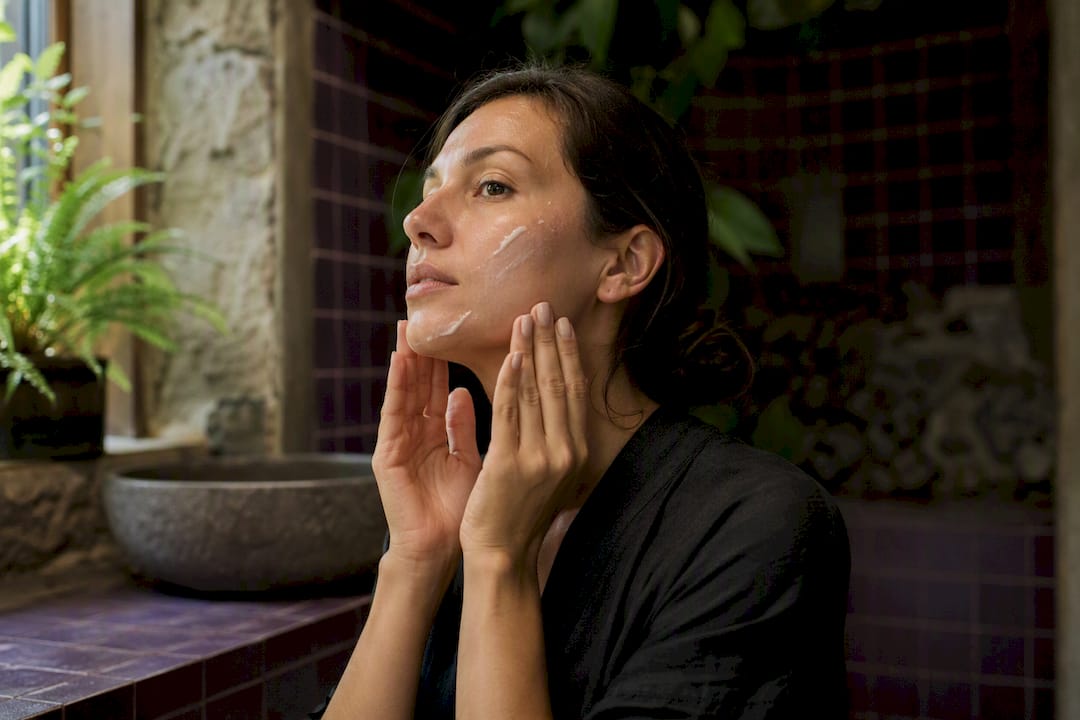
The Infinite Bath's three-step regimen exists because of that exact pattern. The Gel Cleanser handles the cleanse step without foaming agents that strip the barrier. The Lactic Serum treats texture and tone using lactic acid, a gentler alternative to retinol that exfoliates while helping the skin hold onto moisture rather than stripping it away. The Renewal Cream closes the routine as the barrier-repair moisturizer, sealing in hydration rather than fighting it.
— Stella
Where The Infinite Bath fits into a minimal routine
If you've read this far, you already know the ingredients of a safe sensitive skin routine: a gentle cleanser, a treatment step used sparingly, and a barrier moisturizer, all applied in the right order. The Infinite Bath built its entire regimen around that exact structure instead of asking you to piece one together from a dozen different brands.

The Gel Cleanser opens the routine for anyone who needs a non-foaming, short-ingredient-list formula, whether that's a morning rinse-adjacent cleanse or an evening one after sunscreen. The Lactic Serum fits the patch-test-first approach this article walks through: start slow, apply to damp skin, and let lactic acid work as a gentler stand-in for retinol without stripping hydration along the way. The Renewal Cream finishes the sequence as the barrier step, formulated to seal in moisture rather than sit heavy on top of it.
Because the three products are designed to work together, there's no guessing which combination is safe or how to layer them. Browse the full skin care collection to see the complete regimen and start with the pieces your routine is missing.
Sources
- Gentle Skincare Routine for Sensitive Skin (2026) — DermApproved
- The Skincare Routine for Sensitive Skin: A Step-by-Step Guide | The Skin Formulary
- How to Build a Minimalist Routine for Sensitive Skin: A Step-by-Step Guide