
If dryness, dullness, or fine lines are your main concern, lactic acid is your answer. If you're battling blackheads, oily patches, or active breakouts, salicylic acid does the heavier lifting. Many people can use both, just not carelessly. Start with the lowest strength your skin tolerates, and never skip sunscreen the next morning.
TL;DR:
- Use lactic acid for improving skin texture, brightness, and hydration on dry or sensitive skin, starting with 5 percent and building tolerance gradually.
- Apply salicylic acid for deep pore cleansing, blackhead removal, and controlling breakouts, especially effective at concentrations between 0.5 and 2 percent.
- Both acids increase sun sensitivity, so daily SPF is essential, and salicylic acid should be avoided by anyone with aspirin allergies or during pregnancy without medical advice.
- Combining acids can be safe if alternating nights or using zone-based application, but over-exfoliation signs require immediate cessation and rehydration.
- Consistent, gradual use over months yields visible improvements in skin clarity for salicylic and in brightness and fine lines for lactic acid, not overnight.
Table of Contents
- Lactic Acid vs Salicylic: A Quick Side-by-Side
- How Lactic and Salicylic Acid Actually Work
- Which Skin Type Should Use Each Acid?
- How to Use Lactic and Salicylic Acid the Right Way
- Can You Use Lactic Acid and Salicylic Acid Together?
- Safety Precautions Before You Start
- How The Infinite Bath Approaches Lactic Acid
- What Happens to Your Skin Over Months of Consistent Use
- Which Acid Exfoliates More Aggressively?
- Do These Acids Play Well With Other Ingredients?
- Common Myths About Lactic and Salicylic Acid
- A Simple Rule Worth Remembering
- Try The Infinite Bath's Lactic Serum for Gentle Results
- Sources
Lactic Acid vs Salicylic: A Quick Side-by-Side
Think of these two acids as tools with completely different jobs, even though they get lumped into the same "exfoliant" drawer. Lactic acid is an alpha hydroxy acid (AHA), which means it's water-soluble and works mostly on the skin's surface. Salicylic acid is a beta hydroxy acid (BHA), oil-soluble, which lets it slide past sebum and actually get inside the pore lining.
Here's how they stack up:
- Molecular class: Lactic acid = AHA (water-loving); salicylic acid = BHA (oil-loving)
- Depth of action: Lactic works on the outermost layer; salicylic penetrates into the pore itself
- Primary benefit: Lactic brightens, smooths texture, and adds hydration; salicylic clears congestion and calms breakouts
- Common formats: Lactic shows up in serums and overnight creams at 5 to 10 percent for home use; salicylic appears in cleansers, toners, and spot treatments, usually between 0.5 and 2 percent
- Best-known use case: Lactic for dry, dull, or crepey skin; salicylic for blackheads, whiteheads, and inflamed acne
If your mirror complaint is "my skin looks tired," reach for lactic. If it's "my pores are clogged again," salicylic wins.
How Lactic and Salicylic Acid Actually Work
Picture your skin's outer layer as a stack of bricks held together by mortar made of oil and dead cell debris. Lactic acid dissolves that mortar just enough to release the top layer of cells, revealing smoother, more even skin underneath. Because it's water-soluble, it stays mostly on the surface rather than traveling into the pore.
Salicylic acid behaves differently. Its oil solubility lets it slip directly into the pore lining and dissolve the sebum plugs that cause blackheads and breakouts. It's classified as keratolytic, meaning it loosens the bonds between dead skin cells, and it carries mild anti-inflammatory properties that calm the redness around a blemish.
Controlled studies cited by WebMD found that low-concentration lactic acid improved skin texture and significantly reduced inflammatory acne lesions, which surprises people who assume it's purely cosmetic. The FDA's guidance on alpha hydroxy acids also flags increased sun sensitivity as a known effect, and its companion page on beta hydroxy acids notes similar caution for salicylic formulations. Same family of concerns, different mechanisms driving them.
Which Skin Type Should Use Each Acid?
Your skin type is the real deciding factor here, more than any trend or product review.
- Dry, sensitive, or mature skin: Lactic acid is gentler and doubles as a humectant, meaning it draws in moisture while it exfoliates.
- Oily or acne-prone skin, especially with blackheads: Salicylic acid's oil solubility makes it the more effective pore-clearing option.
- Combination skin: Try a zone approach, salicylic on the T-zone where oil and congestion collect, lactic on drier cheeks that need hydration instead of stripping.
- Rosacea or active eczema: Skip both until flare-ups calm down, and check with a dermatologist before reintroducing any acid.
Board-certified dermatologists interviewed by Byrdie generally steer patients toward lactic acid for fine lines and texture, and toward salicylic for clogged pores and active acne. That's not a marketing distinction. It reflects two genuinely different mechanisms solving two genuinely different problems.
How to Use Lactic and Salicylic Acid the Right Way
Jumping straight to a high percentage is the fastest way to end up red, flaky, and worse off than before you started. Build tolerance gradually instead.
- Start low. Begin with a lactic acid concentration around 5 percent, or a salicylic product in the 0.5 to 1 percent range, and use it two to three nights a week.
- Choose your format wisely. A cleanser gives brief contact and lower risk, a leave-on serum delivers stronger results but demands more caution, and a spot treatment concentrates salicylic acid exactly where a blemish is forming.
- Layer in the right order. Cleanse, apply the acid to dry skin, wait a few minutes, then follow with a moisturizer to lock in hydration and buffer any sting.
- Increase frequency slowly. Once your skin tolerates the acid without redness or peeling, move toward nightly use if your product's instructions allow it.
- Never skip morning SPF. Both acid types increase photosensitivity, so sunscreen isn't optional the day after.
Clinical reviews support short-contact techniques, meaning washing an acid off after a minute or two, as a way to get benefits with less irritation, particularly useful for salicylic acid on sensitive facial skin. For a deeper breakdown of how often to exfoliate by skin type, The Infinite Bath's guide walks through building tolerance step by step.
Pro Tip: If your skin stings for more than a few seconds after application, that's not "working." Rinse it off and dial back to a lower frequency next time.
Can You Use Lactic Acid and Salicylic Acid Together?
Combining them isn't reckless, but it does require a plan rather than layering both on impulse.
- Combined formulas: Some products blend both acids at lower percentages, spreading the workload without overwhelming the skin barrier.
- Alternating nights: Use salicylic one night, lactic the next, giving your skin recovery time between actives.
- Zone-based use: Salicylic on oily areas, lactic on dry ones, applied in the same routine.
Watch for tightness, visible flaking, or a burning sensation that lingers, all signs of over-exfoliation. If that happens, pause acids entirely for a few days, moisturize heavily, and reintroduce at a lower frequency. Anyone with persistent redness or broken skin should check with a dermatologist rather than push through it.
Safety Precautions Before You Start
Both acids raise your skin's sensitivity to UV light, so daily SPF and reapplication aren't optional extras, they're part of the treatment itself.
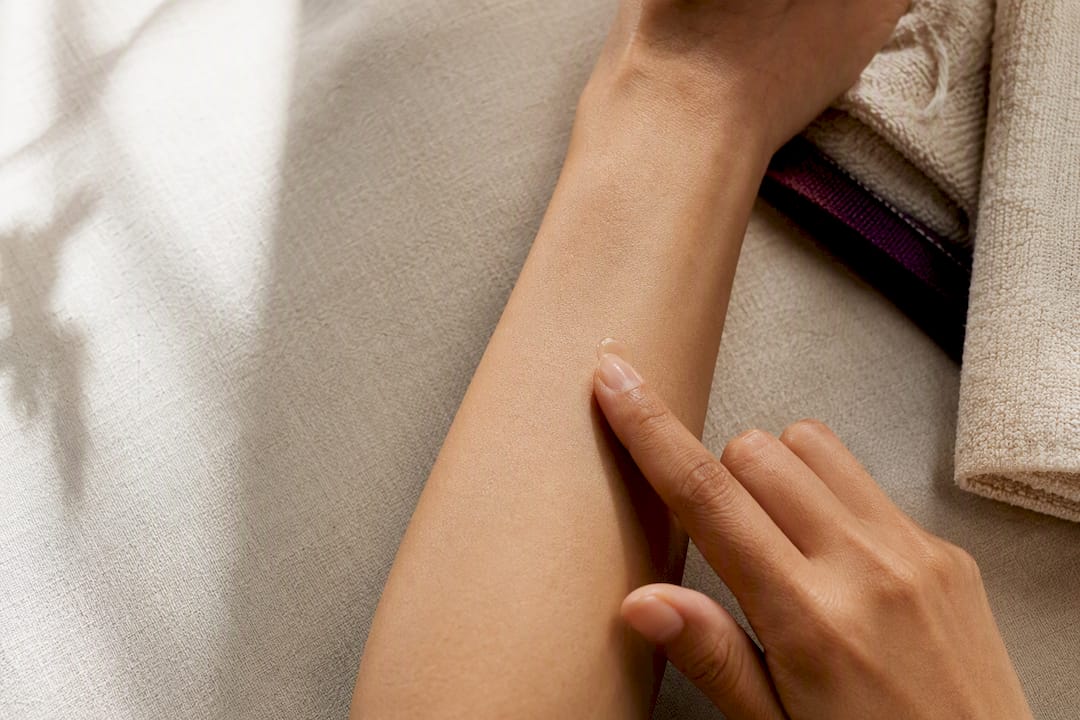
Salicylic acid carries a specific caution: it's chemically related to aspirin, so anyone with an aspirin allergy should avoid it or ask a doctor first. Pregnant and breastfeeding individuals are often advised to limit salicylic acid exposure and choose lactic acid instead, though a doctor's input matters more than any general rule. Patch-test any new acid on your inner arm for 48 hours before applying it to your face, and stop immediately if you notice burning, swelling, or persistent redness.
How The Infinite Bath Approaches Lactic Acid
The Infinite Bath built its three-step regimen around the idea that exfoliation shouldn't cost you your skin barrier. The gel cleanser, lactic serum, and renewal cream work together so the lactic acid does its job while hydration stays intact rather than getting stripped away.
The formulation leans on lactic acid as a natural alternative to retinol, which matters for anyone who finds retinol too harsh or drying. It's designed specifically with sensitive skin in mind, targeting pigmentation and fine lines without the redness that turns people off exfoliating acids entirely. If you're building a routine around sensitive skin, this guide covers how to protect your barrier while still getting results.
What Happens to Your Skin Over Months of Consistent Use
The first two weeks with either acid rarely look dramatic. What changes is subtle, a slightly smoother texture when you run your fingers across your cheek, makeup that sits a little better. That's normal, and it's also where most people quit too early.
By week four to six of consistent lactic acid use, dull, uneven patches typically start to even out, and fine lines on drier skin often look less pronounced because hydration and gentle surface renewal are working together. Salicylic acid tends to show its payoff a bit differently: fewer new blackheads forming, less frequent breakouts, and pores that look less congested when you get up close to a mirror.
The real difference shows up around the three-month mark. Lactic acid users generally report brighter, more even-toned skin with a softer look overall, the kind of change people notice in photos before they notice it in the mirror. Salicylic acid users tend to see a drop in active breakouts and blackhead frequency, though existing acne scars or pigmentation won't fade from salicylic acid alone since that's not what it targets.
Neither acid delivers overnight results, and that's precisely why so many people abandon a routine before it has a chance to work. Consistency at a tolerable frequency beats occasional use at a high concentration every time. If you stop for a few weeks, don't jump back in at your old strength. Skin loses tolerance faster than people expect, and starting over at a lower percentage prevents the irritation that so often ends an otherwise promising routine.
Which Acid Exfoliates More Aggressively?
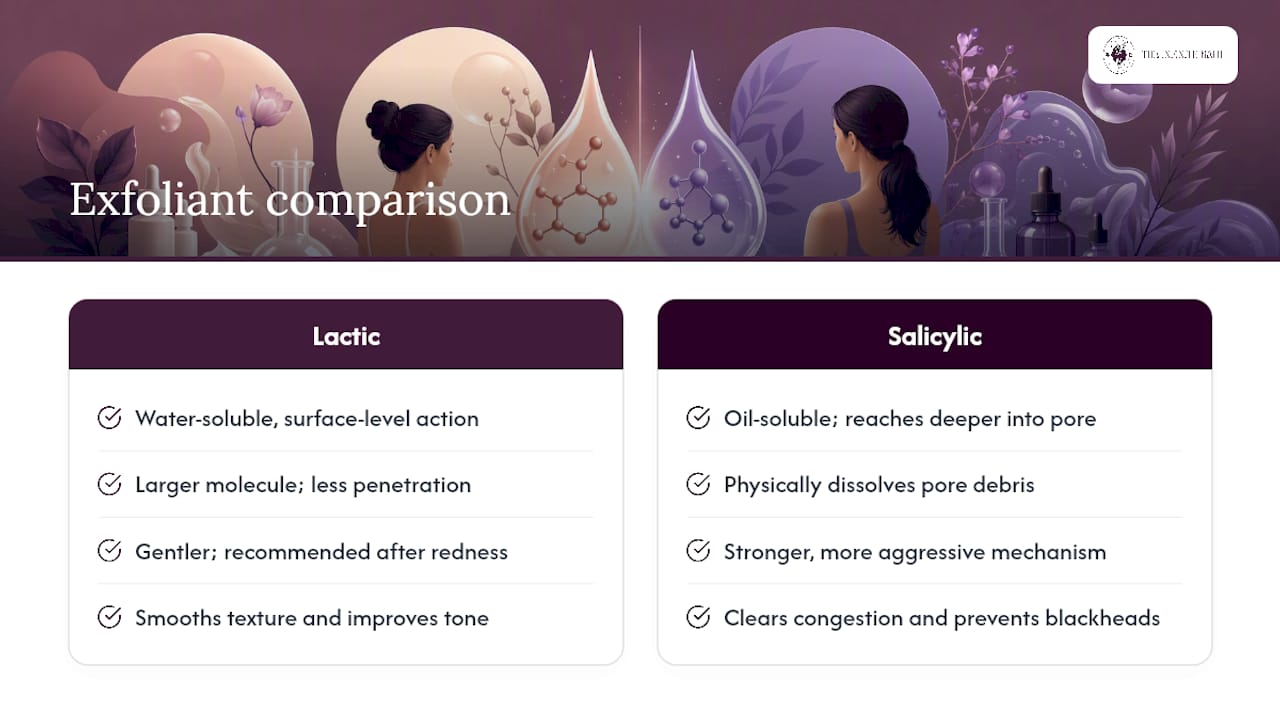
Salicylic acid is generally considered the stronger exfoliant of the two, but "stronger" doesn't mean "better" for every situation. It's oil-soluble, so it reaches deeper into the pore and physically dissolves the debris causing congestion, which is a more aggressive mechanism than lactic acid's surface-level action.
Lactic acid, particularly at lower concentrations, is one of the gentler AHAs available, gentler than glycolic acid, for instance, because its larger molecular size limits how deeply it penetrates. That's exactly why it's the go-to recommendation for people who've tried harsher exfoliants and ended up with redness or a compromised barrier instead of glowing skin.
Effectiveness depends entirely on what you're measuring. For smoothing texture and improving tone, lactic acid at 5 to 10 percent performs remarkably well without the downtime associated with stronger acids. For clearing existing congestion and preventing new blackheads, salicylic acid's depth of penetration gives it a real mechanical advantage that lactic acid simply doesn't have.
The mistake most people make is assuming a higher percentage always means better results. A 2 percent salicylic acid cleanser used consistently often outperforms a 10 percent treatment used once a week and then abandoned because it caused peeling. Gradual, sustained use beats aggressive, sporadic use almost every time.
Do These Acids Play Well With Other Ingredients?
Beyond how lactic and salicylic acid interact with each other, their compatibility with the rest of your routine matters just as much.
Both pair well with hyaluronic acid, which adds hydration without interfering with exfoliation, and with niacinamide, which can help calm redness that sometimes follows acid use. Vitamin C is trickier: layering it directly with either acid can increase irritation for some people, so many dermatologists recommend using vitamin C in the morning and saving your acid for nighttime.
Retinoids are where real caution comes in. Combining retinol with either lactic or salicylic acid in the same routine, especially early on, often overwhelms the skin barrier and causes excessive dryness or flaking. If you already use a retinoid, introduce an acid slowly and consider alternating nights rather than stacking them.
Ceramide-rich moisturizers are one of the most underrated pairings with both acids. Since exfoliation temporarily thins the skin's protective layer, a ceramide moisturizer helps rebuild it, which is part of why The Infinite Bath's renewal cream follows its lactic serum in sequence rather than being sold as a standalone step.
Common Myths About Lactic and Salicylic Acid
A lot of what circulates online about these acids doesn't hold up under scrutiny.
Myth: Salicylic acid is only for teenagers with acne. Adult acne is common, and salicylic acid works the same way regardless of age. It's also useful for anyone with enlarged pores or blackheads, acne or not.
Myth: Lactic acid is "too weak" to do anything real. The clinical evidence on inflammatory lesion reduction says otherwise. Gentle doesn't mean ineffective, it means the effect builds gradually and with less collateral irritation.
Myth: You should feel a tingle for the product to be working. A slight tingle can be normal, but persistent burning is a sign of irritation, not efficacy. Dermatologists don't equate discomfort with results.
Myth: You can't use these acids if you have oily skin and dry patches. That's exactly the combination-skin scenario a zone-based approach solves, salicylic where you're oily, lactic where you're dry.
Myth: More frequent use equals faster results. Over-exfoliating disrupts your skin barrier, and a compromised barrier actually slows down improvement in tone and texture, sometimes for weeks.
A Simple Rule Worth Remembering
Match the acid to your actual concern, not what's trending. Start at the lowest strength, wear sunscreen daily, and give your skin a few weeks before judging results. Sensitive skin and busy schedules deserve routines this forgiving.
— Stella
Try The Infinite Bath's Lactic Serum for Gentle Results
Skip the trial-and-error of testing five different lactic acid products at five different strengths. The Infinite Bath's lactic serum is formulated at a gentle concentration specifically for sensitive, dry, or texture-focused skin, the exact profile this article points toward for lactic acid users.
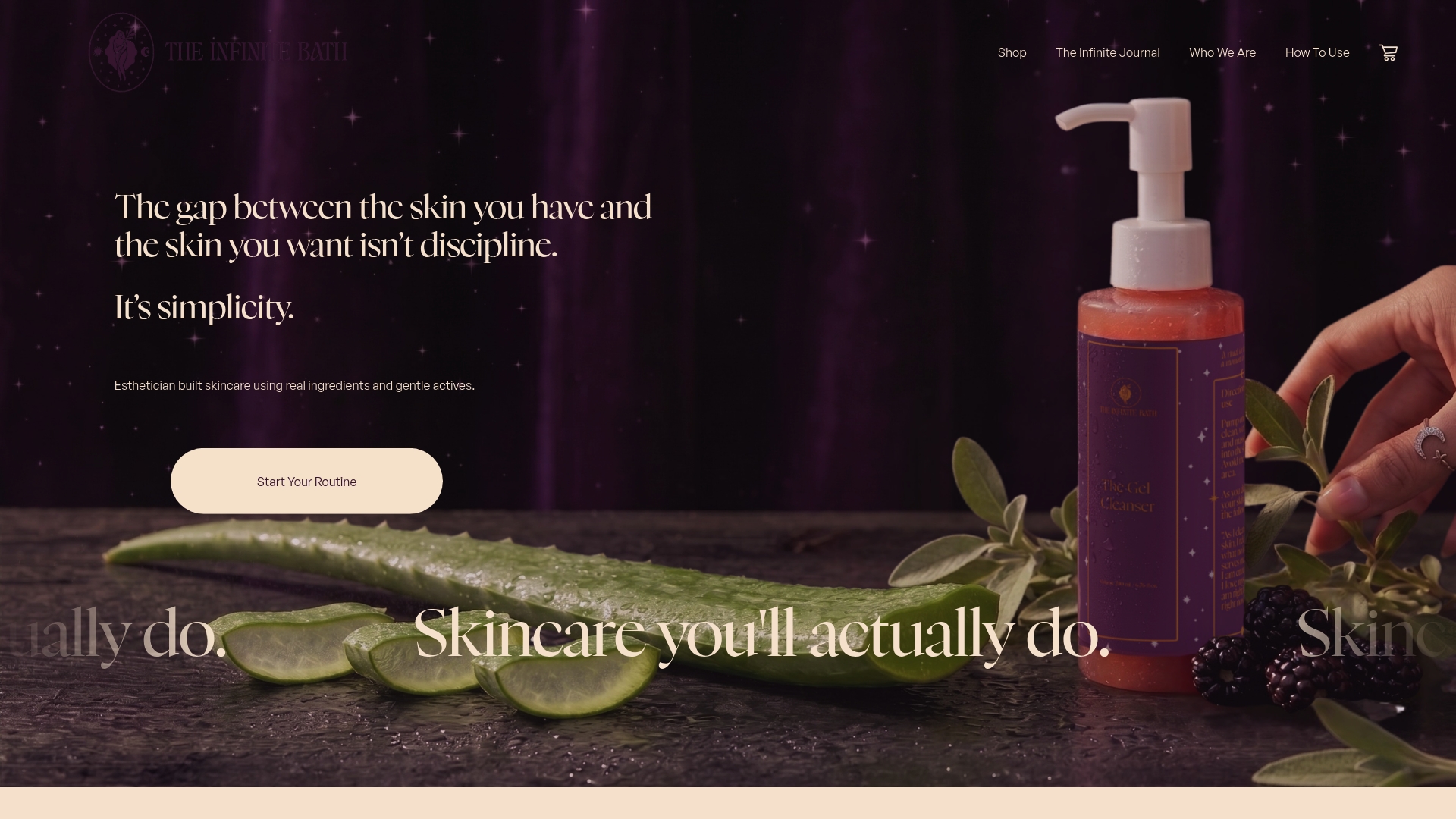
It fits directly into the brand's three-step regimen, paired with a gel cleanser and renewal cream designed to maintain hydration throughout exfoliation rather than fighting against it. That's the core difference from acids that leave your skin tight and flaky by day three, this one is built to work alongside your skin barrier, not against it. If dullness, uneven tone, or early fine lines are your main concern, visit The Infinite Bath's lactic acid page to see the full formulation details and start your order today.
Sources
- Lactic acid for skin care — WebMD
- Alpha hydroxy acids (AHAs) — U.S. Food & Drug Administration
- Lactic Acid vs. Salicylic Acid: How and When to Use Each — Byrdie