
To calm sensitive skin fast, stop using the suspect product immediately, cool the skin with a damp compress, and apply a fragrance-free, barrier-support moisturizer. From there, a simple morning and night routine held steady for a few weeks is what actually repairs the barrier and keeps flares from coming back.
TL;DR:
- Fragrance and harsh ingredients like sulfates or high-concentration acids should be avoided to prevent further barrier damage.
- Consistent use of a gentle, fragrance-free cleanser and a barrier-support moisturizer is key to healing sensitive skin over several weeks.
- Applying moisturizer within three minutes of washing and limiting exfoliation to once or twice weekly helps maintain skin hydration and integrity.
- Cold compresses and soothing ingredients such as colloidal oatmeal or centella asiatica help calm active flare-ups without adding heavy actives.
- Only seek medical help if symptoms worsen significantly, show signs of infection, or do not improve after consistent self-care routines.
Table of Contents
- Why Sensitive Skin Happens: The Barrier Behind It
- What Sensitive Skin Feels Like and What Sets It Off
- A Simple Routine to Calm and Repair Sensitive Skin
- What to Avoid and How to Patch-Test Safely
- When Sensitive Skin Needs a Doctor, Not Just a Routine
- Where The Infinite Bath's Three-Step Regimen Fits In
- Does What You Eat Affect Sensitive Skin?
- Cold Compresses, Mists, and Other Calming Tools
- A Closing Note on Patience
- Try The Infinite Bath's Regimen the Safe Way
- Sources
- FAQ
Why Sensitive Skin Happens: The Barrier Behind It
Sensitive skin isn't one diagnosis. It's a pattern: your skin overreacts to things that shouldn't bother it, and the Cleveland Clinic describes it that way for a reason. Something is missing underneath the surface, and that something is usually barrier function.
Think of your outermost skin layer, the stratum corneum, as a brick wall. Skin cells are the bricks. Lipids like ceramides and fatty acids are the mortar holding everything tight. When that mortar breaks down, the wall develops gaps. Water escapes, and irritants get in more easily than they should. A weakened barrier and a permeable, reactive surface tend to show up together, which is why dermatologists treat barrier repair as the starting point rather than an afterthought, according to a review on the mechanisms of sensitive skin.
A few things chip away at that mortar over and over:
- Over-exfoliating, especially with physical scrubs or frequent strong acids
- Harsh, foaming cleansers that strip natural oils along with dirt
- Dry air, wind, or extreme temperature swings
- Natural aging, which slows oil production and thins the barrier
- Certain medications, including topical retinoids and some acne treatments
None of these single-handedly ruins your skin. It's the stacking, cumulative wear that turns "occasionally reactive" into "constantly irritated."
What Sensitive Skin Feels Like and What Sets It Off
You know something's wrong before you can name it. Skin that stings when you apply moisturizer, burns under sunscreen, or flushes red at the first sign of wind is sending a clear signal.
Common symptoms include:
- Redness or visible flushing, especially across the cheeks and nose
- Burning or stinging, often within seconds of applying a product
- Tightness or a raw, dry feeling that lotion doesn't fix
- Fine scaling or flaking, particularly around the mouth and eyebrows
- Itching that flares with heat, sweat, or fabric friction
The triggers behind these reactions are usually predictable once you look for them. Fragrance sits at the top of the list. Added scent, whether synthetic or from essential oils, remains one of the most common causes of allergic and irritant contact reactions in skincare. Beyond fragrance, watch for laundry detergent residue, denatured alcohol in toners, sudden temperature shifts, wool or synthetic fabrics against the face, sun exposure, and active ingredients introduced too quickly.
Here's the part most people skip: a symptom diary. Keep it dead simple. Note what you used, when, and how your skin responded that night and the next morning. Change one variable at a time, whether that's swapping a cleanser or pausing an active for a week, and give it enough time to show a pattern. Guessing at multiple culprits at once is how flare-ups drag on for months instead of days.
A Simple Routine to Calm and Repair Sensitive Skin
This is the part that actually moves the needle. A minimalist routine built on gentle cleansing, consistent moisturizing, and daily sun protection gives your barrier what it needs to rebuild, and clinical guidance on managing sensitive skin backs exactly this approach.
Morning
- Cleanse with a gentle, low-foam, fragrance-free cleanser, using lukewarm water rather than hot.
- Apply a barrier-support moisturizer to slightly damp skin so it locks in more moisture.
- Finish with a mineral sunscreen containing zinc oxide or titanium dioxide, which tends to sit better on reactive skin than many chemical filters.
Night
- Cleanse again, or simply rinse with water if your skin feels dry or tight that day.
- If tolerated, apply a gentle chemical exfoliant like a low-concentration lactic acid, but only once or twice a week to start.
- Seal everything in with a richer renewal cream or occlusive, especially if your skin feels dry going into the night.
Pro Tip: Apply moisturizer within three minutes of washing your face. Damp skin absorbs and holds hydration far better than skin that's already air-dried, and that small timing habit does more than most expensive serums.
On exfoliation: less is genuinely more here. Overusing acids or physical scrubs is one of the most common ways people damage an already weak barrier, and research on exfoliant use in sensitive skin points to infrequent use of gentle chemical exfoliants, like lactic or mandelic acid, over abrasive scrubs every time. If your skin is actively inflamed, skip exfoliation entirely until it calms down.
Expect a few weeks before you see real change. Barrier repair isn't instant, no matter what a product label promises. Log how your skin feels each week, tracking tightness, redness, and how it reacts to products it used to reject. That log becomes your evidence that the routine is working, even on days when progress feels invisible.
What to Avoid and How to Patch-Test Safely
Reading a label the right way saves you weeks of trial and error. Some ingredients are worth avoiding almost across the board if you're prone to reactivity:
- Fragrance and essential oils, natural or synthetic, remain top triggers for irritation and allergic reactions.
- Denatured alcohol, common in toners and long-wear products, strips lipids and dries the barrier further.
- Sulfates like SLS, found in many foaming cleansers, are more aggressive than sensitive skin can handle daily.
- High-concentration AHAs or BHAs, especially in leave-on formulas, can outpace your skin's ability to recover between uses.
On the other side, certain ingredients consistently show up in barrier-repair research as safe, effective choices: ceramides, glycerin, hyaluronic acid, squalane, and colloidal oatmeal. These support hydration and mortar-layer repair rather than fighting against it.
A single quick patch test behind your ear won't tell you much. Delayed reactions can take days to appear, which is exactly why patch testing protocols call for repeated exposure rather than one pass. Apply the product to your inner forearm twice a day for about three days, watching and photographing the area daily. No reaction after that window means you can move to a small patch on your face before going all in.
One label trap worth knowing: "unscented" doesn't mean fragrance-free. Unscented products often contain masking fragrance to neutralize raw material smells, which can still trigger a reaction. And don't assume "natural" or "botanical" means gentle. Plenty of plant extracts are common contact allergens, marketing language aside.
When Sensitive Skin Needs a Doctor, Not Just a Routine
Self-care handles most flare-ups, but certain signs mean it's time to stop experimenting and call a dermatologist.
Watch for these red flags:
- Signs of infection: pus, warmth, or spreading redness
- A rash that keeps expanding despite stopping all products
- Severe pain, swelling, or blistering
- Fever accompanying a skin reaction
A clinician can offer tools you don't have access to at home, including formal diagnosis, prescription-strength topicals, professional patch testing to identify exact allergens, and phototherapy for stubborn cases. Walk into that appointment prepared: bring photos of the reaction at different stages, a list of every product you've used in the past month, and your symptom diary. That preparation turns a fifteen-minute visit into a much more useful one.
Where The Infinite Bath's Three-Step Regimen Fits In
The Infinite Bath built its three-step regimen around this exact logic. The gel cleanser handles the gentle-cleanse step without stripping lipids. The lactic serum functions as that once-or-twice-weekly chemical exfoliant, meant to be introduced slowly and patch-tested first rather than layered on daily. The renewal cream fills the barrier-support moisturizer role, sealing in hydration at night.
For busy people who don't want to research ten ingredients before buying one bottle, that structure removes the guesswork. Start the serum at low frequency, watch how skin responds over a couple of weeks, and only increase use once your barrier shows it can handle it.
Does What You Eat Affect Sensitive Skin?
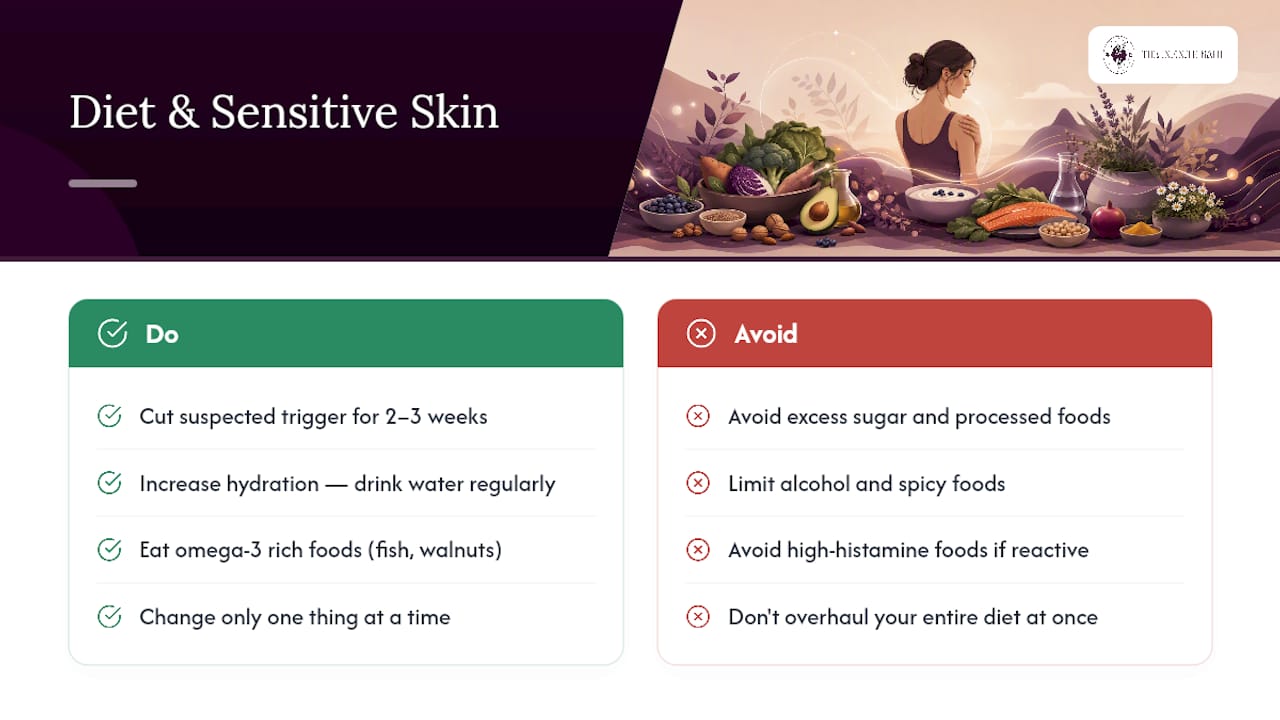
Diet doesn't get enough credit in most sensitive skin conversations, but it plays a real role in how often flares show up. Highly processed foods, excess sugar, and alcohol can promote inflammation throughout the body, and skin, being the largest organ, often reflects that internal state.
Spicy foods and alcohol are frequent flare triggers for people with rosacea-type sensitivity specifically, often causing visible flushing within minutes. That's not universal. Some people tolerate spice fine and react instead to dairy or high-histamine foods like aged cheese, fermented products, or shellfish.
Hydration matters more directly than most people assume. Skin that's dehydrated from the inside struggles to maintain the water content its barrier needs to function, making topical moisturizer work harder to compensate. Omega-3 fatty acids, found in fatty fish, walnuts, and flaxseed, support the same lipid structure that ceramides reinforce topically. Getting them from food doesn't replace a good moisturizer, but it does give your barrier better raw material to work with.
The honest approach here is the same one recommended for products: change one thing at a time. Cut a suspected trigger food for two to three weeks and watch your skin, rather than overhauling your entire diet at once and losing track of what actually helped.
Cold Compresses, Mists, and Other Calming Tools
When skin is actively flaring, a cold compress is still one of the fastest ways to bring down redness and calm the stinging sensation. Wrap ice or a cold pack in a clean cloth and hold it against the area for a few minutes rather than applying ice directly to skin, which can cause its own irritation.
Facial mists built around soothing ingredients, like colloidal oatmeal or plain thermal spring water, offer a lighter option for skin that's too reactive for a full product application. Keep one in the fridge for a genuinely cooling effect during a flare, and reach for it before you reach for another cream.
Anti-inflammatory ingredients like centella asiatica, allantoin, and panthenol show up often in calming formulas because they support recovery without adding fragrance or heavy actives into an already stressed barrier. None of these replace the core routine. They're supplements to it, useful during an active flare or right after sun exposure, not a daily substitute for consistent cleansing, moisturizing, and sun protection.
A Closing Note on Patience
Skip the ten-step routines and the miracle claims. What actually calms reactive skin is boring consistency: fewer products, applied correctly, for longer than feels satisfying. Patch test everything new, even the products marketed as gentle, and give your barrier the full two to four weeks before judging whether something works.
— Stella
Try The Infinite Bath's Regimen the Safe Way
If you've read this far, you already know the plan: fewer products, applied consistently, with real patch testing before anything touches your whole face. The Infinite Bath built its three-step regimen around that exact discipline, using a gentle cleanser and a fragrance-conscious renewal cream instead of a shelf of competing actives you have to guess your way through.

Start with the cleanser and renewal cream as your baseline for two weeks before introducing anything else. If your skin tolerates that pairing, patch-test the lactic serum on your inner forearm before working it into your nights once a week. Visit the skin care shop to see the full regimen and pick your starting point today.
This article is general information, not a substitute for advice from a qualified doctor. Consult a qualified healthcare professional about your own circumstances before acting on anything here.
Sources
- Sensitive skin: mechanisms and management (PMC10656243)
- Fragrance contact allergy: epidemiology and testing (PubMed 31157225)
- Approach to management of sensitive skin (PMC7047566)
- Contact dermatitis and patch testing overview (PubMed 26939643)
FAQ
How do you calm down extremely irritated skin?
Stop every product except a fragrance-free moisturizer, apply a cold compress for a few minutes to reduce heat and redness, and avoid exfoliating or using actives until the irritation fully settles.
What is best for very sensitive skin?
A minimalist routine with a gentle cleanser, a barrier-support moisturizer containing ceramides or glycerin, and daily mineral sunscreen gives reactive skin the most consistent relief over time.
How do you fix overly sensitive skin?
Remove likely triggers like fragrance and alcohol-based products, patch-test anything new for several days before full use, and stick with a simple cleanse-moisturize-protect routine for two to four weeks to let the barrier rebuild.
What is a good calming cream for irritated skin?
Look for a fragrance-free cream with ceramides, glycerin, or colloidal oatmeal, since these support the skin's barrier rather than just sitting on top of it; The Infinite Bath's renewal cream is built around that same barrier-first formula.