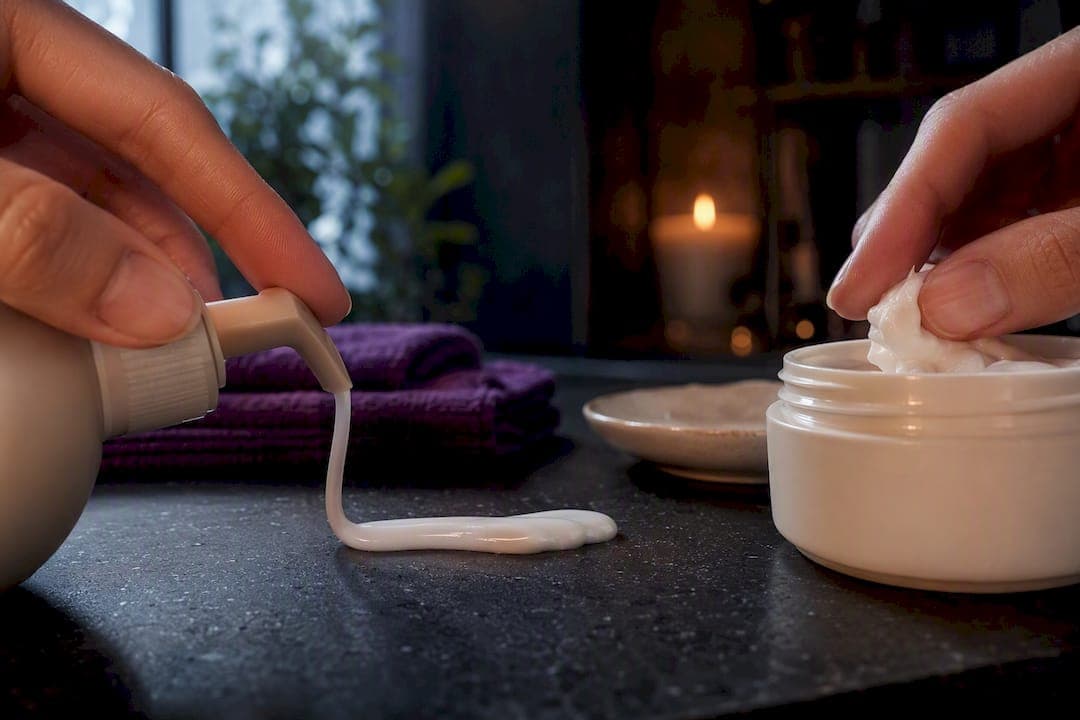
A lotion is mostly water with a little oil folded in, which is why it feels light and vanishes fast. A cream flips that ratio, closer to equal parts oil and water, which is why it sits heavier and holds moisture longer. The quick pick: lotion for everyday hydration on healthy skin, cream for dry patches, mature skin, or during the dead of winter. If your skin is cracked or seriously parched, you're actually looking for an ointment, one step past cream on the richness scale.
TL;DR:
- Creams are more suitable than lotions for dry, sensitive, or mature skin because their higher oil content provides longer-lasting moisture and better barrier protection.
- During winter or in drier climates, switching from lotion to a richer cream helps maintain hydration, especially on areas prone to cracking or redness.
- Packaging in jars increases contamination risk, so using tools and storing products away from heat reduces bacteria growth and maintains efficacy.
- Choosing products with a balance of humectants, emollients, and occlusives ensures optimal hydration without skin drying or irritation.
- For best results, apply moisturizer immediately after bathing on damp skin and use a combination of serum and cream at night for enhanced moisture retention.
Table of Contents
- Cream vs Lotion: What's Actually Different in the Formula
- When to Reach for Lotion vs Cream, by Skin Type and Season
- What to Check on the Label Before You Buy
- Packaging and Storage: The Part Most Guides Skip
- The Environmental Side of Cream vs Lotion
- Author's Perspective: The One-Sentence Rules I'd Actually Follow
- A Richer Cream Option Worth Knowing About
- Sources
- FAQ
Cream vs Lotion: What's Actually Different in the Formula
The difference between a cream and a lotion comes down to one thing: how much water versus oil is in the bottle. Every moisturizer is technically an emulsion, tiny droplets of oil suspended in water (or the reverse), held together by an emulsifier so the two don't separate on your bathroom shelf.
Lotions lean water heavy. That's why they pour, spread thin, and soak in within a minute. Creams often land closer to a 50/50 oil-to-water ratio, which is why they scoop out of a jar instead of pumping out of a bottle, and why they leave a slightly tacky film behind for the first few minutes.
That extra oil isn't just texture, it's function. Your skin loses water to the air constantly, a process dermatologists call transepidermal water loss. Thicker, oil-rich formulas slow that loss more effectively because oil sits on top of skin like a lid on a pot, while water-heavy lotions evaporate off faster and need reapplying more often.
Here's how the three main moisturizer categories stack up on richness:
- Lotion: highest water content, lightest feel, fastest absorption, least occlusive
- Cream: balanced oil and water, richer feel, slower absorption, more occlusive
- Ointment: highest oil or wax content, most occlusive of the three, best reserved for very dry or cracked skin
Petroleum jelly is the classic ointment example, and it's a good mental anchor: if a cream feels too light for your dry elbows, an ointment is the next rung up, not a heavier cream.
When to Reach for Lotion vs Cream, by Skin Type and Season
Matching the product to your skin type matters more than any marketing claim on the label. Oily and normal skin generally do better with lotion, since the higher water content hydrates without adding a greasy layer on top of skin that already produces enough oil. Dry, sensitive, or mature skin tends to need a cream, because thinner formulas often evaporate before they've done their job. The American Academy of Dermatology is blunt about this: there's no single best moisturizer for everyone, and the right pick shifts with skin type, body part, and time of year.
Body area changes the calculus too. Follow this rough order of operations:
- Face: lighter lotions or gel creams during the day, especially under makeup or sunscreen; richer creams at night when you're not layering products on top
- Body: lotion works fine on arms and legs with normal skin; cream earns its place on rougher, drier zones
- Hands, feet, and elbows: these areas lose moisture fastest and usually need a cream or even an ointment, particularly in winter
- Hairy areas like the scalp or forearms: lotion spreads and absorbs more evenly than a thick cream would
Climate flips the script seasonally. Skip to a richer cream once heating season dries out the air indoors, then swap back to lotion when humidity climbs in summer. Older skin holds less moisture overall as oil production naturally declines with age, which is one reason cream tends to outperform lotion for mature skin regardless of season.
Timing matters as much as product choice. Apply moisturizer right after a shower or bath, while skin is still damp, since that residual water gets sealed in rather than evaporating into the air. If you're using a serum, apply it to damp skin first, then layer your lotion or cream on top, and finish with sunscreen during the day.
Pro Tip: Keep a lotion by your bed for humid nights and a cream in the bathroom for after showers. Your skin's needs change with the seasons, and having both on hand means you're never stuck applying the wrong texture out of habit.
What to Check on the Label Before You Buy
Good moisturizers work through three ingredient categories, and understanding them beats judging a product by how thick it feels in your hand.
- Humectants like glycerin and hyaluronic acid pull water into the outer layer of skin, acting like a sponge that draws moisture in from the air and from deeper skin layers.
- Emollients such as squalane and fatty esters fill in the rough gaps between skin cells, which is what gives a product that smooth, silky slip.
- Occlusives like petrolatum, dimethicone, and beeswax sit on top and physically block water from escaping, the closest thing to a raincoat for your skin.
None of these works well alone. A humectant without an occlusive can actually leave skin drier once the water it pulled in evaporates back out, taking some of your skin's own moisture with it. The most effective creams and lotions pair at least one from each category rather than leaning on a single ingredient type.
Watch for two red flags. Fragrance and certain preservative systems are common triggers for allergic contact dermatitis in people with sensitive or eczema-prone skin, so fragrance-free is worth seeking out if you've reacted to products before. For your face specifically, look for "non-comedogenic" on the label, which flags a formula less likely to clog pores and trigger breakouts.
Quick shopper checklist: humectant plus emollient plus occlusive, fragrance-free if you're reactive, non-comedogenic for facial products.
Packaging and Storage: The Part Most Guides Skip
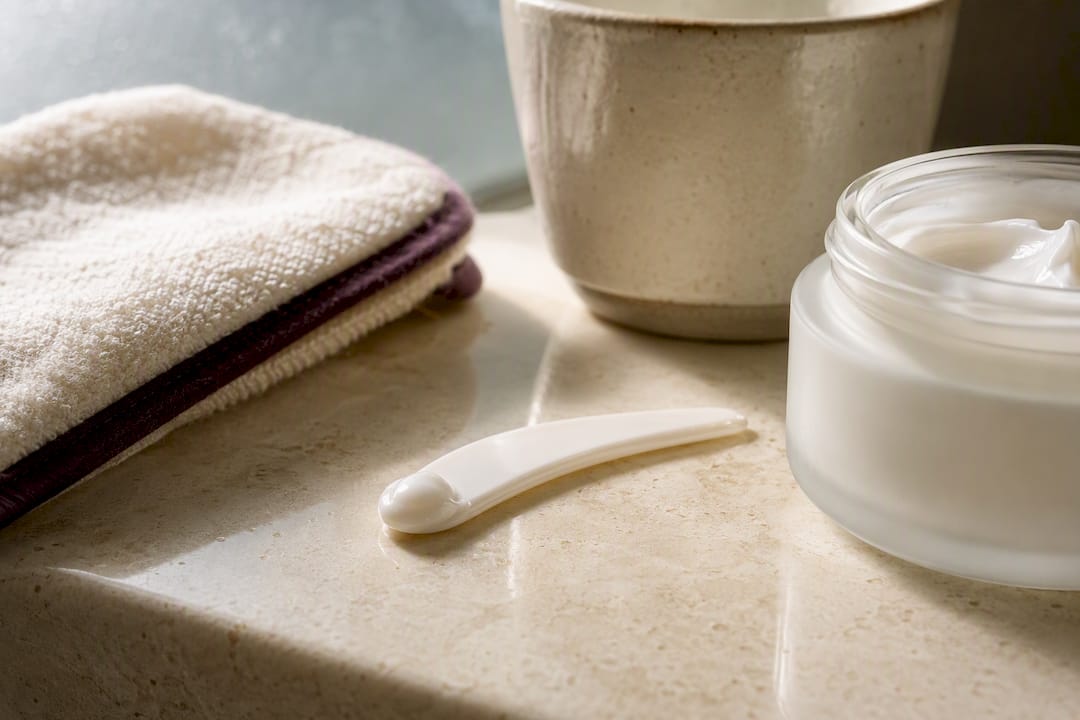
The jar your cream comes in matters more than most people realize. Every time you dip a finger into an open jar, you introduce air and bacteria, which can speed up oxidation and raise contamination risk, especially for active ingredients that break down when exposed to light and air. Pump bottles, common for lighter lotions, seal the product between uses and keep it more stable over time.
A few habits protect your investment either way:
- Use a clean spatula to scoop from jars instead of your fingertip
- Store products away from direct heat and sunlight, which is why that bathroom windowsill is actually a bad spot
- Note any "use within 6 months of opening" symbol (a small open-jar icon) and respect it, especially for cream formulas with active ingredients
Thickness alone doesn't guarantee lasting hydration. Pairing a humectant with an occlusive tends to outperform a heavy formula that skips one or the other. This is where a simple three-step approach helps: a gel cleanser to avoid stripping the skin, a lactic acid serum on damp skin to gently exfoliate and draw in moisture, then a richer cream to seal it all in overnight.
Pro Tip: If your cream comes in a jar, wash and dry a small cosmetic spatula and keep it right next to the jar. It takes five seconds and meaningfully cuts contamination risk.
The Environmental Side of Cream vs Lotion
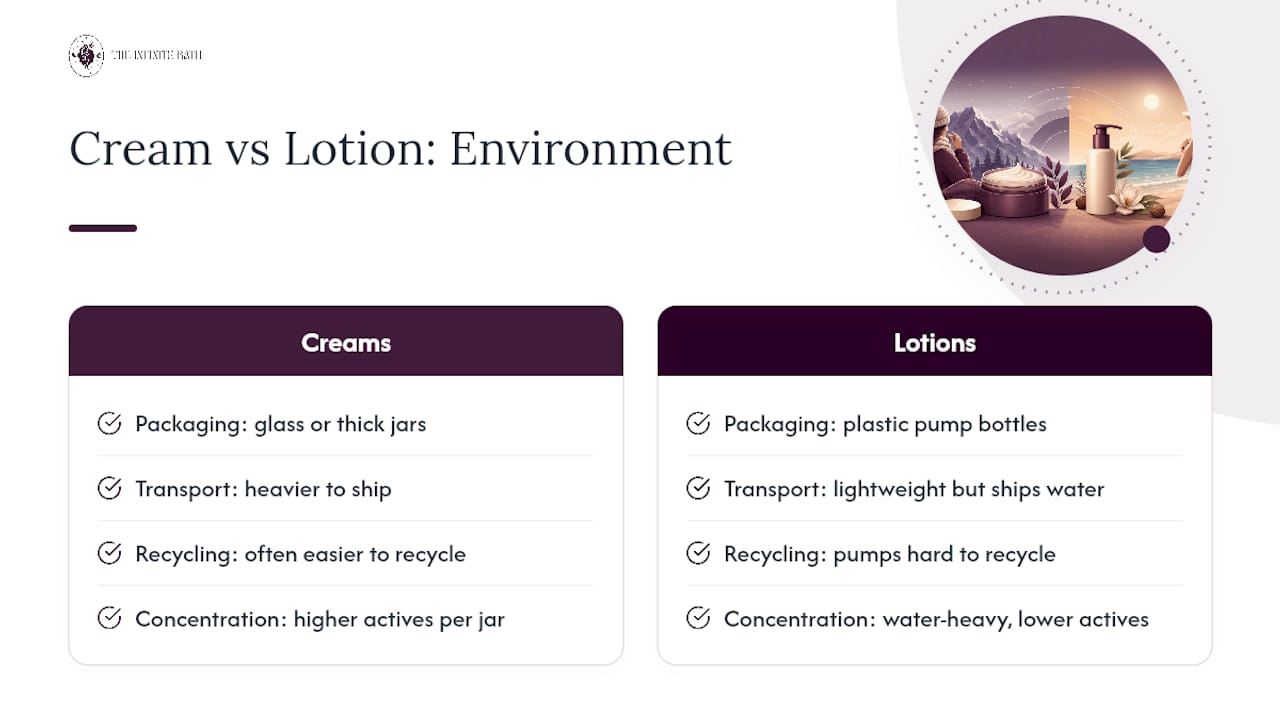
Packaging is where creams and lotions diverge most on sustainability. Lotions typically ship in plastic pump bottles, which are lightweight and cheaper to transport, but pumps combine multiple plastic and metal parts that are harder for most municipal recycling programs to sort and process. Creams often come in glass or thicker plastic jars, heavier to ship but frequently easier to recycle or reuse once empty.
Formula concentration plays a role too. Because creams pack more active ingredient into less water, a jar of cream often lasts through more applications than an equivalent bottle of lotion, which means fewer containers purchased and discarded per year of use. Lotions, being water heavy, are essentially shipping water long distances, adding to transport weight and fuel use without adding skincare benefit.
Ingredient sourcing matters as much as the container. Formulas based on plant-derived humectants and emollients, rather than synthetic occlusives, may have a lighter environmental footprint. Choosing products with purposeful ingredients often means less manufacturing waste. However, no one category is inherently greener than the other. It's important to check brand disclosures on sourcing and packaging, and to choose products you finish rather than waste, to make the biggest sustainability impact.
Author's Perspective: The One-Sentence Rules I'd Actually Follow
If you remember nothing else: lotion carries you through the day, cream puts you to bed. That's the whole system. Light hydration during waking hours when you're moving, sweating, and layering sunscreen underneath; richer cream at night when skin has hours to absorb it undisturbed.
Sensitive skin changes the math slightly. Patch-test any new product on your inner forearm for a couple of days before putting it on your face, since a reaction on a small patch of skin is a lot easier to manage than one across your whole cheek. Fragrance-free versions of both textures are worth the extra look, especially if you've reacted to products before.
One thing conventional advice glosses over: pairing an exfoliating active with a rich cream isn't optional, it's what keeps exfoliation from drying you out. Lactic acid works by loosening the bonds between dead skin cells, and that process needs a hydration partner behind it, not in front of it.
— Stella
A Richer Cream Option Worth Knowing About
If your skin is asking for more than a lotion can give it, especially heading into drier months, The Infinite Bath's Renewal Cream is built for exactly that gap. It's formulated as a richer, oil forward cream rather than a lightweight lotion, designed to work on sensitive skin without the sting or redness that heavier actives sometimes cause.

It slots into a simple three-step routine: cleanse with a gentle gel formula, apply the lactic acid serum to damp skin to gently exfoliate and even out texture, then seal everything in with the Renewal Cream. That order matters, since the cream's job is to lock in the hydration the serum just delivered, not fight against it. For anyone juggling a busy schedule who still wants visible results on fine lines and pigmentation, that's three steps and done, no ten-step routine required. Browse the full skincare shop to see how the Renewal Cream fits alongside the rest of the lineup, or go straight to the product page to check it out for yourself.
Sources
The dermatologist guidance in this article draws primarily from the American Academy of Dermatology's moisturizer picking guide, which remains the clearest consumer-facing resource on matching product texture to skin type and season. Formulation details on water-to-oil ratios come from Cosmetics & Toiletries, while ingredient function and hydration science are grounded in the NCBI Bookshelf's overview of moisturizers and the skin barrier. Packaging and contamination guidance references a peer-reviewed PMC article, and practical application advice for damp-skin application comes from Augustinus Bader's evidence page. Additional emollient and allergen guidance comes from DermNet NZ, and applying moisturizer to damp skin is further supported by this practical guide.
- Comparatively speaking: cream vs lotion — Cosmetics & Toiletries
- How to pick the right moisturizer for your skin — American Academy of Dermatology
- Packaging and microbial contamination considerations — PMC article
- Moisturizers and skin barrier — NCBI Bookshelf
FAQ
Is Cream or Lotion Better to Use?
Neither is universally better. Lotion suits everyday hydration on normal to oily skin, while cream suits dry, sensitive, or mature skin, or anywhere you need longer-lasting moisture.
Is Lotion the Same Thing as Cream?
No. Both are emulsions of oil and water, but lotion contains more water and less oil, making it lighter and faster absorbing, while cream contains a higher oil ratio, making it thicker and more nourishing.
Is Cream or Lotion Better for Older Skin?
Cream is generally the better choice for older skin, since aging skin produces less natural oil and holds moisture less effectively, and dermatologists commonly recommend richer formulas for that reason.
What Lasts Longer on Skin, Lotion or Cream?
Cream typically lasts longer on skin because its higher oil content slows water evaporation and reduces transepidermal water loss more effectively than a water-heavy lotion.
When Should I Switch From Lotion to Cream?
Switch when the season turns colder and drier, when you notice flaking or tightness a lotion no longer resolves, or when applying to naturally drier areas like elbows, hands, or feet.