
Lactic acid is one of the few exfoliating acids most sensitive skin can tolerate well, but only under specific conditions: a home concentration at or below 10%, a product pH at or above 3.5, a patch test before you commit, and daily SPF once you start. Follow those four rules and you can achieve smoother texture without the redness. Skip them, and even a "gentle" acid can backfire.
TL;DR:
- Lactic acid is safe for sensitive skin when used at or below 10% concentration and a pH of 3.5 or higher, with proper patch testing first.
- Start with rinse-off formats or low-percentage serums, applying only one to two nights a week, and always wear SPF daily during use.
- Avoid layering lactic acid with retinoids, benzoyl peroxide, other acids, or physical scrubs on the same night to prevent irritation.
- Choosing gentle delivery methods like cleansers and wipes helps prevent overapplication and reduces the risk of adverse reactions.
- A simple routine of cleanse, treat with lactic acid, and moisturize provides the safest, most effective approach for reactive skin.
Table of Contents
- Is Lactic Acid Safe for Sensitive Skin?
- How to Introduce Lactic Acid Without Wrecking Your Barrier
- What Not to Mix With Lactic Acid
- Choosing the Right Lactic Acid Format for Sensitive Skin
- The Research Behind Safe Lactic Acid Use
- Why a Minimal Routine Protects Reactive Skin Best
- Getting Started With The Infinite Bath's Lactic Serum
- Sources
Is Lactic Acid Safe for Sensitive Skin?
Lactic acid belongs to the alpha hydroxy acid family, the same group that includes glycolic, mandelic, and citric acids. What sets it apart is its size. Its molecule is larger than glycolic acid's, so it penetrates the skin more slowly and stays closer to the surface. Think of it as the difference between a fine mist and a pressure washer. Both clean, but one is far less likely to strip the finish off whatever it touches.
That slower penetration matters for anyone whose skin flares at the first sign of an active ingredient. Lactic acid is also a natural humectant, meaning it pulls water into the skin at the same time it loosens dead surface cells. Most exfoliants only strip. Lactic acid strips and hydrates in the same motion, which is part of why dermatology researchers describe it as having a dual role as both an exfoliant and a moisture-binding agent, a combination many clinicians favor for dry or reactive skin over harsher acids.
A 2024 clinical review concluded that lactic acid is a comparatively safe chemical peeling agent, with low irritation potential and genuine humectant benefits when used at the right strength. Separately, research on alpha hydroxy acids found that low-concentration lactic acid can visibly improve texture and even calm inflammatory acne lesions, largely because its structure resembles the skin's own natural moisturizing factors.
What this means in practice:
- Lower molecular penetration than glycolic acid, so less surface disruption
- Humectant properties that hydrate while exfoliating, rather than just stripping
- Clinical support for improving texture and mild acne at low strengths
- A safety profile researchers describe as gentle relative to other AHAs
None of that makes lactic acid risk-free. It makes it a reasonable starting point, which is a very different claim.
How to Introduce Lactic Acid Without Wrecking Your Barrier
Start with the number that matters most: concentration. The FDA's guidance on alpha hydroxy acids recommends that home-use products stay at or below 10%, with a pH of 3.5 or higher. Concentrations above that range are meant for professional application, under supervision, because lower pH and higher percentage both increase how aggressively the acid works, and how easily it can burn skin that isn't ready for it.
Here's a sequence that respects those limits:
- Patch test first. Apply the product to your inner forearm or behind your ear for 7 to 10 days, checking daily for redness, itching, or delayed reactions.
- Start with rinse-off formats. A cleanser with lactic acid has minimal contact time, which makes it the lowest-risk entry point.
- Move to a low-percentage leave-on serum, ideally around 5%, once your skin tolerates the cleanser without complaint.
- Apply at night, one to two times a week, increasing frequency slowly only if there's no irritation after two to three weeks.
- Wear SPF 30 or higher every morning, without exception, for as long as you're using the acid.
Pro Tip: A faint tingle for the first minute or two after application is normal skin chemistry, not a warning sign. Persistent burning, visible redness that lasts more than an hour, or peeling that feels raw rather than flaky means stop and simplify your routine.
Consumer health resources echo the same starter logic: begin around a 5% concentration, patch test, increase gradually, and never combine lactic acid with other strong actives while you're still calibrating tolerance.
Nighttime use isn't a formality. AHAs increase how easily UV light damages freshly exfoliated skin, so daytime sun exposure after a lactic acid application raises your risk of pigmentation changes. If irritation does show up, the fix is simple: pause the acid entirely, drop back to a bare-bones cleanse and moisturize routine, and wait until your skin looks and feels normal before trying again at a lower frequency.
What Not to Mix With Lactic Acid
Layering actives on the same night is the fastest way to turn a gentle exfoliant into an irritant. Retinoids and lactic acid both increase cell turnover, and stacking them multiplies irritation rather than results. Benzoyl peroxide can deactivate some acid formulations while also compounding dryness. Physical scrubs on top of a chemical exfoliant is simply too much mechanical and chemical stress for one session.
Ingredients and habits to avoid pairing with lactic acid on the same night:
- Retinoids (retinol, tretinoin, adapalene)
- Benzoyl peroxide
- Other AHAs or BHAs (glycolic, salicylic, mandelic)
- Physical scrubs or exfoliating brushes
- Vitamin C serums, which are better used in a separate morning or alternate-day routine
If your skin is actively inflamed, flaking, or visibly compromised, whether from weather, over-exfoliation, or a reaction to something else entirely, pause acids altogether. Clinical guidance is consistent on this point: exfoliation on a damaged barrier delays healing rather than helping it. Barrier lipids can take weeks to rebuild after repeated low-frequency overuse, so give a compromised barrier at least three to seven days of simple moisturizing before reintroducing anything active, and restart at a lower frequency than before.
Choosing the Right Lactic Acid Format for Sensitive Skin
The delivery method matters almost as much as the concentration. A rinse-off cleanser sits on skin for seconds before you wash it away, which makes it the lowest-commitment way to test tolerance. A leave-on serum stays in contact for hours, which means better results for texture and tone but a real need to get the percentage and pH right before you commit to nightly use.
Single-use pads or pre-measured wipes solve a common problem: overapplication. They control dosage automatically, which takes the guesswork out of "how much is too much." Professional in-office peels sit at the other end of the spectrum entirely. These use concentrations well above the 10% home-use ceiling, and they require a clinician's supervision because higher strength and lower pH both raise the stakes if something goes wrong.
A practical breakdown:
- Cleansers: shortest contact time, best for building initial tolerance
- Leave-on serums: strongest results, requires careful attention to percentage and pH
- Pads or wipes: consistent dosing, useful for readers who tend to overapply
- In-office peels: highest concentrations, clinician-supervised, not a home option
Most people with sensitive skin do best starting at the cleanser end and working toward a serum only once their skin has proven it can handle the gentler format first.
The Research Behind Safe Lactic Acid Use
Regulatory guidance exists precisely because AHAs vary so widely in strength and risk. The FDA's recommendations aren't arbitrary. They give consumers a conservative, safety-first threshold that's easy to check against any product label, which is more useful in practice than vague marketing language like "gentle formula" or "dermatologist recommended."
Lactic acid functions as both an exfoliant and a humectant, a combination that explains why clinicians frequently choose it over stronger AHAs for dry or reactive skin types.
That dual mechanism is why the 2024 clinical review singled lactic acid out as comparatively safe among chemical peeling agents, provided the concentration stays appropriate for the setting. It's also why a patch test isn't optional advice, it's the most reliable predictor of individual tolerance available before you commit to a full-face application. A slight tingle can be normal. Persistent burning is your skin telling you to stop.
The practical takeaway from all of this evidence points in one direction: match the strength to the setting, respect the pH floor, and never treat "natural" or "gentle" as a substitute for checking the label.
Why a Minimal Routine Protects Reactive Skin Best
The more products you layer, the harder it becomes to identify what's actually causing a reaction when your skin flares. That's not a minor inconvenience for people with reactive skin. It's often the entire problem. Every additional serum, essence, or treatment step is another variable that can conflict with the others, and a compromised barrier doesn't need more inputs. It needs fewer, better-chosen ones.
A three-part structure, cleanse, treat, seal, gives lactic acid the best possible conditions to work without collateral damage. A hydrating cleanser preps skin without stripping it. A low-percentage lactic serum handles exfoliation while contributing its own humectant benefit. A renewal cream locks in moisture and supports the barrier while new cell turnover happens overnight. Each step has one job, and none of them compete for attention with six other actives.
This is the logic behind The Infinite Bath's three-step approach: not because more steps mean more protection, but because fewer, well-matched steps mean less room for error. For skin that reacts easily, that restraint often matters more than any single ingredient.
— Stella
Getting Started With The Infinite Bath's Lactic Serum
If you've read this far, you already know the safest way to try lactic acid: low concentration, gradual introduction, and hydration built into every step rather than bolted on afterward. That's the exact gap The Infinite Bath was built to close, especially for skin that's punished harsher exfoliants in the past.

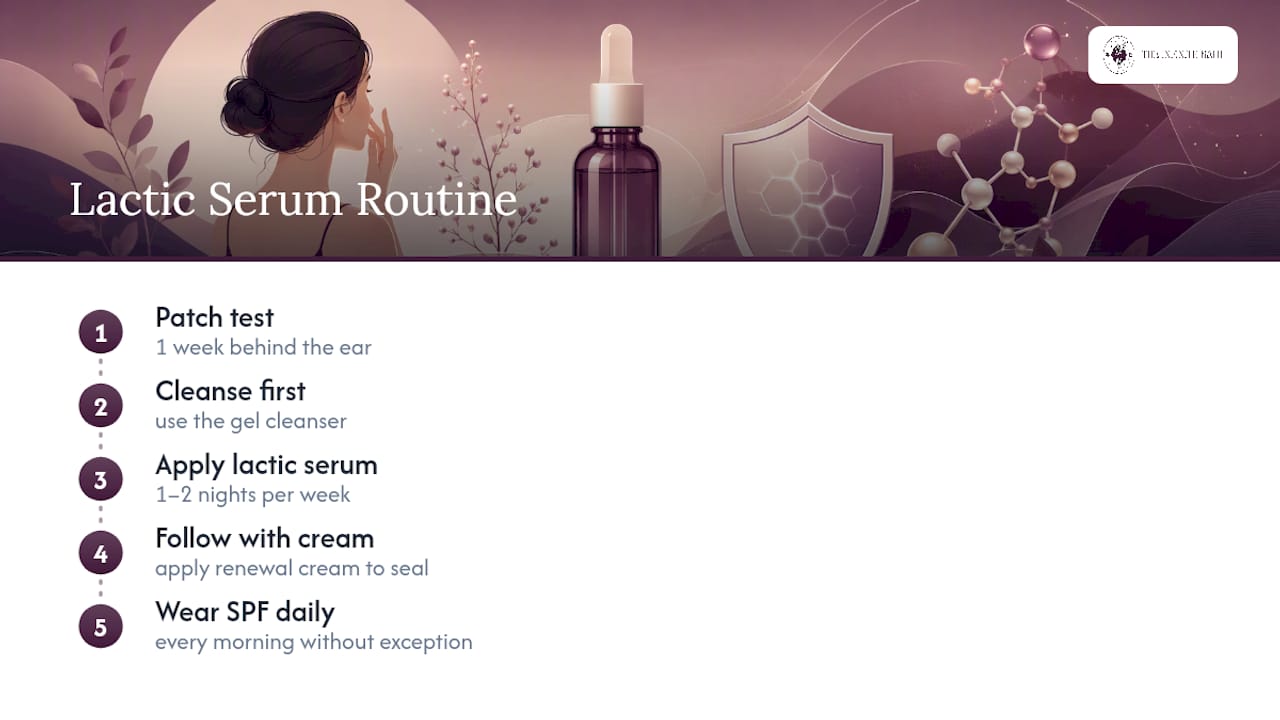
The three-step regimen pairs a gel cleanser, a lactic serum, and a renewal cream, each formulated with natural and organic actives rather than synthetic fillers. The serum is designed to exfoliate and hydrate at the same time, so you're not trading smoother texture for dryness or tightness. To start, cleanse first, apply the lactic serum one to two nights a week, follow with the renewal cream, and wear SPF every morning without exception. A patch test behind the ear for a week is still worth doing before your first full application, even with a formulation built around sensitive skin.
Ready to see the full regimen? Browse The Infinite Bath's lactic serum and build a routine that treats exfoliation and hydration as one step, not two competing ones.
This article is general information, not a substitute for advice from a qualified doctor. Consult a qualified healthcare professional about your own circumstances before acting on anything here.
Sources
- Lactic acid chemical peeling in skin disorders (Clinical, Cosmetic and Investigational Dermatology, 2024)
- The ultimate guide to using lactic acid for skin care (WebMD)