
A melasma-safe routine has three non-negotiables: tinted SPF 50+ with iron oxides reapplied through the day, a gentle barrier-first AM and PM structure, and targeted actives introduced one at a time, never stacked. Treat melasma as something you manage, not cure. Most people see the first real change in 8 to 12 weeks, with fuller results by month four to six, but pigment tends to creep back within 3 to 6 months if maintenance lapses.
TL;DR:
- Using tinted SPF 50+ with iron oxides and reapplying every two to three hours is essential to prevent pigment darkening from light exposure.
- Introducing actives like tranexamic acid or azelaic acid gradually, starting with every other night and monitoring skin reactions, minimizes irritation and hyperpigmentation risk.
- Managing heat and light sources indoors, such as hot showers, screens, and indoor lighting, helps prevent unseen triggers of pigment worsening.
- Deep treatments like peels or lasers should only be used when topicals and photoprotection are stable, as aggressive procedures may worsen melasma if applied too early.
- A simple, consistent skincare routine focused on barrier support and photoprotection can be more effective for long-term management than complex, layered product regimens.
Table of Contents
- What Does a Melasma Skincare Routine Look Like in the Morning?
- What Should Your Evening Melasma Routine Include?
- How Do Dermatologists Structure a Tiered Melasma Treatment Plan?
- How Should You Introduce Melasma Actives Week by Week?
- What Everyday Triggers Make Melasma Worse?
- When Should You See a Dermatologist About Melasma?
- What Side Effects Should You Expect During Treatment?
- Can Diet or Supplements Affect Melasma?
- Which Ingredient Combinations Should You Avoid?
- Why Simple Skincare Often Beats a Complicated Routine
- Where The Infinite Bath Fits Into Your Melasma Routine
- Sources
What Does a Melasma Skincare Routine Look Like in the Morning?
Melasma doesn't care how good your serum is if you skip this part. Your morning routine has one job above all others: keep light, of every kind, off your pigment cells before it has a chance to switch them on.
Start with lukewarm water and a gentle cleanser. Hot water strips the skin's natural lipids, the fats that hold your barrier together like mortar between bricks, and a compromised barrier reacts to everything that comes after it, including your sunscreen. If your cleanser leaves any tightness or squeak behind, it's too aggressive for melasma-prone skin, full stop.
After cleansing, a light antioxidant serum has real value here, but the choice matters. Vitamin C in its pure ascorbic acid form is often too irritating for melasma skin, especially early in a routine. Gentler derivatives, like sodium ascorbyl phosphate or ascorbyl glucoside, offer some of the same environmental protection without the sting. This step is optional in week one. It becomes more useful once your skin has proven it can tolerate daily actives without flushing or stinging.
Then comes the step that determines whether the rest of your routine even matters: sunscreen. Melasma isn't only provoked by UV rays. Visible light, the kind that comes through windows and pours out of your laptop screen, also drives pigment production, which is why standard clear sunscreens often fall short. Tinted formulas containing iron oxides filter that visible-light range in a way plain mineral or chemical filters don't, and clinical reviews have found iron-oxide sunscreens produce measurably better pigment scores than untinted equivalents over time.
Look for three things on the label: SPF 50 or higher, broad-spectrum coverage, and iron oxides listed in the ingredients (sometimes shown as "tinted" or "universal tint" on the front of the bottle). Reapplication is where most people fail this step. A single morning application, no matter how good the formula, cannot protect you at 3 p.m. Dermatology guidance calls for reapplying every two to three hours during real sun exposure, which sounds excessive until you consider that melasma pigment can darken within a single unprotected afternoon.
Reapplying over makeup is the practical hurdle nobody warns you about. A few habits make it workable:
- Mineral sunscreen sticks or pressed powders with SPF let you touch up without disturbing foundation.
- Keep a travel-size stick in your bag, car, and desk drawer so reapplication isn't a planning failure.
- Set a recurring phone alarm for midday reapplication until the habit sticks on its own.
- If you're indoors most of the day, a lighter tinted SPF 30-to-50 near a window still needs reapplying by early afternoon.
There's a format tip worth borrowing from Korean skincare reapplication techniques, where powder and stick sunscreens are standard precisely because cream reapplication over makeup is impractical for most people.
Physical barriers matter as much as anything in a bottle. A wide-brimmed hat blocks a meaningful share of both UV and visible light that a hat brim's shadow simply removes from the equation. If you work near a window, consider that ordinary glass filters UVB but lets a good deal of UVA and visible light straight through, which is part of why melasma can worsen even in people who rarely go outside. A car window film or a strategically angled blind at your desk does more for your pigment than most people assume.

Pro Tip: Keep your SPF stick visible on your desk or bathroom counter, not tucked in a drawer. The products you have to hunt for are the ones you skip by 2 p.m.
What Should Your Evening Melasma Routine Include?
Nighttime is when repair actually happens, and it's also when most melasma routines go wrong through sheer overenthusiasm.
If you wore tinted sunscreen all day, a single cleanse usually won't fully remove it. A brief oil-based or balm cleanser first, followed by your gentle gel or cream cleanser, clears mineral pigments without requiring a harsh scrub. Skip anything with visible exfoliating beads or a foaming action strong enough to leave your skin feeling tight.
This is where the temptation to stack every "brightening" product you own does the most damage. Melasma-prone skin has a lower irritation threshold than average, and irritation itself can trigger post-inflammatory hyperpigmentation, a second pigment problem layered on top of the first. One active at a time, introduced slowly, is the only defensible approach.
A reasonable sequence for introducing PM actives:
- Start with a single active, applied every other night for the first two weeks.
- Watch for redness, stinging, or flaking that lasts more than an hour after application.
- If tolerated, move to nightly use; if not, drop back to twice-weekly or pause entirely.
- Always apply moisturizer immediately after the active to buffer its effect on the skin barrier.
- Never introduce a second new active until the first has been tolerated for at least two weeks.
Which actives belong in this rotation depends on where you are in treatment. Topical tranexamic acid has become a mainstay for melasma maintenance because it interrupts pigment signaling without the bleaching risk associated with older agents. Azelaic acid offers a milder, well-tolerated option that also helps with any accompanying redness or breakouts. Cysteamine cream is another option gaining traction, though its strong odor and shorter working window put some people off. Retinoids can help with texture and pigment turnover, but they carry a real irritation risk in melasma-prone skin, so they're usually the last active added, and only in small amounts.
Hydroquinone occupies a different category entirely. It remains one of the most effective depigmenting agents available, but supervised, cycled use rather than open-ended daily application is the standard approach, since prolonged unsupervised use carries its own risks. After a hydroquinone cycle prescribed by a clinician, most people transition to a non-hydroquinone maintenance active, like azelaic acid or topical tranexamic acid, to hold the results without extending exposure to hydroquinone itself.
Whatever active you land on, the moisturizer that follows it isn't optional padding. Ceramides, cholesterol, and fatty acids are the literal building blocks of your skin barrier. Think of that barrier as a brick wall: the skin cells are the bricks, and lipids like ceramides are the mortar holding them in place. Every active you introduce chips at that mortar a little. A barrier cream reapplied after actives, and on the nights you skip actives entirely, is what keeps the wall standing.
Pro Tip: If a new active leaves your skin tight or shiny-looking the next morning, that's early irritation, not "purging." Pull back before it becomes visible inflammation.
How Do Dermatologists Structure a Tiered Melasma Treatment Plan?
Clinicians don't treat melasma with one product. They treat it in tiers, escalating only as far as each patient's skin and history allow, and stepping back down once pigment stabilizes.
- Tier 1, photoprotection and barrier support. This is the foundation every other tier depends on, and it never gets phased out. Tinted SPF 50+, gentle cleansing, and a ceramide-based moisturizer form the baseline that makes everything above it work.
- Tier 2, topical depigmenting agents. Topical tranexamic acid, azelaic acid, and cysteamine sit here, often used in combination or rotation. Supervised hydroquinone cycles also belong to this tier, typically for a defined stretch of weeks before tapering to a gentler maintenance active.
- Tier 2.5, oral tranexamic acid. For patients whose melasma resists topical management, oral TXA is a documented option, commonly dosed at 250 mg twice daily for 12 to 16 weeks. It requires screening for clotting risk beforehand, since TXA affects clot formation, and it is not appropriate for anyone with a personal or family history of blood clots without a clinician's clearance.
- Tier 3, procedural adjuncts. Microneedling and superficial peels can accelerate clearance once topical treatment and photoprotection are already optimized, not before. Lasers sit at the far edge of this tier, useful in experienced hands but genuinely risky for melasma if done too aggressively or too early, since heat and inflammation from the wrong device can worsen pigment rather than fade it.
Multimodal treatment, combining photoprotection, topical agents, and selective procedures, consistently outperforms any single approach alone, and relapse occurs within 3 to 6 months in patients who stop maintenance care entirely.
That relapse window is the detail most people miss. Melasma responses to treatment, then quietly returns once the routine relaxes, because the underlying pigment-producing cells remain sensitized even after the visible pigment clears. This is why dermatology guidance increasingly frames melasma as a chronic condition to manage rather than a problem with a finish line. The tiers above aren't a ladder you climb once. They're a structure you move up and down within, for years, depending on season, hormones, and how consistent your photoprotection has been.
How Should You Introduce Melasma Actives Week by Week?
Two starting paths work, depending on how cautious your skin needs you to be. Both begin in the same place.
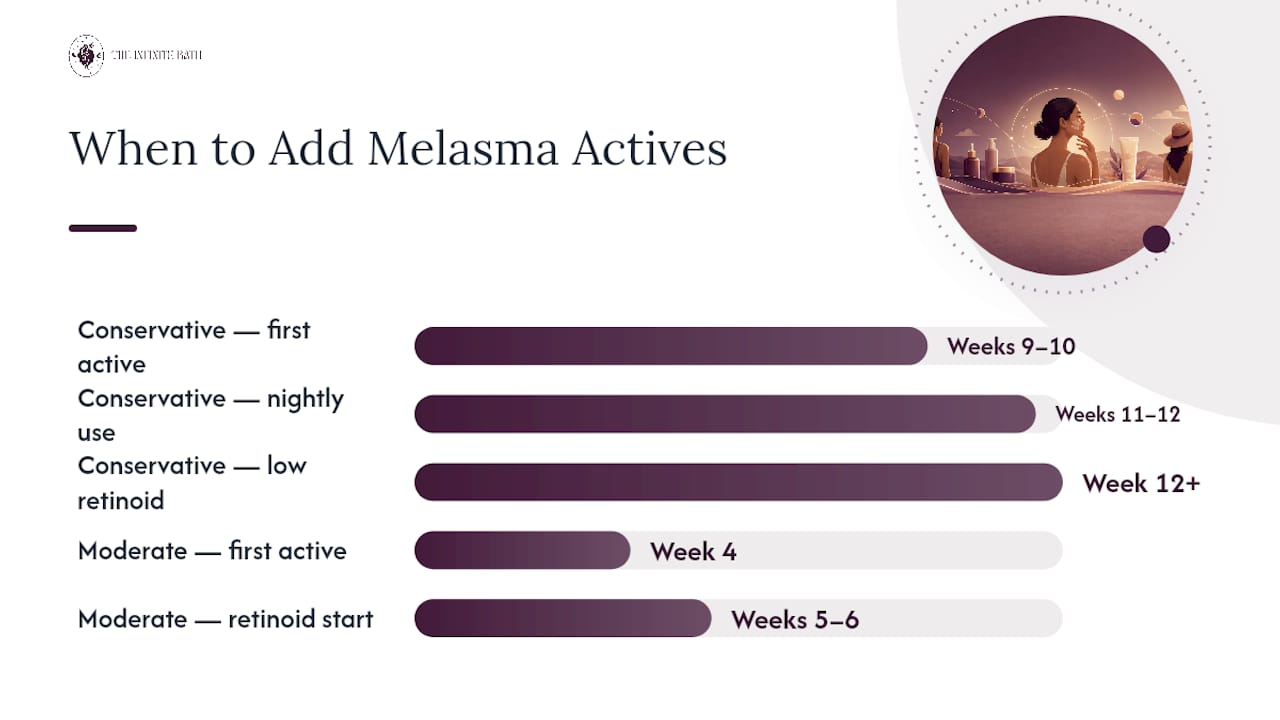
Conservative track:
- Weeks 1 to 8: Tier 1 only. Tinted SPF, gentle cleanser, ceramide moisturizer, nothing else. Let your barrier prove it's stable before adding anything.
- Weeks 9 to 10: Introduce topical tranexamic acid or azelaic acid every other night. Watch closely for any redness beyond an hour.
- Weeks 11 to 12: If tolerated, move to nightly use of that single active. Still no second active yet.
- Week 12 onward: If your skin remains calm, consider a low-strength retinoid, applied twice weekly, buffered with moisturizer.
Moderate track:
- Weeks 1 to 3: Tier 1 foundation, same as above, but shorter.
- Week 4: Add topical tranexamic acid or azelaic acid nightly, assuming no reaction in the first few applications.
- Weeks 5 to 6: Introduce a retinoid using the sandwich method, moisturizer, retinoid, moisturizer, two to three nights a week.
- Week 8 onward: If pigment hasn't budged and tolerance is good, this is the point to discuss prescription hydroquinone cycling with a dermatologist rather than pushing over-the-counter actives harder.
Reactions happen even with careful pacing, and knowing how to recover matters as much as knowing how to start. The moment you notice stinging that outlasts application, visible flaking, or a flare of redness, stop the active immediately. Switch to a bland, fragrance-free moisturizer for 48 to 72 hours, skip everything else, and let the barrier settle before reintroducing anything. Restarting at a lower frequency, once weekly instead of nightly, is almost always more productive than pushing through irritation, which tends to trigger the exact post-inflammatory darkening you're trying to avoid.
Pro Tip: Photograph your skin in the same light every two weeks. Melasma changes slowly enough that day-to-day comparisons feel discouraging even when the routine is working.
What Everyday Triggers Make Melasma Worse?
Products are only half the equation. Heat and light exposure that have nothing to do with the beach can quietly undo weeks of careful treatment.
Visible light from indoor lighting and screens, and heat from cooking, hot showers, or saunas, both provoke melasma independently of UV exposure. Steam from a stovetop or a long hot shower raises skin temperature enough to stimulate the same pigment-producing pathway that sunlight triggers. Practical fixes are simple: a fan running while you cook, lukewarm rather than scalding showers, and stepping back from the oven door when it's open.
Certain products and habits work against everything else in your routine:
- Tanning beds are an unambiguous trigger and worth avoiding entirely, not just minimizing.
- Fragranced skincare and heavily foaming cleansers both raise irritation risk in a barrier that's already compromised.
- Harsh physical scrubs or high-frequency chemical exfoliation can trigger the same post-inflammatory darkening that aggressive actives cause.
- Choose foundation built on a tinted, SPF-based sunscreen rather than layering makeup over a separate sunscreen and hoping for coverage.
Hormones deserve a direct conversation with a clinician rather than guesswork. Pregnancy, oral contraceptives, and hormone replacement therapy are all well-documented melasma triggers, and in some cases the pigment fades substantially after pregnancy or a medication change without any topical treatment at all. If your melasma appeared alongside starting a hormonal medication, that timing is worth mentioning to whoever manages that prescription, not just your dermatologist.
When Should You See a Dermatologist About Melasma?
Some situations call for professional oversight rather than another over-the-counter product.
- Your routine has been consistent for 8 to 12 weeks with no visible improvement.
- Pigment is worsening rapidly rather than gradually, which sometimes signals a different diagnosis entirely.
- You're pregnant or planning pregnancy and need guidance on which actives are safe to continue.
- You're considering oral tranexamic acid or a procedural option like microneedling or laser treatment.
A dermatologist evaluating melasma typically looks at how deep the pigment sits in the skin, since epidermal melasma responds better to topicals than dermal or mixed types, along with your hormonal history and, for anyone considering oral TXA, screening for clotting risk before writing that prescription.
Procedurally, microneedling combined with topical tranexamic acid has shown improved clearance with lower relapse compared to some other adjunct approaches, making it one of the safer procedural add-ons once topicals and photoprotection are already dialed in. Superficial peels can help in the right hands. Medium-depth peels and aggressive laser settings carry real risk for melasma, particularly in deeper skin tones, and guideline summaries advise against them in favor of more conservative options. Any clinician offering a procedure should also be counseling you honestly about relapse, not presenting it as a one-time fix.
What Side Effects Should You Expect During Treatment?
Some irritation during active introduction is common, and knowing what's normal versus what's a warning sign saves you from either overreacting or ignoring real trouble.
Mild, short-lived redness or a slight tingling right after applying a new active, lasting under an hour, is generally within normal range. Peeling that's fine and even, rather than patchy, often signals your skin adjusting to increased cell turnover. The fix is almost always the same: reduce frequency, not potency, and lean harder on your moisturizer for a week or two.
What isn't normal is redness that persists past a few hours, burning that intensifies rather than fades, or new dark patches appearing where irritation occurred. That last one is post-inflammatory hyperpigmentation forming in real time, and it's the exact outcome careful pacing is meant to prevent. Retinoids and hydroquinone are the most common culprits for this kind of reaction in melasma-prone skin.
The management protocol is consistent across almost every active: stop the offending product, simplify to cleanser and moisturizer only, and give the barrier 48 to 72 hours before reintroducing anything, at a lower frequency than before. Sun sensitivity also increases with several melasma actives, particularly retinoids and hydroquinone, which makes the SPF reapplication habit from your morning routine even more important during active treatment phases than during maintenance.
Can Diet or Supplements Affect Melasma?
No food or supplement reverses melasma on its own, but a few dietary factors genuinely influence how your skin responds to treatment.
Oral antioxidants, particularly vitamin C and vitamin E taken together, have some support as adjuncts to topical treatment, likely through reducing oxidative stress that contributes to pigment production. They're a reasonable addition alongside your topical routine, not a substitute for photoprotection or targeted actives.
Alcohol and very high sugar intake can promote low-grade inflammation, which theoretically feeds the same pathways that irritation and heat do. The evidence connecting specific foods to melasma flares is thinner than skincare marketing often suggests, so treat dietary changes as a supporting habit rather than a primary treatment lever.
One supplement worth flagging with caution: some people explore oral tranexamic acid as a supplement purchased online rather than through a prescribing clinician. This is a real safety concern. Oral TXA affects blood clotting and requires medical screening beforehand, and self-dosing without that screening carries genuine risk. If oral TXA interests you, that conversation belongs with a dermatologist, not a supplement aisle.
Which Ingredient Combinations Should You Avoid?
Certain pairings look reasonable on paper and cause real trouble on melasma-prone skin.
Retinoids and hydroquinone used on the same night, without spacing, often overwhelm the skin barrier and trigger the exact inflammation that worsens pigment. If your dermatologist has prescribed both, alternating nights is the usual approach, not simultaneous application. Vitamin C and niacinamide can be layered safely for most people, but combining pure ascorbic acid with a fresh retinoid application frequently causes more irritation than either ingredient alone.
Physical or chemical exfoliants layered with retinoids or hydroquinone is another common mistake. Exfoliating acids and retinoids both increase cell turnover and barrier permeability, and stacking them multiplies irritation risk rather than multiplying results. Benzoyl peroxide, often reached for if melasma coexists with breakouts, can also inactivate certain formulations of tretinoin when applied together, so spacing these by time of day or alternating nights preserves both ingredients' effectiveness. When in doubt, the rule that holds up best is one active ingredient per session, moisturizer as a buffer, and let the skin's response over two weeks tell you whether it's ready for more.
Why Simple Skincare Often Beats a Complicated Routine
Most melasma advice online pushes toward more: more actives, more layering, more products claiming to target pigment from a different angle. What tends to actually work is closer to the opposite. A stable barrier, protected from light and heat, tolerates far more treatment over time than a barrier under constant assault from five "brightening" products applied at once.
The three-step structure built around a gentle cleanser, a mild lactic acid serum, and a barrier-renewing cream isn't a workaround for people who can't commit to a "real" routine. It's closer to what Tier 1 melasma management actually calls for: consistent, low-irritation care that a person will realistically do every single day, because the products don't punish them for using them. Lactic acid in particular supports gentle cell turnover without the aggressive dryness that glycolic acid or a strong retinoid can cause, which matters enormously for skin that's already walking a fine line between treatment and irritation.
For someone newly diagnosed, or for anyone who has burned out trying to manage melasma with a shelf of conflicting actives, a simplified foundation isn't a lesser option. It's often the more sustainable one, because the routine you'll actually stick with for six months beats the ambitious one you abandon after two irritated weeks. Sustainability, not intensity, is what prevents the relapse that shows up three to six months after people give up on maintenance.
— Stella
Where The Infinite Bath Fits Into Your Melasma Routine
This is a low-effort alternative to juggling five separate pigment products, one simple system built to support the Tier 1 foundation every melasma routine needs, without adding another irritation risk to manage.

Here's how the three pieces map onto what you've just read: The Gel Cleanser replaces the harsh, tight-feeling face wash that quietly undermines barrier stability every morning and night. The Lactic Serum works as your gentle PM exfoliant, supporting cell turnover without the aggressive dryness that pushes melasma-prone skin toward irritation and rebound pigment. The Renewal Cream does the barrier-repair work that has to happen after every active night, and on the nights you skip actives entirely.
Worth saying plainly: this system supports Tier 1 photoprotection and long-term maintenance. It isn't a stand-in for supervised treatments or dermatologist-directed induction phases when your melasma calls for one. Those decisions still belong with a clinician. For the daily foundation underneath all of it, the skincare shop is where to start building a routine you'll still be doing in six months, which is the whole point.
Sources
The recommendations above draw on established dermatology guidance and peer-reviewed treatment reviews, not general skincare advice.
- Melasma: Self-care - American Academy of Dermatology
- Melasma: A step-by-step approach towards a multimodal combination therapy - PMC
- Melasma treatment guideline (Medscape reference summary)