
Cleanse, treat with one targeted active on a rotating schedule, then moisturize. That is the entire routine, and it works because your skin repairs itself overnight far better with three consistent steps than with ten inconsistent ones. Skip the 10-step regimen. The Infinite Bath built its three-step system (gel cleanser, lactic serum, renewal cream) around exactly this logic.
TL;DR:
- Using a double cleansing method is essential if wearing makeup or sunscreen, but one gentle cleanse suffices on clean skin days.
- Exfoliating only two to three nights a week prevents skin barrier damage, and avoiding stacking retinoids with exfoliants minimizes irritation.
- Rotating targeted actives like retinoids, niacinamide, and hydrating serums according to a set schedule yields better results than combining multiple actives nightly.
- Applying moisturizer and occlusive layers correctly, especially after acids and retinoids, helps prevent irritation and supports overnight skin repair.
- A minimal three-step routine of cleanse, exfoliate, and repair outperforms complex regimens by reducing irritation and emphasizing consistent night-time renewal.
Table of Contents
- Your Nighttime Skincare Routine, Step by Step
- How to Layer Your Products Without Wasting Them
- Building the Routine Around Your Skin Type
- Mistakes That Undo a Good Routine
- Why a Simple Three-Step Regimen Actually Works
- Why Your Skin Repairs Itself Better at Night
- Adjusting Your Routine for Weather and Season
- Don't Forget Your Eyes and Lips
- The Skinimalism Take: Why Fewer Steps Beat More Steps
- Start Tonight With One Product, Not Ten
- Sources
Your Nighttime Skincare Routine, Step by Step
Every effective evening routine follows the same skeleton: remove the day, treat a specific concern, seal in moisture. The details change based on what you're wearing and what your skin needs, but the order rarely does.
1. Cleanse (and double-cleanse when needed). If you wore makeup, sunscreen, or spent the day somewhere polluted, start with an oil-based cleanser to break down what's sitting on your skin, then follow with a gentle water-based one. This double-cleansing method exists because a single water-based cleanser often can't fully remove SPF or long-wear makeup, and leftover residue blocks whatever treatment you apply next. No makeup, no sunscreen? One gentle cleanse is plenty. Keep it under a minute with lukewarm water. Hot water and harsh surfactants strip your skin's natural oils and can trigger rebound oiliness as your skin overcorrects to replace what you just washed away.
2. Exfoliate, but only 2 to 3 nights a week. Chemical exfoliants at 5 to 10% AHA or 1 to 2% BHA work well at that frequency for most skin types. More than that, and you risk sanding through your skin barrier faster than it can rebuild. One rule matters more than any other here: never exfoliate on the same night you use a strong retinoid. Both are exfoliating your skin in different ways, and stacking them is the fastest route to redness, peeling, and a face that stings when you smile.
3. Apply your targeted treatment. This is where retinoids, niacinamide, or hydrating serums go, and the trick is rotation, not addition. A workable weekly split looks like this:
- Two to four nights: retinoid (start low, build tolerance)
- One to three nights: chemical exfoliant
- Remaining nights: hydrating serum only, no active
Niacinamide is flexible enough to layer most nights since it calms rather than exfoliates. If you're spot-treating a breakout, apply that after your serum but before moisturizer, and only where you need it.
4. Moisturize, and decide if tonight is a slugging night. Every routine ends here, no exceptions. If your skin feels tight, flaky, or barrier-compromised, sealing your moisturizer with an occlusive (a heavier balm or facial oil) can lock in hydration overnight. Skip slugging on nights you've used a strong retinoid or if you're acne-prone. Trapping active ingredients under an occlusive layer can intensify irritation rather than soothe it.
Pro Tip: Keep a simple index card or note on your phone tracking which nights you used which active. After two weeks, patterns in redness or dryness become obvious, and you can adjust your rotation instead of guessing.
How to Layer Your Products Without Wasting Them
Layering order isn't arbitrary. Apply products thinnest to thickest so each one absorbs before the next seals it in.
- Rinse-off cleanser first, always.
- Watery treatments and serums next, waiting roughly 60 seconds or until the product feels absorbed rather than tacky.
- Creams and moisturizers after that.
- Occlusives (oils, balms) last, since their job is to sit on top and trap everything underneath.
If a retinoid leaves your skin irritated, try the "sandwich" method: moisturizer first, then your retinoid, then a second layer of moisturizer on top. It buffers the retinoid's intensity without canceling its benefits, and it's a favorite trick among people who want retinoid results without the retinoid flake.
Building the Routine Around Your Skin Type
The three-step skeleton stays the same. What changes is texture, ingredient concentration, and how often you push actives.
- Dry skin: Use a cream cleanser instead of a gel or foam. Layer hyaluronic acid before a ceramide-rich moisturizer, and don't be afraid of an occlusive most nights.
- Oily or acne-prone skin: A gel cleanser controls surface oil without over-stripping. Salicylic acid once or twice a week targets clogged pores, and non-comedogenic moisturizers keep hydration up without adding to congestion.
- Sensitive skin: Start with lactic acid rather than glycolic or salicylic. It exfoliates more gently. Prioritize barrier-support ingredients like niacinamide and panthenol over anything aggressive, and read The Infinite Bath's sensitive skin routine for a specific low-irritation sequence.
- Combination skin: Zone-treat rather than blanket-treat. Lighter, oil-controlling textures go on the T-zone; richer creams go on drier cheeks. Resist the urge to apply the same strong active everywhere on your face.
If you're navigating a skin condition that changes what's safe to use, like pregnancy, a pregnancy-safe skincare routine walks through which actives to pause and which gentle substitutes still deliver results.
Mistakes That Undo a Good Routine
Most skin irritation traces back to a handful of repeat offenders:
- Using a chemical exfoliant and a strong retinoid on the same night.
- Stacking three or four active ingredients at once instead of rotating them.
- Skipping moisturizer because skin feels oily, which often backfires into more oil production.
- Reaching for a stripping, foaming cleanser that leaves skin tight and squeaky.
Consistency matters more than intensity. Dermatologists increasingly point to a less-is-more approach, since over-layering causes more damage than it prevents. If your skin is already irritated, strip back to just a gentle cleanser and moisturizer for a week, then reintroduce one active at a time, waiting several days between each addition before judging how your skin responds.
Why a Simple Three-Step Regimen Actually Works
Complexity feels productive, but it rarely is. The Infinite Bath's three-step regimen (gel cleanser, lactic serum, renewal cream) maps directly onto the routine outlined above: cleanse, treat, moisturize, nothing extra to overthink.
The lactic serum does double duty. Lactic acid is a gentler AHA than glycolic acid, meaning it exfoliates while also drawing in moisture, which matters because exfoliation without hydration is what leaves skin feeling raw. That combination makes it a practical entry point for anyone who's been burned by harsher acids before.
- Gel cleanser: removes the day without stripping your barrier.
- Lactic serum: exfoliates gently while maintaining hydration, used on rotation nights.
- Renewal cream: locks in moisture and supports repair while you sleep.
Pro Tip: If you're new to acids, use the lactic serum once or twice a week for the first two weeks before working up to three nights. Your skin will tell you when it's ready for more.
Why Your Skin Repairs Itself Better at Night
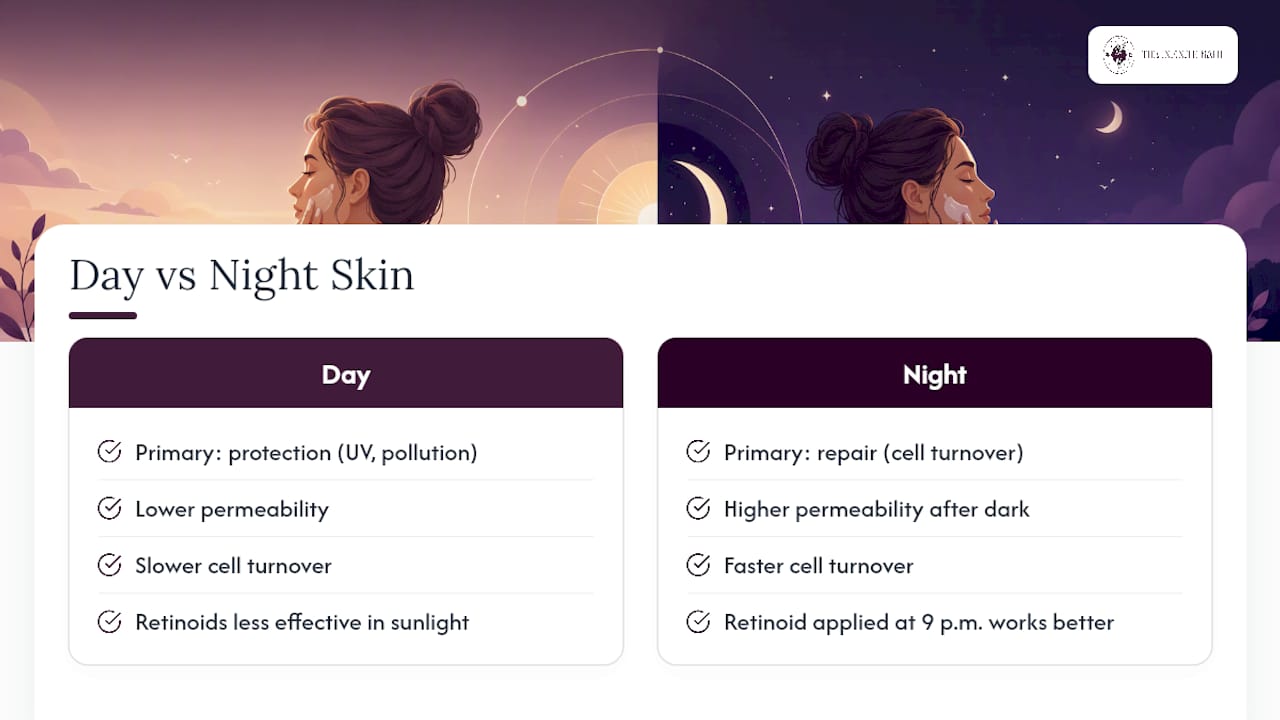
Your skin isn't just resting while you sleep. It's working harder than it does during the day. Research on nighttime skin function shows skin becomes more permeable after dark and loses water through its surface at a higher rate, a process called transepidermal water loss. That combination, more permeable and losing water faster, is exactly why nighttime is the highest-leverage window for reparative ingredients.
During the day, your skin is busy defending itself: blocking UV rays, filtering pollution, fighting off environmental stress. At night, with none of that defensive work required, cell turnover speeds up and your skin redirects its energy toward repair instead of protection. This is why a retinoid applied at 9 p.m. does more than the same retinoid applied at 9 a.m., beyond the obvious fact that retinoids break down in sunlight.
It also explains why skipping moisturizer at night is a bigger mistake than skipping it in the morning. Because your skin is losing water more quickly while you sleep, an under-moisturized night is a net loss for your skin barrier, even if you wake up and slap on a heavy day cream to compensate. The damage from a dry night doesn't fully reverse with a good morning routine.
This is also the best argument for treating your night routine as the one that matters most if you can only commit fully to one. Morning skincare is largely about protection (sunscreen, antioxidants). Nighttime skincare is about repair, and repair is where lasting improvements in texture, tone, and fine lines actually happen.
Adjusting Your Routine for Weather and Season
Your skin doesn't stay the same all year, so your routine shouldn't either.
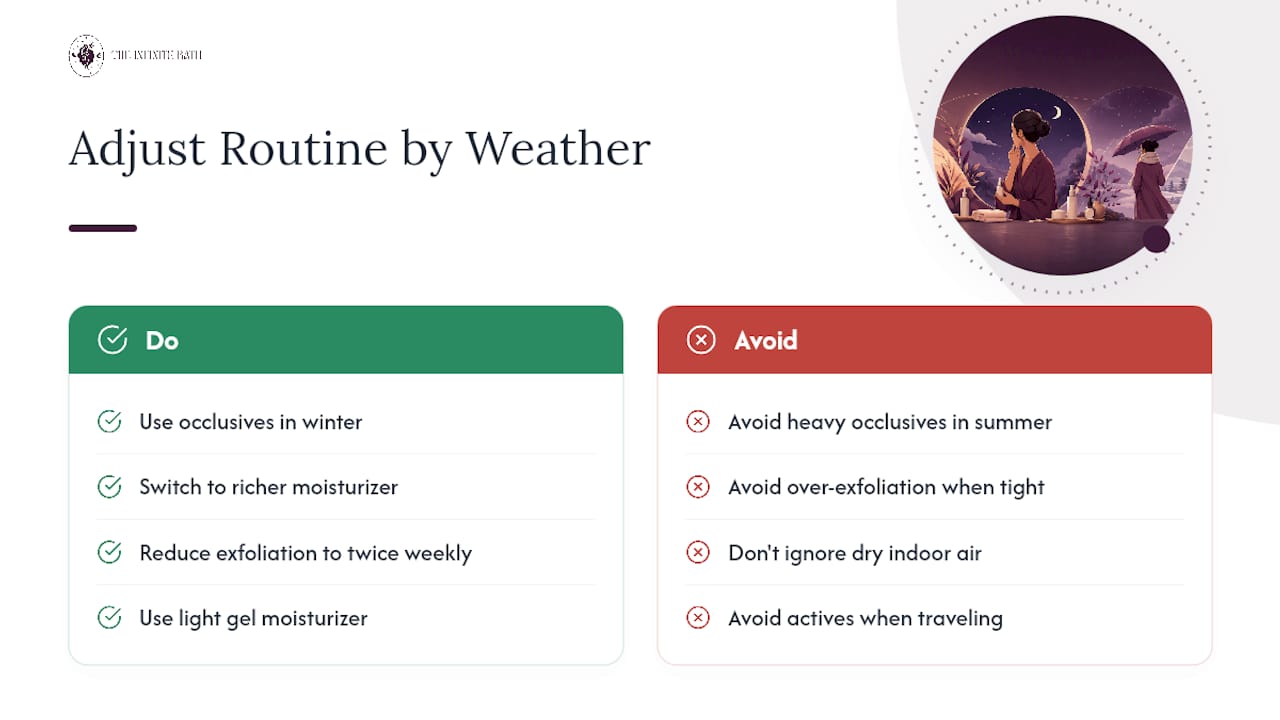
Winter and dry climates: Indoor heating and cold, low-humidity air pull moisture out of your skin fast. This is the season to lean into occlusives most nights, size up to a richer moisturizer, and possibly dial back exfoliation frequency to twice a week if your skin feels tight or flaky more easily.
Summer and humid climates: Higher humidity means your skin retains moisture more easily on its own, so a heavy occlusive every night can feel greasy and even contribute to clogged pores. Lighter gel moisturizers usually perform better, and you may tolerate exfoliation slightly more often since your barrier isn't under the same stress.
Dry indoor air (year-round, not just winter): Air conditioning is just as dehydrating as heating. If you notice your skin acting "wintery" in July, treat it like winter skin: more hydration, less aggressive exfoliation.
Travel and altitude: Higher altitudes and airplane cabins are notoriously drying. Pack a travel-size moisturizer and skip actives entirely for a night or two if your skin feels reactive in a new environment.
The through-line is simple: watch how your skin actually feels rather than following a fixed calendar. Tightness, flaking, or dullness signals it's time to add moisture and pull back on actives. Congestion or excess shine signals the opposite.
Don't Forget Your Eyes and Lips
The skin around your eyes has no oil glands and is dramatically thinner than the rest of your face, which is why it shows dryness and fine lines first. Apply an eye cream with a light patting motion, using your ring finger for the gentlest pressure, after your serum but before your heavier moisturizer. A little goes a long way; this area doesn't need much product, just consistency.
Lips are frequently the most neglected part of a night routine, yet they're skin too, just without the oil glands to protect themselves. A basic lip balm or overnight lip mask applied as your last step, after everything else has absorbed, prevents the cracking and flaking that shows up the moment the air turns dry. If you use a retinoid or strong exfoliant, avoid applying it near your lips. That skin is thinner and irritates easily.
The Skinimalism Take: Why Fewer Steps Beat More Steps
The skincare industry has spent years convincing people that more steps signal more seriousness about your skin. The evidence points the other way. A gentler, minimal formulation approach tends to outperform a crowded routine, because every additional product is another opportunity to irritate your barrier, and irritated skin heals slower and looks worse than skin left alone.
What conventional advice gets wrong is treating every active as additive: more retinol, more vitamin C, more acids, stacked in the same 20 minutes. Your skin doesn't process ingredients that way. It processes them one irritation event at a time, and enough small irritations compound into a barrier that can't repair itself efficiently, which is the opposite of what a night routine is supposed to accomplish.
What I'd prioritize first, before adding a single additional product: nail the rotation. Retinoid nights, exfoliant nights, hydration only nights. That schedule alone solves more skin concerns than any serum. The Infinite Bath's three-step regimen works precisely because it forces this discipline. There's no fourth or fifth product tempting you to overdo it. A gel cleanser, a lactic serum, and a renewal cream cover cleansing, gentle exfoliation, and repair, which is genuinely all most people's skin needs on a given night.
— Stella
Start Tonight With One Product, Not Ten
You don't need to overhaul your bathroom counter to see results. Start with one piece of The Infinite Bath's three-step regimen, most people begin with the gel cleanser or the lactic serum, and use it consistently for two weeks before adding the next step. That gradual build is what keeps skin calm instead of overwhelmed.

A simple 7-night plan looks like this: two nights of lactic serum for gentle exfoliation, two to three nights of a retinoid if you already use one, and the remaining nights with just the renewal cream over a hydrating layer. No guesswork, no ten-step regimen to maintain. Just three products used in the right order, on the right nights.
Ready to build your own version of this routine? Browse The Infinite Bath's skincare shop to start with the full three-step system, or check out the lactic serum on its own if gentle exfoliation is your first priority.