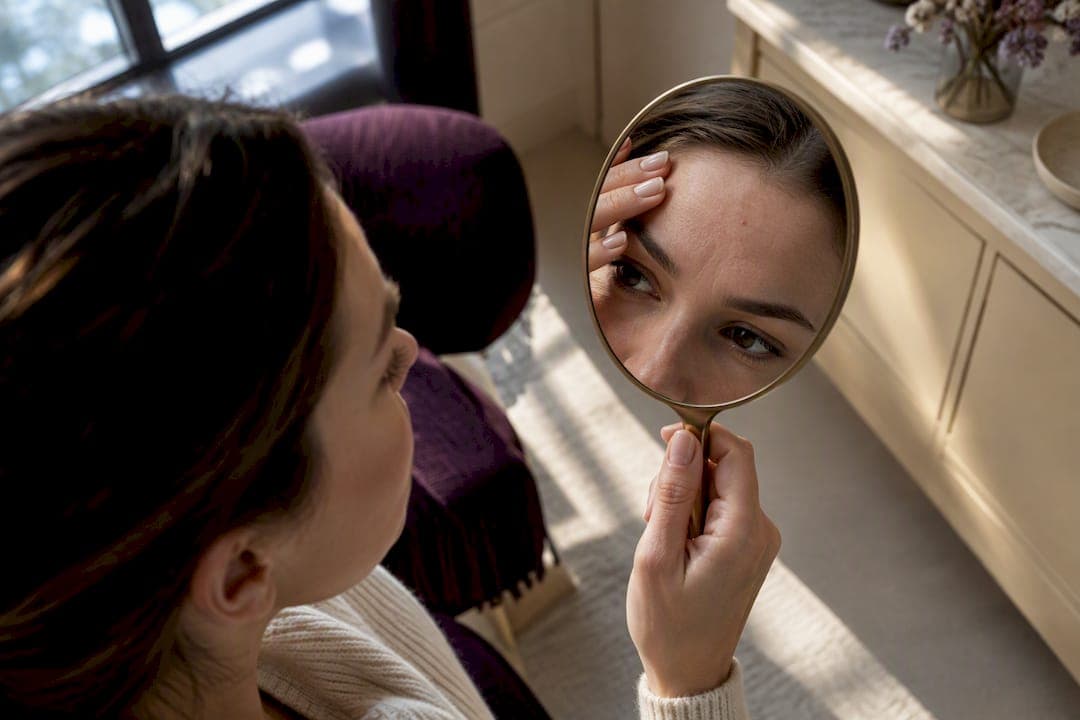
Yes, lactic acid can trigger a temporary purging-like flare in some people, especially in the first few weeks of use. If it's mild, stick with a low frequency, patch test before applying to your whole face, and wear sunscreen daily. If it's severe (burning, raw skin, spreading redness), stop and let your skin recover before you reintroduce anything. The nuance, and how to tell purging from a real breakout, is below.
TL;DR:
- Lactic acid's larger molecule makes it gentler and less likely to cause deep irritation compared to glycolic acid, reducing the severity of purging.
- Purging typically appears within one to two weeks, mostly affecting areas with existing congestion and presenting as small whiteheads or clogged pores.
- Longer-lasting purging beyond six weeks or worsening symptoms may indicate irritation or another skin reaction, requiring routine reassessment.
- Combining lactic acid with other active ingredients like retinoids or BHAs increases irritation risk, especially when used at higher concentrations or frequencies.
- Starting with low concentrations, patch testing, and avoiding layering multiple actives help manage purging safely and prevent skin damage.
Table of Contents
- What Is Skin Purging and How Does Lactic Acid Cause It?
- Purging vs. Acne: How to Tell the Difference
- How Long Does Lactic Acid Purging Usually Last?
- What Raises Your Risk of Purging or Irritation
- How to Manage Lactic Acid Purging Safely
- When to Stop Using Lactic Acid and See a Dermatologist
- Clinician Checks and a Gentler Way to Start
- Does Purging Look Different Depending on Your Skin Type or Tone?
- Adjusting Your Routine While You're Purging
- Quick Rules Worth Remembering
- A Gentler Way to Start With Lactic Acid
- Sources
- FAQ
What Is Skin Purging and How Does Lactic Acid Cause It?
Purging describes a temporary uptick in breakouts after you start a product that speeds up skin cell turnover. Think of your skin's surface like a brick wall with mortar holding everything in place. Lactic acid loosens that mortar, the bonds between dead skin cells, so your skin sheds faster than it normally would.
Here's the part most articles skip: "purging" isn't an official medical term. Medical News Today notes there are no clinical studies that formally define or validate purging as a distinct process. It's a term the skincare world adopted to describe something real, but the science behind it is thinner than the internet chatter suggests.
What is happening biologically is well documented, though. Alpha hydroxy acids like lactic acid reduce the "stickiness" between dead skin cells and can speed up the breakdown of desmosomes, the structures that hold those cells together. When that turnover accelerates, congestion that was already forming beneath the surface gets pushed up and out faster than it would on its own. You're not creating new problems. You're revealing ones that were already there.
A few things matter when you're weighing this:
- Lactic acid has a larger molecule than glycolic acid, which limits how deep it penetrates and tends to make it gentler on reactive skin.
- The same clinical review that documents lactic acid's exfoliating action also describes it as having moisturizing properties, which is unusual for an acid.
- Purging is temporary by definition. If breakouts keep escalating past a few weeks, something else is going on.
Purging vs. Acne: How to Tell the Difference
This is the question that actually matters, because treating irritation like purging (by pushing through it) can genuinely damage your skin. Here's how to read what your face is telling you.
- Check the timing. Purging tends to show up within the first one to two weeks of starting lactic acid and follows a predictable arc: it gets a little worse, then noticeably better. A new breakout from irritation or clogged pores can show up anytime and just keeps building.
- Look at where the bumps are. Purging usually surfaces in the same spots where you already break out, your congestion zones. If you're suddenly seeing acne somewhere you never have before, like your jawline or hairline when you've always been clear there, that's more likely a new product reacting badly with your skin.
- Check the type of lesion. Purging tends to bring small whiteheads and clogged pores to the surface faster. Deep, painful cysts or widespread inflamed bumps point away from purging and toward irritation or a true breakout.
- Notice how your skin feels, not just how it looks. Dermatology resources are clear that a lot of what gets blamed on purging is actually a new moisturizer or cleanser clogging pores or triggering plain irritation. Burning, stinging, tightness, or a "raw" feeling are irritation signals, not purging signals.
Pro Tip: Take a phone photo of your skin before you start lactic acid, then again every few days. Memory is unreliable when you're staring at a breakout up close every morning. A timeline photo won't lie to you.
If you're not sure, the stop-and-reintroduce method settles it: pause the product for a week, see if things calm down, then bring it back at a lower frequency. If the same pattern repeats, it's likely a genuine reaction, not purging.
How Long Does Lactic Acid Purging Usually Last?
Most purging tied to lactic acid resolves within a few weeks, roughly matching how long a full skin cell turnover cycle takes. That's the window most people should expect, though it shifts based on a few variables.
- Product strength. A 5% lactic serum used a few nights a week purges more mildly and briefly than a stronger daily peel.
- How often you use it. Nightly use accelerates both the purge and the payoff, but it also raises irritation risk.
- Your skin's baseline. Skin with a lot of underlying congestion, think chronic blackheads or hormonal breakouts, tends to purge longer because there's more to clear out.
If you're past six weeks with no improvement, or things are getting worse instead of better, that's not purging anymore. That's a sign to reassess, not to wait it out longer.
What Raises Your Risk of Purging or Irritation
Lactic acid doesn't act alone. What you pair it with, and how you use it, changes your odds significantly.
The biggest culprit is active stacking, using lactic acid alongside retinoids, BHAs like salicylic acid, or physical scrubs in the same routine. Each of these speeds up turnover or strips surface oils through a different mechanism, and combining them multiplies the irritation risk instead of just adding to it. Here's what tends to move the needle most:
- Concentration and pH. Higher percentages and lower pH formulas exfoliate more aggressively, purge harder, and irritate more easily.
- Frequency. Nightly use of a strong formula is a very different experience than twice-weekly use of a gentle one.
- A compromised barrier. If your skin is already dealing with dryness, sunburn, or recent harsh exfoliation, lactic acid will hit harder than it would on healthy, balanced skin.
- Prior inflammation. Existing acne or eczema flares make your skin more reactive to any new active, purging included.
How to Manage Lactic Acid Purging Safely
You don't have to choose between clear skin and comfortable skin. A slower approach gets you both.
- Patch test first, then start slow. Apply a small amount to your inner arm or jawline for two nights before using it on your full face. Once you're in the clear, begin with just one to two nights a week.
- Simplify everything else. Use a gentle, non-stripping cleanser and skip other actives (retinoids, BHAs, scrubs) on the nights you use lactic acid. A barrier-supporting moisturizer afterward helps offset the dryness that comes with faster turnover.
- Wear sunscreen every single day, no exceptions. The FDA specifically warns that AHAs like lactic acid increase your skin's sensitivity to UV light while you're using them, and for up to a week after you stop. Broad-spectrum SPF isn't optional here.
- If things flare hard, pull back rather than push through. Drop to once a week, or pause for a few weeks entirely, then reintroduce slowly and watch how your skin responds before adding frequency back.
Pro Tip: If you're new to lactic acid, products under 10% concentration in a leave-on formula are the safer starting point. You can always build up. You can't un-irritate a barrier overnight.
When to Stop Using Lactic Acid and See a Dermatologist
Some reactions aren't purging, and pushing through them makes things worse, not better. Stop immediately if you notice:
- Severe burning or stinging that doesn't fade within minutes of application
- Blistering, weeping, or raw-feeling skin
- Redness that's spreading rather than staying localized
- No improvement, or continued worsening, past the typical four to six week window
Before you see a clinician, document what happened: photograph the reaction daily, list every product you've introduced recently with dates, and note how often you're applying each one. Product safety labeling for lactic acid formulations lists stinging, burning, and erythema (redness) as known effects, and recommends discontinuing use if hypersensitivity develops. A dermatologist may suggest supervised in-office peels, azelaic acid, or a prescription option depending on what your skin needs.
Clinician Checks and a Gentler Way to Start
You don't have to guess your way through this. Our own breakdown of clinician checks for telling purging from irritation walks through the same start-low, go-slow logic in more depth, built around the same four signals: timing, location, lesion type, and how your skin feels.
The Infinite Bath's three-step regimen, a gel cleanser, lactic serum, and renewal cream, is built around this exact approach: gentle exfoliation paired with barrier support at every step, rather than an acid working alone against dry, stripped skin.
Does Purging Look Different Depending on Your Skin Type or Tone?
Purging isn't a one-size-fits-all experience, and skin type changes both what you'll see and how worried you should be.
Oily and acne-prone skin tends to purge more visibly because there's simply more congestion sitting under the surface waiting to come up. If you already deal with regular blackheads or clogged pores, expect a more noticeable (though still temporary) wave when you start lactic acid.
Dry and sensitive skin purges less dramatically in terms of visible bumps, but it's far more prone to irritation running alongside it. Because lactic acid also has moisturizing properties, it's often better tolerated here than harsher AHAs like glycolic acid, but a compromised barrier still needs extra support during the adjustment period.
Deeper skin tones carry a different concern entirely: post-inflammatory hyperpigmentation. Any inflammation, whether it's true purging or irritation, can leave darker marks that last longer than the breakout itself. That makes the sunscreen step even more critical, since UV exposure on freshly turned-over skin can deepen and prolong that discoloration. If you have deeper skin tone, treat sun protection as your top priority rather than an afterthought.
Whatever your skin type, the same rule holds: introduce one active at a time. Layering lactic acid into a routine that already includes a new cleanser, a new moisturizer, and a retinol makes it nearly impossible to know what's actually causing a reaction.

Adjusting Your Routine While You're Purging
Your routine during a purge should get simpler, not more aggressive. The instinct to "fight" a breakout with more products is exactly backward here.
Cut back to the basics: a gentle, sulfate-free cleanser, your lactic acid on its scheduled nights, a barrier-repairing moisturizer, and sunscreen every morning. That's the whole routine. Skip anything with alcohol, fragrance, or additional acids until your skin settles into a rhythm with the new active.
Avoid the temptation to add a spot treatment with benzoyl peroxide or salicylic acid on top of lactic acid nights. Both work through different mechanisms, and combining them raises your irritation risk without necessarily speeding up results. If you want to use a BHA, put it on a separate night entirely.
Resist over-washing, too. It feels productive to cleanse twice as often when you're breaking out, but that strips the same barrier your lactic acid is already working to keep intact. Stick to twice daily, morning and night, with a formula that doesn't leave your skin feeling tight afterward.
If you're using a retinoid alongside lactic acid, most dermatology guidance and dermatologists' patient-education resources recommend alternating nights rather than layering them, since both compounds accelerate turnover through overlapping pathways. Give your skin the space to adjust to one change before introducing another.

Quick Rules Worth Remembering
A few things hold up no matter whose routine you're following: introduce one active at a time so you actually know what's causing what. Wear sunscreen every day, without exception, while you're using lactic acid. Stop immediately if your skin burns, blisters, or feels raw, that's never purging. And photograph your skin along the way. Memory bends under stress; a timeline doesn't.
— Stella
A Gentler Way to Start With Lactic Acid
The Infinite Bath's three-step regimen is built specifically for the scenario this article just walked through: wanting exfoliation without a routine that fights your skin barrier the whole way there. Instead of buying an acid and guessing what to pair it with, the gel cleanser, lactic serum, and renewal cream work as one sequence designed to hydrate while it exfoliates, not after the fact.

If you're new to lactic acid, patch test the serum on your inner arm for two nights before it touches your face, then start at one to two nights a week as outlined above. The full three-piece system is available through the Lustral Flood Collection, or you can browse the full skincare shop to build a routine at your own pace. Either way, the next step is the same: start slow, protect your skin daily, and give your face the four to six weeks it needs to show you what's actually working.
This article is general information, not a substitute for advice from a qualified doctor. Consult a qualified healthcare professional about your own circumstances before acting on anything here.
Sources
- Skin purging vs breakout: What's the difference? — Medical News Today
- Guidance for industry: labeling cosmetics containing alpha hydroxy acids — FDA
- Lactic acid chemical peels and clinical applications — PMC
- Lactic acid for skin: benefits, uses and safety — WebMD
FAQ
How Long Does Lactic Acid Purging Last?
Purging linked to lactic acid typically resolves within four to six weeks, matching a full skin cell turnover cycle. If breakouts haven't improved by then, or they're getting worse, it's likely irritation or a separate issue rather than true purging.
Can Lactic Acid Make You Break Out?
Lactic acid can trigger a temporary increase in breakouts by speeding up cell turnover and surfacing congestion that was already forming beneath your skin. It can also cause a genuine breakout if it's layered with too many other actives or used at too high a concentration for your skin.
How Can You Tell if Skin Is Purging or Breaking Out?
Purging shows up fast (within one to two weeks), appears in your usual congestion zones, and follows a clear pattern of getting worse before it improves. A true breakout or irritation reaction tends to show up in new areas, brings deeper or more painful lesions, and comes with burning or raw-feeling skin rather than just visible bumps.
What Are the Signs of Using Too Much Lactic Acid?
Warning signs include persistent stinging or burning, spreading redness, raw or blistered skin, and breakouts that keep worsening well past the typical six-week window. Any of these calls for stopping use and, if symptoms don't settle quickly, checking in with a dermatologist.
Does the Infinite Bath's Lactic Serum Help With Purging?
The Infinite Bath's lactic serum is formulated to pair exfoliation with hydration, following the same start low, go slow approach recommended for managing purging. Current pricing and product details are available directly on the product page.