
If the bumps showed up where you always break out and started within a few weeks of a new exfoliating active, that is likely purging, and patience is your best move. If your skin is burning, itching, or turning red in new areas, that is irritation, and the right move is to stop the product and calm your skin down. When in doubt, treat it as irritation until proven otherwise.
TL;DR:
- Purging occurs within one to four weeks of starting or increasing exfoliating actives like retinoids, acids, or benzoyl peroxide and typically resolves in 4 to 6 weeks.
- Irritation, with burning, redness, swelling, or pain, appears quickly, spreads beyond usual breakouts, and persists longer than six weeks, requiring immediate stopping of the product.
- Purging shows in familiar breakout areas with small whiteheads and blackheads, while irritation may cause widespread, painful bumps and flaking, often on new or unusual sites.
- If symptoms last over eight weeks, worsen, or involve severe swelling or cysts, seeing a dermatologist is advised; routine management varies significantly between purging and irritation.
- Starting with gentle routines and low-strength actives reduces the risk of irritation and makes it easier to distinguish between purging and adverse reactions.
Table of Contents
- What Skin Purging Actually Is (and What Causes It)
- What Irritation and Product Reactions Feel Like
- Purging vs Irritation: A Step-by-Step Checklist
- How Long Purging Lasts and When to Pull the Plug
- What to Do Next, Depending on Which One You Have
- When It's Time to Call a Dermatologist
- A Gentler Path for Skin That Reacts Easily
- Considering a Gentler Routine Instead?
- Where to Read More
- Sources
What Skin Purging Actually Is (and What Causes It)
Purging happens when an active ingredient speeds up how fast your skin turns over new cells, pushing existing clogs to the surface faster than they would have appeared on their own. Those clogs, called microcomedones, were already forming under your skin before you ever opened the bottle. The product did not create them. It just sped up their arrival.
Not every ingredient can do this. Purging is biologically tied to a specific group of actives:
- Retinoids (retinol, tretinoin, adapalene)
- Alpha hydroxy acids like glycolic or lactic acid
- Beta hydroxy acid (salicylic acid)
- Benzoyl peroxide
- Azelaic acid
- Chemical peels performed at higher strengths
If your new product is a moisturizer, a face oil, or a plain hydrating serum with none of the ingredients above, what you are seeing is not purging. There is no mechanism for a non-exfoliating product to accelerate cell turnover, according to WebMD's overview of skin purging. A breakout from that kind of product usually means it is comedogenic for your skin or triggering a plain irritant reaction instead.
What Irritation and Product Reactions Feel Like
Irritation announces itself through sensation, not just appearance. Burning, stinging, tightness, and a raw feeling are your skin's alarm bells, and they are different from the mild tingling some people notice with a new retinoid.
Watch for these signs:
- Diffuse redness spreading beyond where you normally break out
- Persistent itch that does not fade within a day or two
- Uniform, tiny bumps that look almost identical to each other
- Visible scaling or flaking patches
- Swelling, especially around the eyes or mouth
- New breakouts on your hairline, jaw, chest, or back where you never had issues before
Mild retinization, the dryness and flaking that comes from a retinoid adjusting your skin, tends to stay contained and calm down within days of reducing frequency. True irritation gets worse, spreads, or comes with a burning quality that mild retinization simply does not produce.
Pro Tip: Press two fingers gently on the affected area. If it feels hot to the touch or genuinely painful, that is irritation, not purging. Purging almost never hurts; it just looks unwelcome.
Purging vs Irritation: A Step-by-Step Checklist
Run through these four checkpoints in order. The more of them that line up with purging, the more confident you can be about riding it out.
- Check the timing. Did the bumps appear within one to four weeks of starting or increasing an exfoliating active? Purging follows a predictable arc: it appears, peaks, then fades within a single skin cycle. Irritation can show up within days and tends to keep escalating instead of improving.
- Check the location. Purging shows up in your usual trouble spots, the same jawline or forehead zones you have dealt with for years. New territory, especially the hairline, chest, or back, points toward irritation or a comedogenic reaction to the product itself.
- Check the lesion type. Purging tends to produce whiteheads, blackheads, and small papules that clear on their own timeline. Irritation more often produces monomorphic (all-the-same-size) itchy bumps or lesions that spread outward rather than resolving.
- Check the symptom quality. Ask yourself honestly: does it burn? Does it sting? Purging is visually annoying but rarely painful. A raw, hot, or stinging sensation is a stop signal, not a wait-it-out signal.
Skin purging typically runs its course in 4 to 6 weeks, with visible improvement starting partway through that window. If your skin is still breaking out past 8 weeks with no sign of calming down, what you are dealing with probably is not purging anymore.
How Long Purging Lasts and When to Pull the Plug
Give purging a fair window, but not an unlimited one. Most cases resolve within 4 to 6 weeks, and you should see the trend line pointing down by the midpoint even if you are not fully clear.
Stop the product immediately, no waiting required, if you notice:
- Burning or stinging that lasts more than a few minutes after application
- Swelling, blistering, or hives
- Severe pain rather than mild discomfort
- Lesions that are rapidly multiplying or spreading day over day
If you are past 6 to 8 weeks with no improvement, or the bumps are turning into deep, cystic, or scar-prone lesions, that is your cue to talk to a dermatologist rather than keep waiting it out. Persistent breakouts beyond that window are more consistent with irritation or an unrelated acne pattern than with a purge, per Healthline's clinician-sourced guidance.
What to Do Next, Depending on Which One You Have
Your management plan should follow directly from your diagnosis. Treating irritation like purging (powering through) is one of the most common mistakes people make, and it usually makes things worse.
If it looks like purging:
- Cut back the frequency or strength of the active rather than stopping cold, unless symptoms turn severe
- Pair it with a gentle, non-foaming cleanser and a real moisturizer to keep your barrier supported through the adjustment
- Hold off on adding other actives, like a new acid or a fresh retinoid, until things settle
- Take a dated photo every few days so you can actually see the trend instead of guessing from memory
If it looks like irritation:
- Stop the product. Not "use it less," stop.
- Strip your routine down to a gentle cleanser, a fragrance-free moisturizer, and sunscreen until your skin calms down
- Look for barrier-supporting ingredients like ceramides, niacinamide, and humectants (glycerin, hyaluronic acid) to speed up recovery
- Once calm, reintroduce any active slowly: patch-test on your inner arm first, then apply once or twice a week before building up
Pro Tip: Never pick at purging bumps, even when they are maddening to look at. Picking and over-exfoliating both raise your risk of scarring and secondary infection, a caution echoed in WebMD's guidance on managing purging. If your fingers keep wandering toward your face, that is worth noticing too.
Reintroducing an active after any kind of flare works best on a schedule, not a whim. A structured morning and night routine that spaces out when you apply stronger ingredients gives your skin the recovery time it actually needs between exposures.
When It's Time to Call a Dermatologist
Severe swelling, painful cysts that keep recurring, visible scarring, a rash spreading across large areas, or any systemic symptoms like fever warrant a prompt appointment, not more waiting.
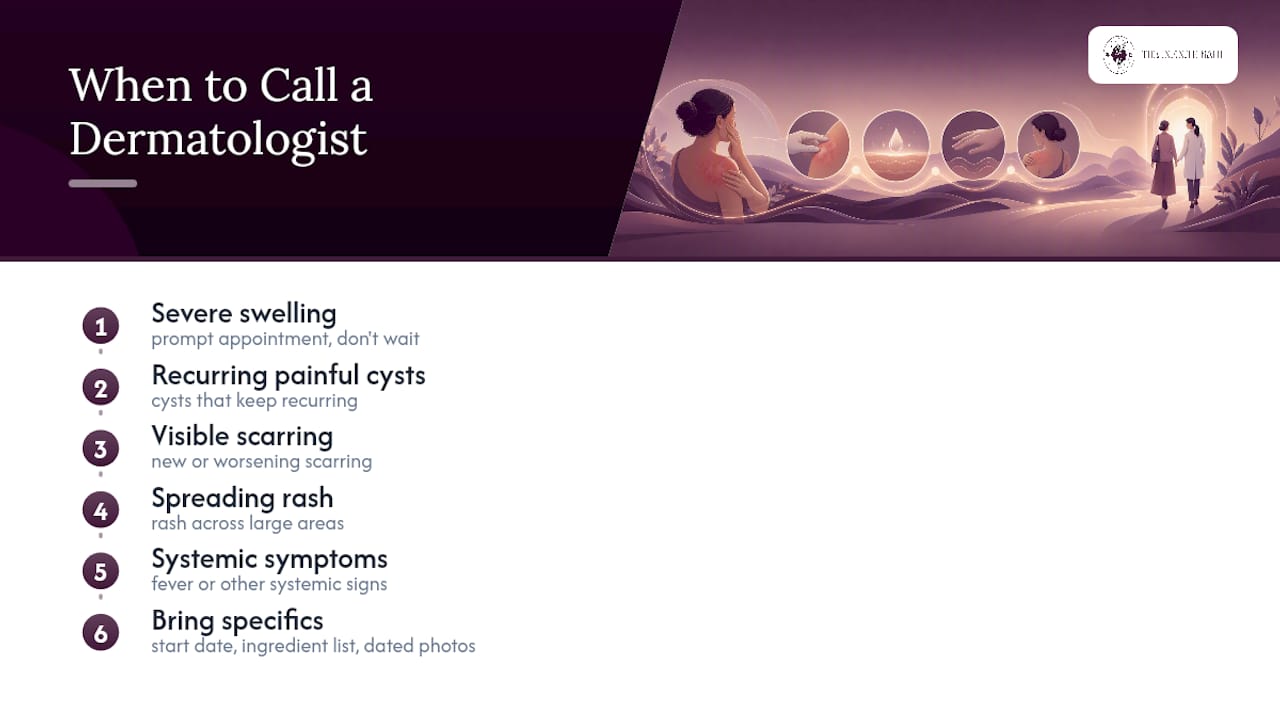
Bring the specifics: the date you started the product, its full ingredient list, dated photos, any recent routine changes, and whatever you have already tried at home. Clinicians typically examine the pattern, ask you to stop the suspected product, and may prescribe something better suited to your skin or run a patch test if allergic contact dermatitis seems likely, a diagnostic approach that relies heavily on timing and product history.
A Gentler Path for Skin That Reacts Easily
Here's what years of reading about retinoid flare-ups and purge cycles has taught the team behind The Infinite Bath: plenty of people do not need to earn clear skin through weeks of discomfort. If your skin reacts easily, or you have been burned by an aggressive routine before, starting low and slow with genuinely mild actives beats gambling on a harsh one.
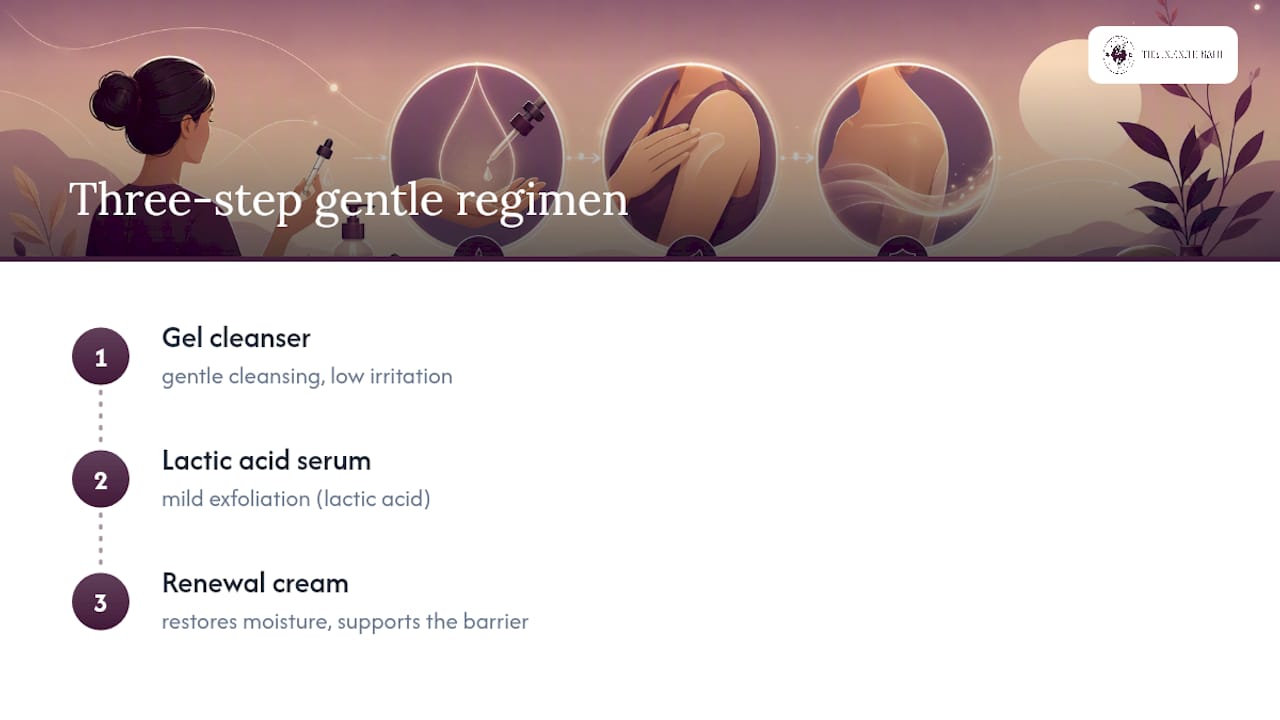
That thinking shapes The Infinite Bath's three-step regimen: a gel cleanser, a lactic acid serum, and a renewal cream, built around gentler exfoliation instead of the retinoid-driven approach that tends to trigger the purge cycle in the first place. It is not a medical treatment, and it will not promise a purge-free guarantee. It is simply a lower-friction way to work toward smoother texture and more even tone without betting your barrier on it.
— Stella
Considering a Gentler Routine Instead?
If you have decided your skin needs a break from harsh actives, The Infinite Bath's approach swaps the "power through the flare" model for gradual, barrier-friendly exfoliation from day one, so there's less guesswork about whether what you're seeing is progress or damage.

The lactic acid serum uses a milder acid than many glycolic or retinoid formulas, which supports gentle exfoliation while your moisture barrier stays intact. Pair it with the renewal cream to lock in hydration overnight, or start simpler with just the gel cleanser if you want to rebuild your routine one step at a time. Browse the full skincare shop to see how the three-step system fits into a routine that does not ask you to tolerate discomfort as proof it is working.
Where to Read More
For deeper reading on this topic, WebMD's breakdown of purging causes and timelines covers the 4 to 6 week window in detail. Healthline's clinician-sourced explainer walks through reintroduction strategies. The PubMed trial comparing adapalene and tretinoin is worth a look if you want the clinical evidence behind why formulation changes tolerability.
This article is general information, not a substitute for advice from a qualified doctor. Consult a qualified healthcare professional about your own circumstances before acting on anything here.
Sources
- Skin Purging: Causes, Signs, and Treatment — WebMD
- Comparative tolerability: adapalene vs tretinoin — PubMed
- How to tell if your skin is purging — Healthline