
Daily broad-spectrum sun protection, calming the inflammation that started the mark in the first place, and a gentle combination of proven topicals (think a retinoid, azelaic acid, and an antioxidant) form the real first line of defense. Expect gradual change over an extended period, not days, and skip the harsh scrubbing. If marks are widespread, deeply pigmented, or not budging after consistent topical care, that's your cue to see a dermatologist.
TL;DR:
- Using a combination of retinoids, azelaic acid, and antioxidants with daily sun protection accelerates fading without over-aggressive treatments.
- Consistent application of ingredients in the correct order and buffering with moisturizer prevents irritation and maintains skin barrier health.
- Professional procedures like peels or lasers are only suitable when topical treatments fail after several months of diligent, carefully planned care.
- Active inflammation must be addressed first, as ongoing breakouts or irritations will continually regenerate pigmentation regardless of topical use.
Table of Contents
- Post-Inflammatory Hyperpigmentation Skincare: The Ingredients That Actually Work
- How to Build a PIH-Safe Skincare Routine Without Backfiring
- Why You Have to Treat the Underlying Inflammation First
- How Long Does It Actually Take to Fade Dark Marks?
- When Peels and Lasers Make Sense, and When They Backfire
- Sunscreen and Daily Habits That Prevent New Dark Marks
- What I Think Most Advice Gets Wrong About Dark Marks
- Why a Simpler Routine Fits This Approach
- Sources
Post-Inflammatory Hyperpigmentation Skincare: The Ingredients That Actually Work
I want to say this plainly, because so many people get talked into overcomplicating it: you don't need ten serums to fade a dark mark. You need a handful of proven ingredients, used consistently, in the right order. Think of your skin's outer layer like a brick and mortar wall. The bricks are your skin cells, the mortar is the lipid barrier holding them together, and every one of these ingredients either helps rebuild that wall or, if you overdo it, chips away at it. The goal is fading pigment without tearing down the wall in the process.
Retinoids remain the most studied category for post-inflammatory hyperpigmentation, or PIH as it's known clinically. Tretinoin, adapalene, and over-the-counter retinol all work by speeding up how quickly pigmented skin cells cycle out and get replaced with fresh ones. Tretinoin is the strongest of the three and typically requires a prescription; adapalene sits in the middle; retinol is the gentlest and most forgiving for beginners. The tradeoff is real: the stronger the retinoid, the higher the chance of redness, flaking, and the exact irritation that can trigger new dark marks. This is the paradox that trips up so many people trying to self-treat.
Azelaic acid deserves more attention than it usually gets. Used at 15 to 20 percent concentrations, it works on both the inflammatory acne that causes PIH and the pigment itself, which makes it a genuine two-for-one. It's also considered one of the safer options during pregnancy, when so many other actives get taken off the table.
Hydroquinone is still the ingredient with the longest clinical track record for lightening stubborn marks, but it's not meant for indefinite daily use. Guidance generally calls for time-limited courses, and when it's paired with a topical steroid in combination formulas, that steroid component is typically capped at two to four weeks to avoid thinning the skin. This is one to use under professional guidance rather than pulling off a shelf and using indefinitely.
Glycolic acid and salicylic acid bring exfoliation into the mix, and exfoliation matters because it helps clear out pigmented, dead skin cells faster. Glycolic acid in the 10 to 20 percent range is the commonly cited window for meaningful benefit without excessive stinging. Salicylic acid, being oil soluble, tends to be the better pick if acne is still active alongside the pigmentation.
Antioxidants and brighteners like vitamin C, niacinamide, and kojic acid don't typically drive dramatic change on their own, but they support the harder-working ingredients around them. Vitamin C interferes with melanin production and fights the oxidative stress that keeps inflammation simmering. Niacinamide calms and reinforces the barrier. Kojic acid inhibits the same enzyme pathway as hydroquinone, just more gently.
Here's the finding that should shape your entire routine: combination therapy consistently outperforms monotherapy for PIH. A retinoid paired with a pigment inhibitor and an antioxidant works through several mechanisms at once, cutting melanin production while accelerating turnover and defending against the oxidative triggers that keep restarting the cycle. That's genuinely different from using one strong ingredient and hoping it does all the work.
How to Build a PIH-Safe Skincare Routine Without Backfiring
The order you apply products in matters almost as much as which products you choose. Get the sequence wrong and you can turn a helpful ingredient into an irritant.
- Cleanse gently. A mild, non-stripping gel or cream cleanser removes debris without disturbing the barrier you're trying to protect.
- Address any active inflammation first. If there's an acne lesion or eczema flare happening right now, that gets treated before you layer on pigment correcting ingredients.
- Apply your active serum. Retinoids go on at night; azelaic acid and vitamin C can typically go on morning or night depending on the formula.
- Moisturize. This step isn't optional padding. It's what keeps actives from tipping into irritation.
- Finish with sunscreen every morning, rain or shine. No exceptions here; this step protects everything you just did.
If that sequence sounds almost too simple, that's the point. The most common mistake I see isn't under-treatment, it's over-treatment. Piling on a strong retinoid, a glycolic acid toner, and a vitamin C serum in the same week, all at full strength, sets off what dermatology guidance calls a cycle of irritation: the actives cause micro-inflammation, which then produces fresh pigment, which prompts people to add even more actives. It's a loop that feeds itself.
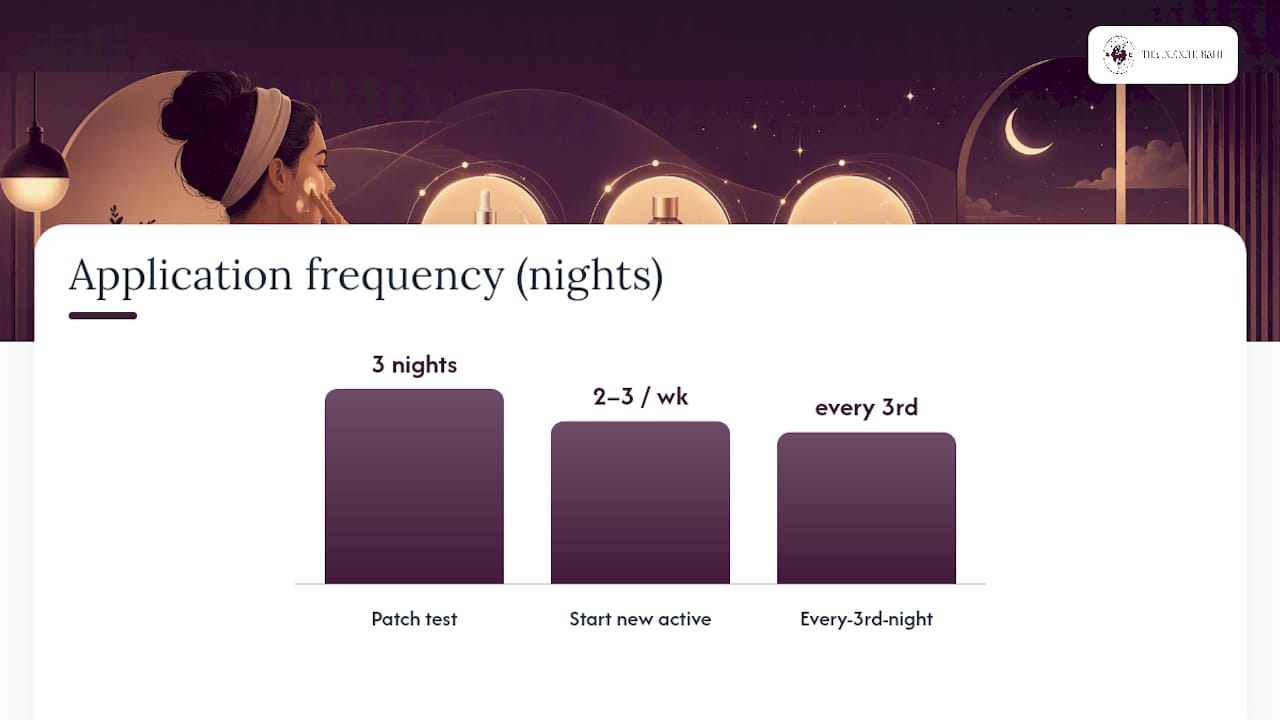
Buffering breaks that loop. Apply moisturizer first, then your active over it, to soften the delivery. Alternate nights between actives instead of stacking them. Cut frequency to two or three nights a week when you're starting something new, then build up slowly as your skin tells you it's ready.
Patch testing isn't a formality, it's your early warning system. Apply a small amount of any new product to the inner forearm or just behind the ear for three consecutive nights before it goes anywhere near your face. Watch for burning, stinging that doesn't fade within a minute, or visible redness the next day. If your skin stays calm, introduce it to one small facial area for a week before going all in.
Pro Tip: Start any new active at half strength or every third night, whichever your product allows. It's far easier to build tolerance slowly than to calm down skin that's already reacting.
Pregnancy changes this calculus. Hydroquinone, retinoids, and high-strength salicylic acid are generally advised against during pregnancy, while azelaic acid and gentle exfoliants tend to stay on the approved list. If you're pregnant or nursing and dealing with post-acne marks, a pregnancy-safe skincare routine built around gentler actives will get you results without the guesswork.
For a broader look at protecting the barrier while you exfoliate, a sensitive skin routine framework applies directly here, since PIH-prone skin and reactive skin need the same careful hand.
Why You Have to Treat the Underlying Inflammation First
Here's a mistake I see constantly: someone spends months applying brightening serums to old marks while a fresh breakout keeps generating new ones right next to them. It's like repainting a wall that has an active leak behind it. The paint never has a chance.
Clinical guidance is direct on this point: PIH will keep regenerating as long as the inflammatory trigger, whether that's acne, eczema, or folliculitis, remains active. Treating the pigment without treating the cause is chasing a symptom while ignoring its source.
So how do you know if over-the-counter care is enough, or if you need a dermatologist? A few signals point toward professional care:
- Multiple active lesions appearing weekly rather than occasionally
- Breakouts spreading to new areas of the face, chest, or back
- Deep, painful, or cystic lesions that carry high scarring risk
- No improvement in the underlying skin condition after six to eight weeks of consistent OTC care
Hormonal acne flares are a common culprit worth naming specifically, since cyclical breakouts around your period can quietly restart the PIH cycle every month even when your routine hasn't changed. Understanding why skin breaks out during your cycle can help you anticipate and manage those flares before they leave new marks behind.
Behavior matters just as much as products here. Picking, popping, or aggressively scrubbing an active lesion is one of the most reliable ways to guarantee a dark mark forms. Gentle cleansing, non-comedogenic moisturizers, and keeping your hands off your face during a flare are unglamorous habits, but they do more to prevent new PIH than any serum on the market.
How Long Does It Actually Take to Fade Dark Marks?
Set your expectations now, because this is where most people quit too early. Meaningful resolution of PIH typically takes months to years of consistent treatment, not the two or three weeks many product labels imply.
That said, you shouldn't feel like you're shouting into a void the entire time. Early signs of improvement, a slight lightening at the edges of a mark or a mark that's stopped getting darker, often show up somewhere around the eight to twelve week mark with consistent use. That's your checkpoint. If you see nothing at all by twelve weeks, it's worth reassessing your routine or getting a professional opinion rather than pushing forward blindly.
Depth of pigment is the biggest variable in how fast things move. Marks sitting in the epidermis, the outermost layer of skin, respond well to topical treatment because those pigmented cells naturally shed and get replaced. Marks that have settled deeper into the dermis are a different story; they respond more slowly to topicals and often carry a higher risk of relapse, which is one reason a dermatologist's exam, sometimes using a Wood's lamp to assess depth, matters for marks that feel stuck.
If you're improving, even slowly, the move is to stay consistent rather than escalate. Piling on stronger ingredients out of frustration is exactly how the cycle of irritation restarts. If you're truly plateaued after several months of a well-buffered routine, that's the moment to talk to a dermatologist about prescription-strength options or procedural care.
When Peels and Lasers Make Sense, and When They Backfire
Procedures aren't the first move for PIH. They're the backup plan for marks that topical care hasn't resolved, and global consensus guidelines are explicit that topical therapy should be tried first, with procedures reserved for recalcitrant cases.
- Chemical peels using glycolic, salicylic, or trichloroacetic acid work by controlled exfoliation, removing pigmented surface layers faster than skin would shed on its own. The risk runs in direct proportion to the peel's strength: a superficial glycolic peel is fairly low risk, while a deeper TCA peel can itself trigger new PIH if the skin reacts to the injury.
- Lasers and IPL can produce excellent results, and a systematic review found that laser treatment achieved complete resolution in a subgroup of patients, but the same review noted cases where laser treatment made pigmentation worse. Low-fluence Nd:YAG and picosecond lasers tend to carry lower PIH risk than older, more aggressive devices, but outcomes depend heavily on the practitioner's skill and experience with darker skin tones specifically.
- Microneedling can help with texture and mild pigment, but the micro-injury it creates is itself a form of controlled inflammation, meaning it carries the same PIH risk as any other injury to skin prone to reacting this way.
One detail that gets skipped in a lot of consumer advice: priming the skin with topical lighteners like hydroquinone or azelaic acid for several weeks before a procedure meaningfully lowers the risk of post-procedure PIH. If you're considering any procedural treatment and have a history of PIH or a deeper skin tone, ask your provider whether pre-treatment priming is part of the plan. If it isn't being mentioned, that's worth a second opinion.
The through line across all of this: aggressive, one-size-fits-all procedures are exactly what turns a manageable mark into a worse one. This is a category where more intense isn't automatically better, and finding a practitioner experienced with skin of color specifically changes outcomes.
Sunscreen and Daily Habits That Prevent New Dark Marks
If you fix nothing else in your routine, fix this: sunscreen isn't optional maintenance for PIH, it's part of the active treatment. Ultraviolet exposure stimulates the same pigment producing cells that are already in overdrive from the original inflammation, and unprotected sun exposure can undo months of progress in an afternoon.
- Choose broad-spectrum SPF 30 to 50 or higher, and apply it as the last step of your morning routine, every single day, including cloudy days and days spent mostly indoors near a window.
- Use about a quarter teaspoon for your face alone, and reapply roughly every two hours during real sun exposure, more often if you're sweating or swimming.
- Reach for a tinted sunscreen or one containing iron oxide if you have a deeper skin tone, since visible light, not just UV, contributes to worsening pigmentation, and iron oxide formulations specifically block that visible light spectrum in a way plain mineral sunscreens don't.
- Treat flares the moment they start, rather than waiting to see if a breakout resolves on its own, since every extra day of active inflammation is another day of pigment production.
The behavioral side matters just as much as the bottle you choose. Friction from tight masks, rough towels, or habitually touching your face can quietly reignite inflammation in skin that's already sensitized. So can switching products too frequently, chasing the next trending ingredient before your skin has settled from the last one. Consistency, unglamorous as it sounds, is the actual active ingredient here.
What I Think Most Advice Gets Wrong About Dark Marks
Most content on this topic treats PIH like a pigment problem you solve by adding more brightening products. That's backwards. PIH is fundamentally an inflammation problem with a pigment symptom, and the industry's instinct to sell you five new serums works directly against the calm, consistent care your skin actually needs.
The conventional wisdom of "stronger is better" is where I'd push back hardest. A review of outcomes in skin of color shows aggressive procedures sometimes worsen the exact marks they're meant to fix. That should reframe how you think about your daily routine, not just your dermatology visits.
If I had to prioritize one thing for readers, it's this: fewer products, applied more consistently, beats a crowded shelf used inconsistently. A cleanser, one well-chosen active serum, a barrier-supporting moisturizer, and daily sunscreen will outperform a nine-step routine that irritates skin every third day. Simplicity isn't a compromise here. It's the strategy the evidence actually supports.
— Stella
Why a Simpler Routine Fits This Approach
If the sequence in this guide: cleanse, treat inflammation, apply an active, moisturize, protect, sounds familiar, that's because it maps closely to how The Infinite Bath built its own three-step regimen. The gel cleanser handles that first gentle step without stripping the barrier you're trying to protect. The lactic serum offers a milder alternative to harsher acids, supporting cell turnover at a strength formulated to avoid the micro-inflammation that restarts the PIH cycle. The renewal cream closes the routine by reinforcing the exact barrier function this guide keeps circling back to.
None of this replaces a dermatologist for deep, dermal-level pigment or marks that haven't budged after months of consistent care. What a simplified regimen does offer is fewer opportunities to overdo it, which, as the research throughout this guide shows, is often the real obstacle standing between someone and clearer skin. If your routine currently has more steps than you can consistently keep up with, that's worth changing before you change your ingredients. Browse the full skin care shop to see how the three-step approach comes together, and start with the cleanser, serum, and cream as your foundation before adding anything else.
This article is general information, not a substitute for advice from a qualified doctor. Consult a qualified healthcare professional about your own circumstances before acting on anything here.
Sources
- Postinflammatory hyperpigmentation - StatPearls - NCBI Bookshelf
- Treatment evidence summary for PIH (systematic/clinical review)
- How to fade dark spots in darker skin tones — AAD patient guidance