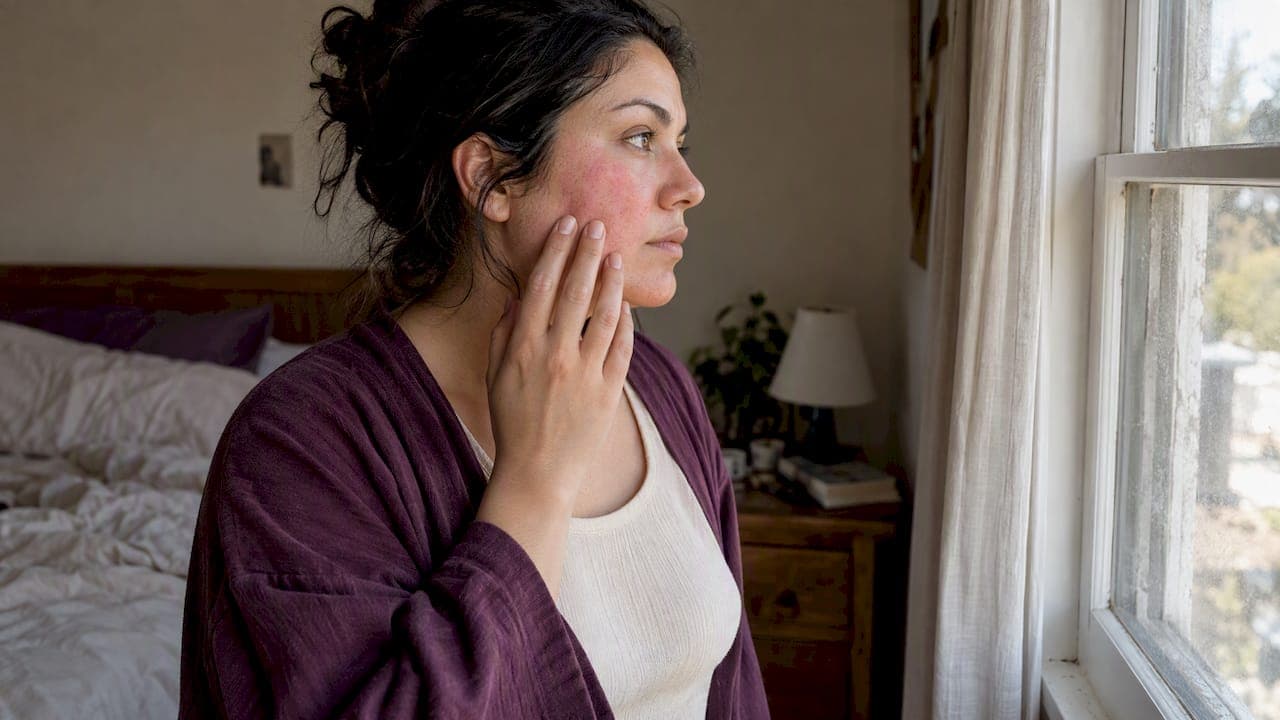
Your skin feels tight, red, and angry, and you're wondering if you've damaged it for good. This is almost always retinoid irritation, not a true burn, and the fix starts now: stop the retinol, strip your routine down to the basics, and shield your skin from the sun. Most mild reactions start calming down within about a week. If you see blistering, swelling, or a rash spreading beyond where you applied the product, that's your cue to call a dermatologist.
TL;DR:
- Most retinoid irritation improves within one to two weeks after halting retinol and minimizing active ingredients in your routine.
- Using high concentrations, applying retinol frequently, or combining it with exfoliating acids increases the risk of irritation, especially for sensitive skin or conditions like eczema.
- During recovery, avoid active ingredients, use gentle cleansers and moisturizers, and always wear broad-spectrum SPF 30 or higher to support healing and prevent further damage.
- Reintroduce retinol gradually at low strength and frequency, buffering with moisturizer, and test new products on a small skin area before full use to rebuild tolerance safely.
- Seek medical attention if blistering, spreading rash, severe swelling, or other systemic symptoms occur, rather than waiting for natural resolution.
Table of Contents
- What does retinol burn actually look like?
- Why does retinol cause this kind of irritation?
- Your first 48 hours: stop, soothe, and protect
- What healing actually looks like, week by week
- How to rebuild tolerance without repeating the burn
- When it's time to call a dermatologist
- What years of working with reactive skin has taught me
- A gentler way back to your routine
- Sources
- FAQ
What does retinol burn actually look like?
I've sat across from plenty of clients who came in convinced they'd ruined their skin. What they usually had was a textbook case of retinoid irritation: skin that's overwhelmed, not injured beyond repair. MedlinePlus lists the common symptoms of topical retinoid reactions, and they tend to show up within days to a few weeks of starting or increasing a retinol.
Here's what tends to show up together:
- Stinging or a burning sensation right after application
- Redness that can range from a light flush to deep, angry patches
- Dryness, flaking, or rough texture that feels like sandpaper
- A tight, stretched feeling, especially after cleansing
A quick way to check where you stand: does a bland, fragrance-free moisturizer sting when you apply it? If it does, your barrier is compromised and needs quiet time. If instead you notice blistering, a rash spreading well past the treated area, severe swelling, hives, or you're feeling unwell in a broader sense, that's not typical retinoid irritation anymore, and it deserves prompt medical attention.
Why does retinol cause this kind of irritation?
Think of your skin's outer layer as a brick wall, with skin cells as the bricks and lipids as the mortar holding everything together. Retinol works by speeding up how quickly your skin cells turn over, which is fantastic for smoothing texture and fading discoloration over time. But that acceleration comes at a cost if it happens too fast.
A peer-reviewed review of cosmetic retinoid use explains that retinoids can weaken the cohesion between skin cells and disrupt the lipids that make up that mortar. When the mortar thins out, water escapes through the wall faster than it should, a process called transepidermal water loss. That's the dryness, tightness, and stinging you're feeling: your wall is temporarily short on mortar.

Some people are more likely to hit this wall than others. Using a high concentration, applying too often, or pairing retinol with other exfoliating acids or benzoyl peroxide all raise the risk. If you already live with eczema or rosacea, your barrier starts out thinner than most, which means it has less room for error.
Your first 48 hours: stop, soothe, and protect
The first two days set the tone for how quickly you bounce back. Treat this like damage control, not a time to experiment with new products.
- Stop every retinol, acid, and exfoliating product immediately, even ones that felt fine before.
- Cleanse with a gentle, pH-balanced, non-foaming cleanser, and skip anything with alcohol or physical scrubbing beads.
- Apply a bland, fragrance-free moisturizer while your skin is still damp from cleansing to help lock in water.
- For more intense dryness, layer on a thick, fragrance-free emollient or plain petrolatum to create a protective seal.
- Use a cool, damp compress for a few minutes if your skin feels hot or itchy, but keep ice away from bare skin.
- Wear broad-spectrum SPF 30 or higher every morning, and add a hat or shade when you can, since newly turned-over skin sunburns more easily.
Pro Tip: Keep your evening routine down to cleanser and moisturizer only for at least a few days. Adding anything else, even something marketed as "soothing," risks restarting the irritation cycle.
If discomfort is significant, a short course of over-the-counter hydrocortisone or an oral antihistamine can help, but check with a pharmacist or your prescriber before using either for more than a few days.
What healing actually looks like, week by week
Recovery isn't instant, but it's rarely as slow as people fear. Healthline notes that visible redness and flaking in mild cases often start improving within about one to two weeks of stopping the irritant. Deeper barrier repair, especially if you have naturally reactive skin or eczema, can take closer to two to four weeks.
Your daily routine during this stretch should feel almost boring:
- Cleanse once or twice a day with something gentle, never anything that foams aggressively or smells strongly
- Moisturize generously and often, reapplying anytime your skin feels tight
- Skip every active ingredient, including vitamin C, exfoliating acids, and fragrance, until your skin tolerates plain moisturizer without stinging
- Apply sunscreen every single morning, since sun exposure on compromised skin slows healing and raises the risk of lingering discoloration
Watch for less redness day over day and fewer flakes when you touch your face. Two mistakes commonly stall progress: over-exfoliating in an attempt to "fix" the flaking, and jumping to a new active ingredient before the old irritation has fully settled. Makeup can usually return once your skin no longer stings with plain moisturizer. When you do reintroduce it, choose mineral-based, fragrance-free formulas and apply with clean fingers rather than a brush that might drag on sensitive spots.
How to rebuild tolerance without repeating the burn
Once your skin has fully calmed down, going back to retinol doesn't have to mean gambling with another flare-up. The American Academy of Dermatology recommends a low-and-slow approach: start with the mildest form available and build up gradually rather than resuming at your old frequency.
- Restart with the lowest-strength retinol you can find, applied just once or twice a week.
- Increase frequency only after several uses pass with zero stinging or peeling, working toward every other night before nightly use.
- Try buffering: apply a moisturizer first, then the retinol over it, to soften the initial contact with your skin.
- Patch test any new or reformulated product on your jawline or inner arm for a week before applying it to your whole face.
- Consider a gentler alternative, like a lactic acid—based exfoliant, or look for retinol formulas using encapsulation or added emollients, which recent formulation research links to lower irritation.
MedlinePlus is clear that tolerance should be judged by how your skin actually responds, not by counting days on a calendar. If a bland moisturizer still stings, you're not ready to reintroduce anything stronger.
When it's time to call a dermatologist
Most retinoid irritation resolves with rest and patience, but certain signs mean you shouldn't wait it out. Contact a dermatologist or your prescriber if you notice blistering, intense or worsening pain, a rash spreading well beyond the treated area, swelling around your eyes or face, hives, fever, or any difficulty breathing.
If you're using a prescription retinoid or isotretinoin, always loop in the prescriber rather than trying to manage a bad reaction alone. Depending on severity, a clinician might recommend a short course of topical corticosteroids, a calcineurin inhibitor, or in rare, more severe cases, a brief oral treatment to calm the reaction.

What years of working with reactive skin has taught me
Most people treat a retinol reaction as a failure of willpower, like they just couldn't handle it. I see it differently. Your skin gave you honest feedback, and the fastest way back to healthy skin is listening to that feedback instead of pushing through it.
This philosophy is built around real ingredients and simple routines precisely because so many people are dealing with the aftermath of doing too much, too fast. A few things I come back to with every client recovering from irritation:
- Barrier repair always comes before active ingredients, no exceptions.
- Lactic acid tends to be far gentler than retinol while still supporting texture and tone.
- A simplified routine removes the guesswork that leads people back into irritation in the first place.
— Stella
A gentler way back to your routine
If you're tired of guessing which product will calm your skin down without undoing your progress, our Lustral Flood Collection was built around exactly that problem: a gel cleanser, a lactic serum, and a renewal cream, all designed to work together instead of competing for your skin's attention.

The Renewal Cream in particular focuses on hydration and comfort, which is what recovering skin needs most. None of this replaces medical care. If your reaction is severe or getting worse, see a dermatologist first. If you're looking for a simple, hydration-first routine to lean on while your skin settles, you can shop the collection here.
This article is general information, not a substitute for advice from a qualified doctor. Consult a qualified healthcare professional about your own circumstances before acting on anything here.
Sources
- Tretinoin Topical: MedlinePlus Drug Information
- Retinol Burn: Symptoms, Causes, Treatment, and Prevention — Healthline
- Cosmetic retinoid use in photoaged skin: A review of the compounds, their use and mechanisms of action — PMC
- Retinoid or retinol? — American Academy of Dermatology
FAQ
Will a retinol burn go away on its own?
Yes, mild retinoid irritation typically resolves once you stop the product and focus on gentle care, with visible improvement often starting within about a week. Severe symptoms like blistering or spreading rash need a dermatologist rather than waiting it out.
How long do retinol uglies last?
The initial purging and irritation phase, sometimes called retinol uglies, commonly settles within two to four weeks as your skin adjusts, though this varies based on your skin's baseline sensitivity. Sticking with gentle care and avoiding other actives during this window helps it resolve faster.
What does a retinol burn look like?
It usually shows up as redness, stinging, dryness, flaking, and a tight feeling in the areas where retinol was applied, appearing within days to a few weeks of use. Blistering, significant swelling, or a rash spreading beyond the application site are not typical and warrant medical attention.
I got retinol on my lips by accident. What should I do?
Rinse the area gently with lukewarm water and apply a bland, fragrance-free lip balm or petrolatum to protect the thin skin there. If you notice significant swelling, blistering, or persistent pain, contact a healthcare provider rather than waiting for it to resolve on its own.