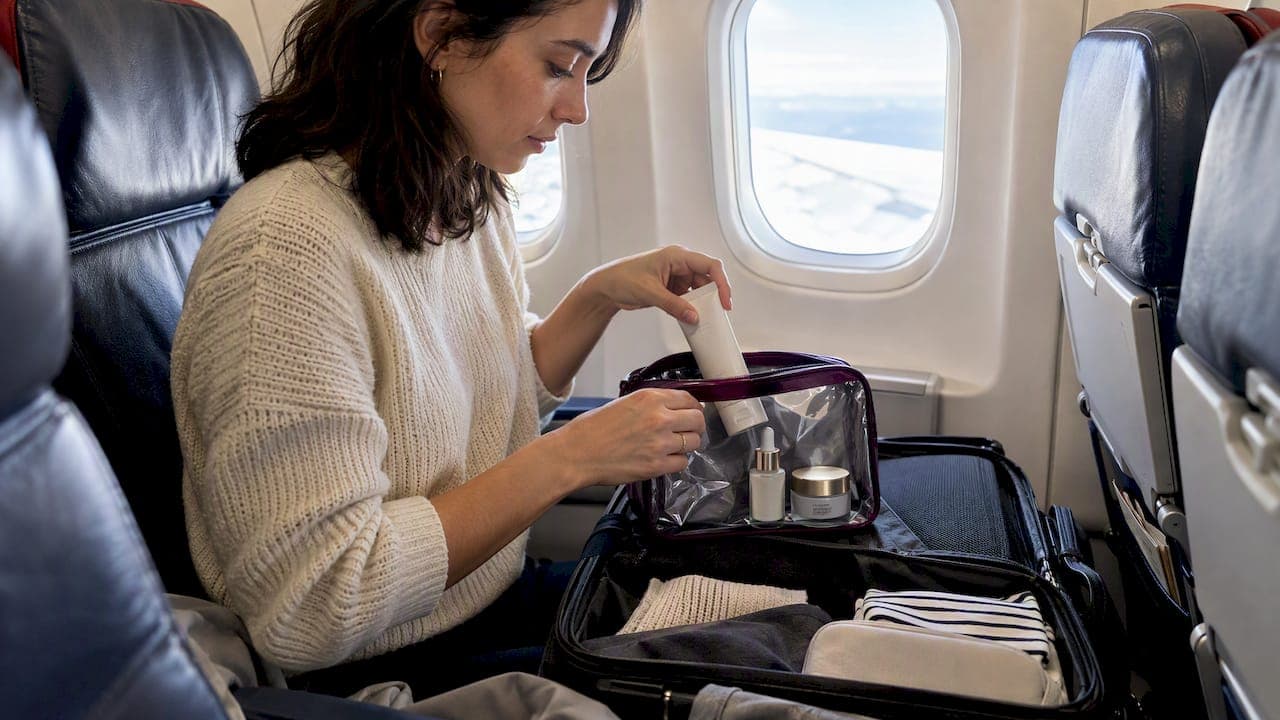
A pared-down, familiar routine built around hydration, barrier support, and sunscreen is the most reliable way to protect your skin on the road. Two rules shape everything you pack: the TSA 3-1-1 liquids rule and the American Academy of Dermatology's sunscreen guidance on broad-spectrum SPF 30 or higher.
TL;DR:
- Using a simple routine of cleanse, hydrate, and protect is essential because low cabin humidity damages skin barrier proteins after about three hours of flight.
- Packing travel-sized bottles of familiar, tested products, along with a barrier-supportive renewal cream, minimizes irritation risks caused by unfamiliar or heavy products.
- Carrying a hydrating mist, occlusive balm, and SPF stick helps maintain moisture and barrier support during long flights and in dry or high-altitude destinations.
- A three-step skincare kit designed for travel reduces decision fatigue and ensures product compatibility, especially when testing new products ahead of time.
- Drinking steadily, applying hydrating serums, and sealing with balm during flights counteract dryness, especially on trips longer than three to four hours.
Table of Contents
- The travel-ready routine that fits in a carry-on
- Packing smart within TSA rules
- What low cabin humidity does to your skin and how to counter it
- Matching your routine to where you land
- Prepping your skin before you ever pack a bag
- What to pack for skin emergencies on the road
- Why a simple three-step system travels well
- A personal note on packing light for your skin
- Travel easier with a kit built for the road
- Sources
- FAQ
The travel-ready routine that fits in a carry-on
Think of your skin barrier as a brick wall: the skin cells are the bricks, the lipids between them are the mortar. Travel chips away at that mortar, so your routine's job is to keep it intact, not to experiment.
In the morning, splash or gently cleanse, apply a humectant serum with hyaluronic acid or glycerin, follow with a barrier-focused moisturizer, then seal it all with SPF 30 or higher. At night, remove makeup, cleanse gently, use a lactic serum only if you have already tested it at home, and finish with a renewal cream or occlusive balm, especially on longer flights when air feels drier than usual.
A few swaps make this easier to carry:
- Cleansing wipes instead of a liquid cleanser for quick refreshes between flights.
- Serum and moisturizer decanted into containers under 3.4 ounces.
- A sunscreen stick for easy reapplication without spilling liquid.
- A lip balm with SPF to protect a surface people often forget.
Skip anything new here. Strong retinoids or an unfamiliar acid you have never used before can irritate skin that is already dealing with recycled cabin air and disrupted sleep.
Pro Tip: Pack one multi-use balm that can handle lips, cuticles, and dry patches. Fewer products mean fewer things to lose, spill, or react to.
Packing smart within TSA rules
The TSA 3-1-1 rule allows liquids, gels, and creams in containers of 3.4 ounces or 100 milliliters or smaller, all fitting into a single quart-sized bag per passenger. Duty-free purchases have their own exceptions, so check the paperwork before you board.
- Decant your cleanser, serum, and moisturizer into labeled, leakproof travel bottles.
- Keep medically necessary topicals separate. The TSA exempts these from the 3.4 ounce limit, but you must declare them at the checkpoint.
- Bring a printed prescription or a short note from your dermatologist for any prescription cream.
- Pack your quart bag near the top of your carry-on so it is easy to pull out at security.
A short checklist like this saves time at the checkpoint and keeps your products intact for the flight.
What low cabin humidity does to your skin and how to counter it
Aircraft cabins run drier than almost any room you will stand in on the ground. Research on low relative humidity in aircraft cabins shows this dryness affects skin and mucous membranes, with effects often noticeable after about 3 to 4 hours in the air.
A separate peer-reviewed study on barrier function found that repeated exposure to low humidity reduces barrier proteins and increases water loss through the skin. That is the mortar wearing thin.
Flights longer than 3 to 4 hours are where dryness typically becomes noticeable, according to research on cabin air quality, which is exactly when a little extra care pays off.
On the plane itself:
- Drink water steadily rather than relying on the one cup the cart brings by.
- Use a hydrating mist followed by a humectant serum rather than the mist alone, since water without something to hold it in just evaporates.
- Apply an occlusive balm on lips and any dry patches to lock moisture in.
- Save heavier actives, including exfoliants, for the ground.
Matching your routine to where you land
The right products depend on where you are headed, not just how you got there.
- In humid climates, switch to lighter gel textures, consider an oil-control step, and use a water-resistant SPF if you are swimming.
- In dry or cold destinations, layer a richer emollient over your serum and lean on an occlusive balm at night to support recovery while you sleep.
- At high altitude or under strong sun, the AAD recommends SPF 30 or higher, broad-spectrum and water-resistant, reapplied roughly every two hours, with a hat or long sleeves adding backup protection.
- On active outdoor days, a sweat-resistant sunscreen matters more than a fancy serum, and rinsing off right after activity prevents salt, chlorine, or sweat from sitting on skin too long.
Prepping your skin before you ever pack a bag
The AAD advises testing new products at home for roughly two weeks before travel, which gives you time to catch a reaction before you are stuck with it in an unfamiliar bathroom.
- Patch-test anything new at least two weeks before departure.
- Exfoliate a few days ahead rather than the night before, since fresh exfoliation can leave skin more reactive to dry air and sun.
- Pack a small safety kit: a fragrance-free cleanser, a multi-use moisturizer, a hydrating serum, a spot treatment, and a few bandaids.
That kit covers most situations without taking up much space.
What to pack for skin emergencies on the road
Minor skin flare-ups happen more on trips than at home, largely because sleep, diet, and stress all shift at once. A small kit handles most of it.
- OTC hydrocortisone for sudden irritation or bug bites.
- An antiseptic cream for small cuts or scrapes.
- Petroleum jelly for chapped lips, cracked heels, or raw skin from new shoes.
- A spot treatment for an unexpected breakout.
Carry prescription topicals in their original packaging with a printed prescription or dermatologist's note, and declare them at the checkpoint to avoid delays. If you notice spreading redness, fever, swelling, or a rash that will not calm down, that is a signal to find local medical care rather than wait it out, especially somewhere humid or unfamiliar.
Why a simple three-step system travels well
A routine built on three steps, cleanse, treat, and repair, maps directly onto what travel demands: fewer containers, fewer decisions, and nothing new for your skin to negotiate with mid-trip. Our own sensitive skin routine follows that same logic at home, which makes it easy to carry over onto the road.
- A gel cleanser can handle makeup and grime without stripping the barrier.
- A lactic serum offers gentle resurfacing, with frequency possibly eased back while traveling if skin feels more reactive.
- A renewal cream closes the routine with barrier support suited to dry cabin air.
Pro Tip: If unsure how skin will handle travel stress, consider skipping exfoliating serums the first two nights of a trip and reintroduce them once skin adjusts.
Each product may fit within TSA limits once decanted, and minimal, fragrance-free formulas reduce guesswork about what might cause a reaction far from home.

A personal note on packing light for your skin
Here is the habit I never skip: SPF and moisturizer go in my carry-on, not checked luggage. Skin under travel stress rarely needs more product, it needs less friction and more consistency.
— Stella
Travel easier with a kit built for the road
A pre-packaged three-step kit solves the exact problem travel creates: too many decisions, too many containers, and no way to know how a new product will behave until you are already away from home. The Lustral Flood Collection pairs a gel cleanser, lactic serum, and renewal cream in one system you can test at home and carry with confidence.

- One system instead of a shelf full of separate bottles to decant.
- Formulas you have already tried, so travel is not when you find out something irritates your skin.
- Barrier-first ingredients suited to the dry air and disrupted sleep that travel brings.
Explore the full skincare shop to build a travel kit around your skin's needs, or start with The Renewal Cream on its own if your current routine just needs one barrier-support step added before your next trip.
Sources
- Liquids, Aerosols, and Gels Rule | Transportation Security Administration
- American Academy of Dermatology sunscreen guidance
- Barrier function research (2025) on humidity effects
- Low Relative Humidity and Aircraft Cabin Air Quality (PubMed)
FAQ
What size containers can I bring for travel skincare?
The TSA allows liquids, gels, and creams in containers of 3.4 ounces or 100 milliliters or smaller, all packed into a single quart-sized bag per passenger. Medically necessary liquids are exempt from this limit but must be declared at the checkpoint.
Do I need sunscreen on a plane near a window?
Yes, UV rays pass through aircraft windows, so the AAD's guidance of broad-spectrum SPF 30 or higher still applies if you are seated near one. Reapplying every two hours is harder in flight, so a stick formula makes touch-ups simpler.
Is it safe to use acids like lactic acid while flying?
It is safer to stick with acids your skin already tolerates rather than introducing a new one mid-trip, since low cabin humidity can make skin more reactive. If you already use a lactic serum at home, easing back to every other night during travel is a reasonable adjustment.
How do I stop breakouts from showing up while traveling?
Keep your usual cleanser and avoid unfamiliar hotel toiletries, since dermatologists note that unfamiliar fragrance products are a common cause of travel-related irritation. Pack a small spot treatment for anything that does break through, and keep hands off your face as much as possible on planes and trains.
What is the biggest cause of dry skin after a flight?
Low cabin humidity is the main driver, with research showing that dryness often becomes noticeable after flights of about 3 to 4 hours or longer. Drinking water steadily and layering a humectant serum under a moisturizer during the flight helps counter it.