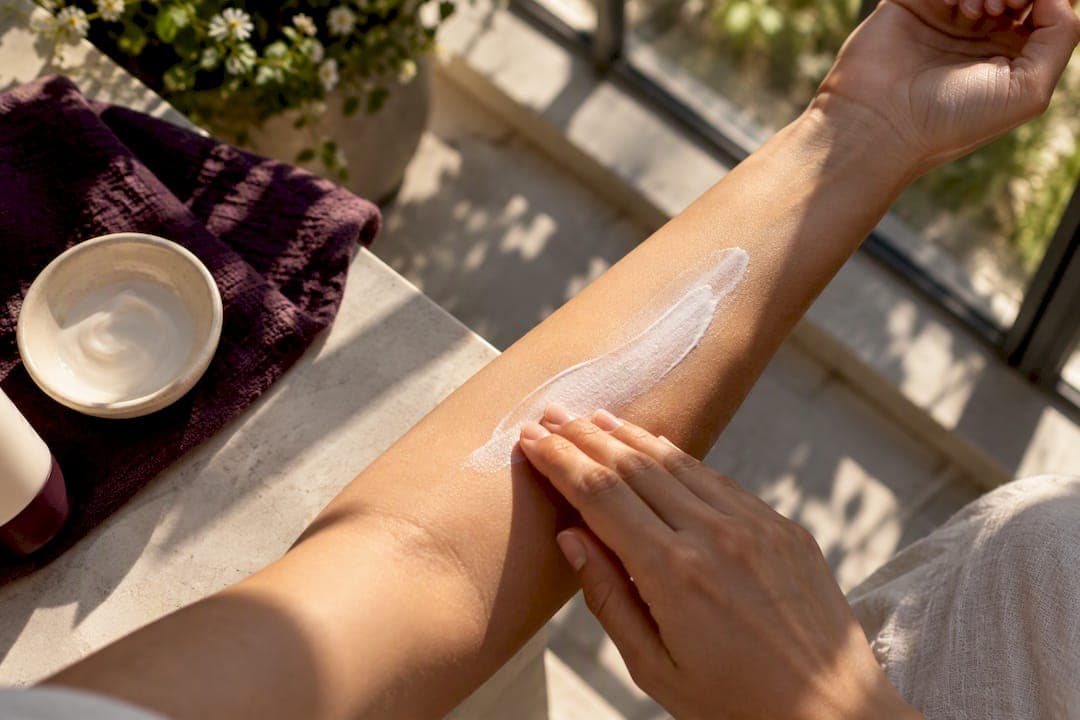
Yes, lactic acid can raise your skin's sensitivity to sunlight while you use it and for about a week after you stop, according to FDA guidance on AHA labeling. The fix is simple: daily broad-spectrum SPF, a hat or shade during peak hours, and a formula under 10% lactic acid. A low-percentage lactic serum is one practical starting point if you want gentler exfoliation without the guesswork.
TL;DR:
- Using lactic acid increases sun sensitivity for up to a week after stopping, so consistent daily sun protection is essential even on non-application days.
- Products with higher pH, lower percentages, and buffering agents tend to be gentler, reducing the risk of irritation and sensitivity.
- Starting with a low percentage, patch testing, and gradual frequency build-up helps minimize adverse reactions and overexposure.
- Layering multiple actives like retinoids or stronger acids on the same night can overwhelm the skin barrier and heighten UV vulnerability.
- Fair skin, recent resurfacing treatments, or existing skin conditions like eczema or hyperpigmentation require extra caution and possibly professional guidance before using lactic acid.
Table of Contents
- How lactic acid changes your skin and why the sun notices
- What the FDA, CIR, and clinical research actually recommend
- How long the sensitivity lasts and signs you're overdoing it
- Who faces higher risk and when to check with a dermatologist first
- Safe-use rules that let you keep the benefits without the burn
- Sun protection habits that actually prevent burns and dark spots
- Combinations to avoid and how to sequence your actives
- How The Infinite Bath approaches lactic acid safely
- Why I keep telling clients to slow down
- A gentler way to work lactic acid into your routine
- Sources
- FAQ
How lactic acid changes your skin and why the sun notices
Think of your skin's outermost layer, the stratum corneum, as a coat of paint over the brick and mortar wall underneath. That paint job is what deflects a lot of incoming UV light before it ever reaches living cells. Lactic acid works by loosening the bonds between dead skin cells so they shed faster, which is exactly why it smooths texture and fades dullness. But thinning that outer layer, even gently, means less paint standing between the sun and your skin.
Researchers have measured this directly. Short-term topical AHA use, in some studies as brief as four days, lowered subjects' minimal erythema dose, the smallest amount of UV needed to cause visible redness, and increased sunburn cell formation in treated skin, according to a peer-reviewed review of hydroxyacid formulations. A separate clinical trial found that pretreating skin with glycolic acid increased UVB and UVA induced tanning compared to untreated sites, and it happened even in people who showed no visible irritation, according to a study published in the Journal of the American Academy of Dermatology93488-8). No stinging, no redness, just quietly more sun exposure getting through.
Here is the part that matters for how you shop: not every lactic acid product behaves the same way on your skin. Formulation, pH, and vehicle (the base the acid is suspended in) all shift how much sensitivity you actually experience. A well-buffered, moisture-rich formula at a higher pH tends to be gentler than a low-pH, alcohol-heavy one, even at similar percentages. That is why reading a percentage on a label only tells you part of the story, something we dig into further in our comparison of lactic acid and glycolic acid.

What the FDA, CIR, and clinical research actually recommend
You do not have to take anyone's word for this. Regulatory bodies and researchers have been tracking AHA sun sensitivity for decades, and their guidance is consistent enough to build a routine around.
The FDA's guidance on AHA labeling states that topical alpha hydroxy acids may increase skin sensitivity to the sun while a product is in use, and for up to one week after you stop, which is why the agency recommends manufacturers include a prominent Sunburn Alert along with advice to use sunscreen, wear protective clothing, and limit sun exposure. That one-week window is worth remembering: stopping your lactic serum the morning of a beach trip does not undo the sensitivity by lunchtime.
The Cosmetic Ingredient Review's safety assessment concluded that glycolic and lactic acid are safe for consumer use in cosmetics at concentrations at or below 10%, with a final formula pH of 3.5 or higher, or with daily sun protection directions included on the label. The panel also noted that something as small as an SPF of around 2 built into a formula, or a more reflective vehicle, could eliminate the measurable increase in UV markers seen in some studies. That is a meaningful detail: it suggests the risk is manageable, not a reason to avoid lactic acid altogether.
Put together, the guidance boils down to a short list:
- Choose retail leave-on products at or below 10% lactic acid with a pH of 3.5 or higher.
- Treat the Sunburn Alert on the label as a real instruction, not fine print.
- Assume sensitivity lingers for about a week after your last application.
- Pair any AHA use with daily sun protection, not just on days you remember.
None of this is exclusive to prescription-strength treatments. It applies just as much to the gentle exfoliating serum sitting in your bathroom cabinet.
How long the sensitivity lasts and signs you're overdoing it
Most people's skin returns to its normal UV tolerance within roughly a week of stopping lactic acid, matching the FDA's labeling guidance on how long increased sensitivity can persist. That said, individual variability is real. Clinical data show some people barely register a change while others react noticeably more, which is part of why a slow, personalized approach beats jumping straight to daily use, a pattern we also cover in our lactic acid versus salicylic acid guide.
If you are unsure whether your skin is handling lactic acid well, watch for these signals in order of severity:
- Mild stinging or tightness right after application that fades within minutes is common and usually not a red flag.
- Redness that lingers for hours, rather than settling within thirty minutes, suggests you are using it too often or at too high a concentration.
- Blistering, peeling beyond light flaking, or visible new dark patches means stop immediately and give your skin a break.
- Hyperpigmentation that seems to be getting darker despite consistent sunscreen use warrants a conversation with a dermatologist.
If you hit stage three or four, pause the product, protect the area from further sun exposure, and keep your routine simple with a gentle cleanser and a fragrance-free moisturizer while things calm down. Severe or lingering reactions deserve a professional opinion rather than trial and error.
Who faces higher risk and when to check with a dermatologist first
Fair skin types tend to show sun sensitivity more visibly and sooner than deeper skin tones, simply because there is less natural melanin buffering the effect. If you have recently had in-office resurfacing, whether a chemical peel, microneedling, or laser treatment, your barrier is already compromised, and layering lactic acid on top asks a lot of skin that is still recovering. The same caution applies if you deal with chronic barrier issues like eczema or rosacea, or if you take medications known to increase photosensitivity, since the combined effect can be greater than either factor alone.
Melasma and post-inflammatory hyperpigmentation deserve their own note. Because AHAs can transiently increase UV-induced tanning even without irritation, using lactic acid on skin already prone to pigmentation can work against you if sun protection slips even slightly. Some people with melasma do fine with a low-percentage, well-buffered formula and disciplined sunscreen use, while others are better off avoiding AHAs during active flare-ups or using them only under a clinician's guidance. If you fall into any of these categories, a quick conversation with a dermatologist before starting is worth more than guessing.
Safe-use rules that let you keep the benefits without the burn
Getting the benefits of lactic acid without inviting sun damage comes down to a handful of habits, not a complicated protocol.
Start with the product itself. Look for a leave-on formula at or below 10% lactic acid with a pH of 3.5 or higher, and lean toward the lower end of that range if your skin is reactive or you are new to acids. Our guide to sub-10% lactic acid routines walks through how to read a label for this. Do not assume a rinse-off cleanser gets you off the hook: even a short contact time is enough to trigger the exfoliation effect that alters your skin's UV response, per FDA guidance, so sun protection still applies on cleanser-only days.
Introduce it slowly. Patch test on a small area of skin, like the inside of your forearm, for two to three nights before applying it to your face. If nothing unusual happens, start with once or twice a week and build up gradually as your skin tolerates it, rather than diving into nightly use. Apply lactic acid at night, when UV exposure is not a factor and your skin has hours to work through the exfoliation process undisturbed.
Be deliberate about what you layer it with. Using a strong exfoliant or retinoid the same night as your lactic serum compounds the barrier disruption, so alternate nights if you use both. Keep your barrier supported with a hydrating cleanser, rather than a stripping one, and follow up with a ceramide-rich moisturizer to help lock in moisture while the acid does its work.
- Patch test for two to three nights before applying anywhere else.
- Start at one to two uses per week and increase only if your skin tolerates it well.
- Apply at night and avoid stacking with retinoids or other strong acids the same evening.
- Follow with a ceramide or moisture-rich cream to support your barrier.
If you notice ongoing redness, stinging that does not fade, or peeling beyond light flaking, stop using the product and give your skin a week or two to recover before trying again at a lower frequency.
Pro Tip: Keep a small notebook or phone note of when you introduce a new active and how your skin responds. Patterns show up faster than memory does.
Sun protection habits that actually prevent burns and dark spots
Sunscreen choice matters more once you are using an AHA regularly. Mineral sunscreens built on zinc oxide or titanium dioxide are generally recommended for sensitive skin, according to the American Academy of Dermatology's guidance on sunscreen labels, because they sit on top of skin rather than being absorbed into it.
A few habits make the biggest difference:
- Apply a broad-spectrum SPF 30 or higher every morning, rain or shine, since UV rays pass through clouds.
- Reapply about every two hours, or sooner after swimming or heavy sweating, following standard AAD guidance.
- Add clothing, a wide-brim hat, or shade during the middle of the day when UV intensity peaks.
- Continue daily sunscreen for roughly a week after you stop using lactic acid, matching the sensitivity window noted in FDA labeling guidance.
Even a modest SPF of around 2 built into a formula can offset the measurable UV sensitivity increase seen in some AHA studies, according to the Cosmetic Ingredient Review's safety assessment. That is a small buffer with a real effect, and it is part of why pairing your acid routine with a proper sunscreen, not just a moisturizer with a token SPF, is worth the extra step.
Cumulative exposure adds up quietly. A few unprotected afternoons here and there can undo weeks of careful exfoliation work, since the hyperpigmentation that lactic acid is often used to fade is itself triggered by UV exposure. Treat sun protection as the other half of the routine, not an optional add-on.
Combinations to avoid and how to sequence your actives
Layering too many actives in one night is one of the most common ways people turn a gentle routine into an irritated one. Retinoids and lactic acid both work on cell turnover, and stacking them the same evening can overwhelm your barrier faster than either one alone. The same goes for pairing lactic acid with stronger acids like glycolic or salicylic, or with physical scrubs, on the same night.
A safer approach is sequencing rather than stacking:
- Alternate nights between lactic acid and retinoids rather than using both together.
- If you want to introduce vitamin C alongside lactic acid, ease into it gradually. Our twelve-week layering plan walks through a clinician-informed pace.
- Skip additional physical or chemical exfoliants on nights you use lactic acid.
- If you are getting professional peels or resurfacing treatments, pause at-home acids beforehand and check with your provider on timing.
When in doubt, simpler wins. Fewer actives applied consistently tend to outperform an aggressive stack applied inconsistently.
How The Infinite Bath approaches lactic acid safely
The Infinite Bath's three-step routine, a gel cleanser, a lactic serum, and a renewal cream, was built around exactly this concern: exfoliation that does not leave skin more vulnerable than it needs to be. The formulas stay under 10% lactic acid, and the emphasis is on pH and hydration rather than chasing a higher percentage number on the label. That distinction, pH over percentage, is the same principle behind the CIR's own safety guidance, and it is why the routine is designed to pair naturally with daily sun protection rather than fight against it.
Why I keep telling clients to slow down
If there is one thing years of watching people chase results have taught me, it is that consistency beats intensity almost every time. A lower-percentage lactic acid used steadily, with real sun protection behind it, does more for your skin over months than an aggressive routine used in bursts. Protect your barrier first. Everything else, including brighter, more even-toned skin, follows from that.
— Stella
A gentler way to work lactic acid into your routine
If reading about pH, percentages, and sun windows makes you want a simpler starting point, that is exactly what The Infinite Bath's Lustral Flood Collection was built for. It brings together the brand's low-percentage lactic serum with a hydrating cleanser and renewal cream, so you are not left guessing which products to pair or how often to use them.

Getting started is straightforward:
- Cleanse with the gel cleanser to avoid stripping your barrier before exfoliating.
- Apply the lactic serum at night, starting once or twice a week.
- Follow with the renewal cream to lock in moisture while your skin adjusts.
Whatever routine you choose, carry the sun-protection habits from this guide with you, daily SPF, shade during peak hours, and a week of continued protection after you stop. You can browse the full lineup, including Wearable Affirmations for the days you want a small reminder to be gentle with yourself, on The Infinite Bath's site.
Sources
- Guidance for Industry: Labeling for Cosmetics Containing Alpha Hydroxy Acids | FDA
- Re-Review of Alpha Hydroxy Acids as Used in Cosmetics (CIR)
FAQ
What are the signs of too much lactic acid?
Persistent redness that does not fade within thirty minutes, ongoing stinging, blistering, or peeling beyond light flaking are all signs you are using too much lactic acid or using it too often. New or worsening dark patches are also a warning sign, especially if they appear despite consistent sunscreen use. If you notice any of these, stop use and let your skin recover before reintroducing it at a lower frequency.
What skincare to avoid in the sun?
Avoid layering strong exfoliants, including retinoids and higher-percentage AHAs or BHAs, right before extended sun exposure, since they can heighten your skin's sensitivity to UV light. Fragrance-heavy or alcohol-based products can also aggravate sun-exposed skin. Stick to a simple routine with sunscreen as the priority on days with significant sun exposure.
What should I avoid when using lactic acid?
Avoid stacking lactic acid with retinoids, stronger acids, or physical scrubs on the same night, since this can overwhelm your skin's barrier. Also avoid skipping sunscreen, since FDA guidance notes increased sun sensitivity while using AHAs and for about a week afterward. Choosing a leave-on product at or below 10% with a pH of 3.5 or higher, like the option covered in our sensitive-skin lactic acid guide, also helps limit irritation.
Can I go in the sun after glycolic acid?
You can go in the sun after using glycolic acid, but your skin will likely be more sensitive to UV rays, since clinical research has shown glycolic acid can increase UVB and UVA induced tanning even without visible irritation. Wear broad-spectrum SPF 30 or higher, reapply regularly, and consider shade or protective clothing during peak sun hours for at least the following week.