
If your skin stings when you apply serum, feels tight an hour after cleansing, or looks shiny in a way that isn't quite a glow, you're likely dealing with over-exfoliation. The fix starts today: stop every exfoliant and retinoid, drop your routine down to a gentle cleanser, a ceramide moisturizer, and daily SPF, and give your skin's barrier room to rebuild. Most people see real improvement within a few weeks.
TL;DR:
- Over-exfoliation causes persistent redness, burning, flaking, and increased sensitivity, often appearing together as signals your skin barrier is compromised.
- Transitioning to a gentle, fragrance-free cleanser and ceramide-rich moisturizer helps repair the barrier, with visible improvements typically occurring within a few weeks.
- Avoid active ingredients like retinoids, acids, and physical scrubs until skin shows signs of healing, such as reduced stinging and sustained hydration.
- Reintroduce exfoliants slowly, starting with low concentrations once redness and tightness subside, and always patch-test new products before full use.
- Severe symptoms like spreading redness, blistering, or fever require urgent medical attention and should not be managed with home care alone.
Table of Contents
- What Are the Signs of Over-Exfoliation?
- Why Does Over-Exfoliation Happen to Your Skin?
- How Do You Repair Over-Exfoliated Skin?
- When Should You Start Exfoliating Again?
- When Should You See a Dermatologist Instead?
- A Publisher's Take on Getting Back to Simple
- Why Most Over-Exfoliation Advice Misses the Point
- Support Your Barrier While It Rebuilds
- Sources
- FAQ
What Are the Signs of Over-Exfoliation?
There's a difference between the healthy flush you get after a good acid treatment and the kind of redness that lingers for hours or shows up again the next morning uninvited. That second kind is your skin waving a flag. Think of your skin's outer layer, the stratum corneum, as a brick wall: the skin cells are the bricks, and lipids like ceramides are the mortar holding everything together. Over-exfoliation chips away at that mortar faster than your skin can replace it.
Here's what to check against:
- Redness that outlasts the glow. Normal post-exfoliation pink fades within an hour. Over-exfoliated redness sticks around or reappears the next day.
- Burning or stinging with products you used to love. This is one of the clearest markers. If your usual moisturizer suddenly stings, your barrier is compromised.
- Tightness, flaking, or visible peeling that shows up even on days you didn't exfoliate.
- A waxy or shiny texture that looks slick rather than plump. A genuine healthy glow comes from hydration, not surface dehydration masquerading as radiance.
- Paradoxical oiliness or new breakouts, as skin overcompensates for lost moisture.
- Heightened sun sensitivity and sudden reactivity to products that never bothered you before.
According to dermatology-reviewed guidance, the common clinical signs of over-exfoliated skin include redness, burning, persistent flaking, and increased sensitivity, often appearing together rather than in isolation. One symptom alone might mean nothing. Three or four at once is your answer.
Why Does Over-Exfoliation Happen to Your Skin?
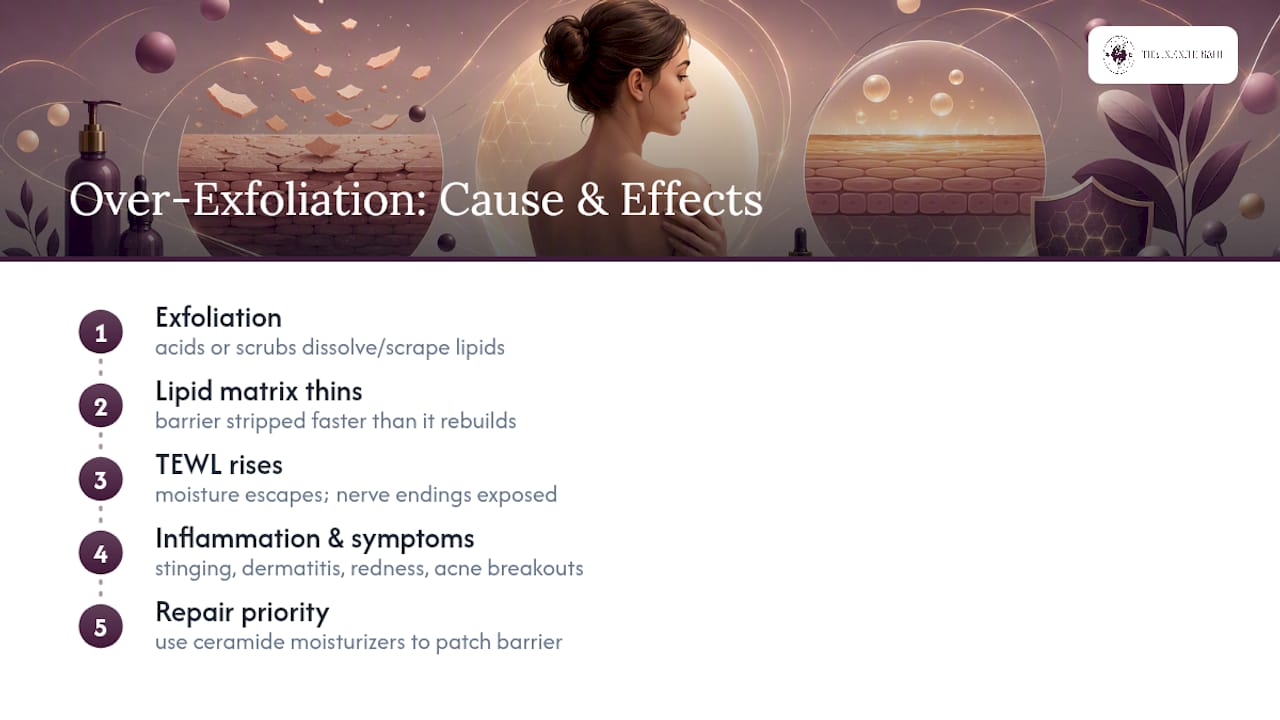
Your skin barrier works like a coat of paint over that brick wall: thin, protective, and easy to strip if you're aggressive with the wrong tools. Exfoliation, whether from acids or physical scrubs, dissolves or scrapes away the lipids holding your skin cells together. Do it too often and you strip paint faster than your skin can repaint it.
Once that lipid matrix thins out, transepidermal water loss, or TEWL, climbs. Moisture escapes, nerve endings that are normally shielded become exposed, and inflammation follows. This is the same mechanical pathway behind irritant contact dermatitis, and it explains why over-exfoliated skin can flare into rosacea-like redness or acne-style breakouts even though nothing "new" touched your face.
When the barrier thins, water loss increases, inflammation rises, and nerve endings become more reactive, which is why previously tolerated products suddenly sting.
This is exactly why ceramide-based moisturizers matter more than another active ingredient right now. You're not treating a texture problem. You're patching a wall.
How Do You Repair Over-Exfoliated Skin?
Recovery isn't complicated, but it does require restraint. Here's the order that works:
- Stop everything active. Retinoids, acid serums, physical scrubs, even your cleansing brush. All of it pauses.
- Switch to a non-foaming, fragrance-free cleanser. Foaming cleansers strip lipids further; lukewarm water only, no hot showers on your face.
- Layer a ceramide-and-humectant moisturizer. Ceramide-dominant lipid moisturizers measurably improved hydration and reduced water loss within 28 days in clinical research, which is the kind of evidence worth following instead of guessing.
- Apply broad-spectrum SPF every single morning. Damaged barriers burn faster and scar more visibly.
- Use 1% hydrocortisone sparingly for genuinely inflamed patches, for no more than a few days, and skip it if you have rosacea or perioral dermatitis, where steroids can worsen things long term.
- Track your milestones. No more stinging with your moisturizer, less flaking, skin that feels plump instead of tight. That's your green light, not a calendar date.
Dermatologists are consistent on one point: don't exfoliate away the peeling. It feels productive. It's actually the opposite, since it re-injures skin that's trying to knit itself back together.
Pro Tip: Keep a one-week log of how your skin feels each morning, tightness, stinging, texture. Patterns show up faster than memory does, and they'll tell you exactly when you're ready for the next step.
For a full routine breakdown while you're rebuilding, our sensitive skin routine guide walks through product order in more detail.
When Should You Start Exfoliating Again?
Wait until three things are true at once: no stinging with your regular moisturizer, hydration that holds through the day instead of fading by noon, and skin that tolerates SPF without protest. Rushing this stage is the single most common reason people cycle through over-exfoliation more than once.
When you're ready, restart slow and specific to your skin type:
- Sensitive or reactive skin: a low-concentration lactic acid, once a week, nothing else layered on top.
- Oily or acne-prone skin: a mild BHA once weekly, still avoiding retinoid stacking for at least two more weeks.
- Combination skin: alternate lactic acid and a rest day, watching for any return of tightness.
Dermatologists tend to favor individualized frequency over rigid schedules, since tolerance varies more by person than by skin "type" alone. Patch-test on your jawline first, wait 48 hours, then expand to your full face. Going forward, use one active ingredient at a time and space out physical scrubs. Our guide on how often to exfoliate by skin type breaks down realistic weekly limits.
When Should You See a Dermatologist Instead?
Some symptoms are past the point of home care. Severe pain, blistering, oozing, spreading redness, or fever need urgent medical attention, not another week of moisturizer. Pus, warmth that spreads quickly, or red streaks point to infection.
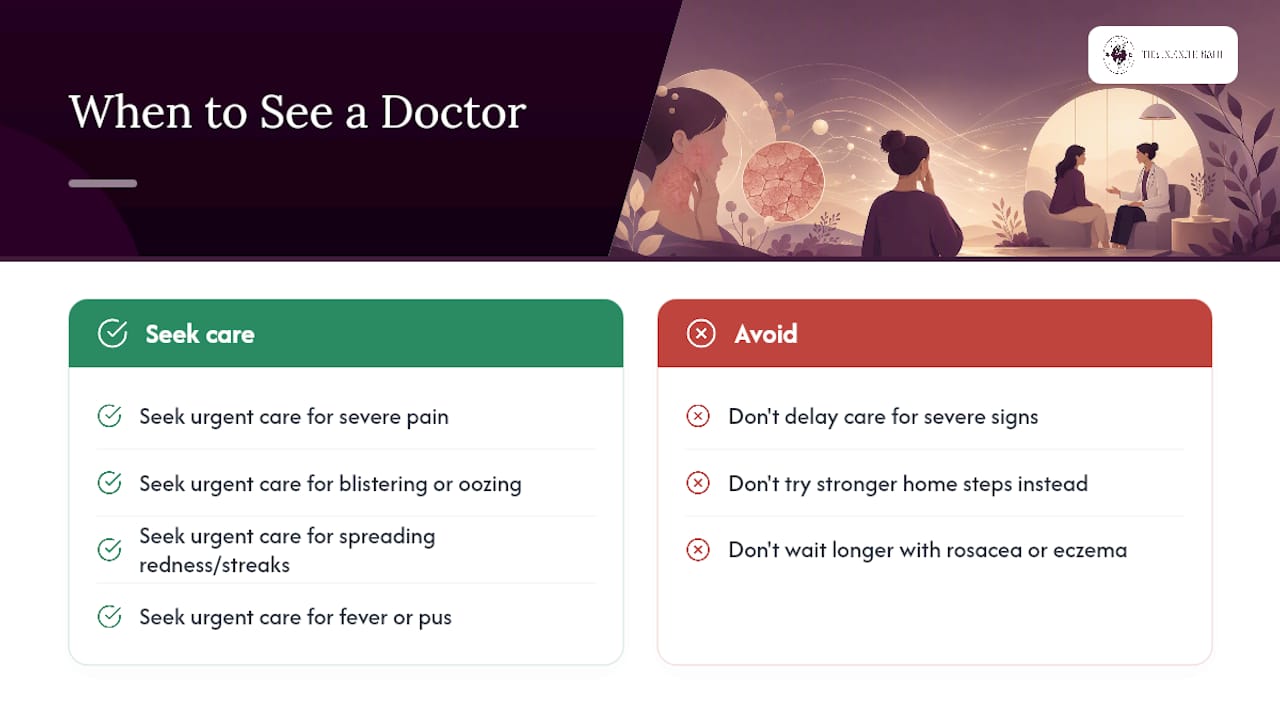
If conservative care hasn't calmed things down after several weeks, that's not a sign to try harder. It's a sign to get seen. This goes double if you have rosacea or eczema, since these conditions often extend recovery timelines and respond better to gentler, dermatologist-guided routines than standard barrier-repair steps alone.
A Publisher's Take on Getting Back to Simple
Some skincare regimens focus on consistency rather than multiple steps for recovery. Lactic acid tends to be gentler on reactive skin than stronger acids due to its larger molecule size, which slows penetration, making it a preferred choice over retinol for sensitive skin. If you're mapping out your own reintroduction pace, our lactic acid versus retinol breakdown is worth a read before you restart anything.
Why Most Over-Exfoliation Advice Misses the Point
Most skincare content treats over-exfoliation like a dosage problem: use less, less often, and you'll be fine. That's true, but it skips the harder truth. The real failure point isn't the acid concentration. It's the belief that more active ingredients always mean more progress.
I'd argue the bigger culprit is routine complexity itself. When you're layering five or six products, an acid toner, a retinol serum, a physical scrub twice a week, you lose track of what's actually causing the reaction. You can't fix what you can't isolate. Simplifying isn't a compromise while you heal. It's the diagnostic tool that tells you what your skin can actually handle. Skin that's constantly recovering from the last active never gets to show you its real baseline.
That's the piece worth sitting with: the goal isn't tolerating more exfoliation. It's needing less of it to get the same result.
— Stella
Support Your Barrier While It Rebuilds
A damaged barrier doesn't need more ingredients. It needs fewer, gentler ones that actually do the repair work. The Lustral Flood Collection pairs a lactic acid serum, formulated to be gentler than stronger acids, with a ceramide-rich renewal cream built specifically for the hydration side of recovery.

Skip the guesswork of stacking five separate products and start with a routine built around three steps that work together instead of against each other. If you're rebuilding from over-exfoliation right now, patch-test the renewal cream on your jawline for 48 hours before applying it to your full face, same rule as any new product during recovery. When you're ready to simplify for good, browse the full skincare shop and start with the cleanser and cream alone before adding the serum back in.
Sources
- Over-Exfoliation: Warning Signs, Causes, and Prevention — Westlake Dermatology
- Irritant contact dermatitis — DermNet NZ
- Are You Over-Exfoliating? How to Tell & Reverse the Trend — Healthline
- How To Heal Over-Exfoliated Skin, According To A Dermatologist — HuffPost
FAQ
How do you fix over-exfoliated skin?
Stop all exfoliants, retinoids, and scrubs immediately, and switch to a gentle non-foaming cleanser, a ceramide-based moisturizer, and daily sunscreen. Dermatologists specifically caution against exfoliating away visible peeling, since that only re-injures skin that's already trying to heal.
How long does it take to recover from over-exfoliation?
Mild cases often improve within a few days to a week of stopping actives and simplifying your routine. More significant barrier damage can take two to six weeks, with progress showing up gradually as stinging fades and hydration holds.
What happens if you exfoliate your skin too much?
Your barrier's lipid matrix breaks down faster than it can rebuild, which raises transepidermal water loss and exposes nerve endings underneath. That's what drives the redness, stinging, and reactive breakouts that define over-exfoliation.
What is the best moisturizer for over-exfoliated skin?
Look for a moisturizer built on ceramides paired with a humectant like glycerin or hyaluronic acid, since that combination has shown measurable improvements in hydration and water loss within weeks. The Renewal Cream in our Lustral Flood Collection follows this same ceramide-forward approach.
How do I know if I'm over-exfoliating versus just purging?
Purging tends to bring small, contained breakouts in areas you already break out, without the burning or tightness. Over-exfoliation usually comes with stinging on application, visible flaking, and sensitivity that spreads beyond your usual trouble spots.