
Most purging settles within a few weeks, though certain treatments can stretch that window longer. If your skin is bumpy but improving, keep going. If it's spreading, burning, or worse at week six, stop the product and check in with a dermatologist.
TL;DR:
- Most skin purging lasts four to six weeks, with onset within one to four weeks and full clinical benefits taking up to 12 weeks for stronger treatments.
- Purging occurs in areas where you normally experience breakouts, and new bumps in unrelated zones indicate a reaction rather than purging.
- During purging, avoid layering strong acids, physical scrubs, or multiple actives, and use gentle cleansing, barrier-supportive moisturizer, and daily sunscreen.
- If symptoms worsen after six weeks or bumps spread beyond usual zones, discontinuing products and consulting a dermatologist is recommended.
- Post-inflammatory hyperpigmentation appears after a purge and can fade over weeks or months with sun protection and gentle brightening treatments.
Table of Contents
- What Skin Purging Actually Is (and Why It Happens)
- Skin Purging Timeline: What to Expect Week by Week
- Is It Purging or a Breakout? Four Questions to Ask
- Caring for Skin During a Purge (and When to Stop)
- What Comes After the Purge Clears
- A Gentler Way to Handle the Purge Window
- A Note on Patience From Stella
- Sources
- FAQ
What Skin Purging Actually Is (and Why It Happens)
Think about the skin's surface for a second, like a countertop covered in crumbs you can't see until you sweep. Purging is that sweep. It's a period of accelerated cell turnover that pushes clogged material, technically called microcomedones, up to the surface faster than they'd normally travel. Those clogs were already forming under your skin before you ever opened the new bottle. The active ingredient didn't create them. It just sped up their exit.
That's the key distinction I want you to hold onto, because it changes how you interpret every bump that shows up over the next month.
Certain ingredient categories are known for triggering this speedup:
- Retinoids (retinol, tretinoin, adapalene), which accelerate cell cycling at the follicle level
- AHAs and BHAs (glycolic, lactic, salicylic acids), which loosen the "glue" holding dead skin cells together
- In-office resurfacing treatments, like chemical peels or microneedling, which trigger a similar surface turnover response
Purging is different from an allergic or irritant reaction, and it's different from a new product simply clogging your pores (true breakouts from comedogenic ingredients). Purging is temporary acceleration of something already underway. Irritation is your skin barrier waving a flag. New breakouts from a comedogenic product are the formation of entirely fresh clogs you didn't have before. All three can look similar at a glance. They behave very differently over time, and behavior over time is what this whole article is really about.
Skin Purging Timeline: What to Expect Week by Week
Here's where most people get impatient, and honestly, I understand why. Nobody signs up for a new serum expecting their face to look worse before it looks better. But the skin purging timeline follows a pattern that clinicians see consistently enough to map it out.
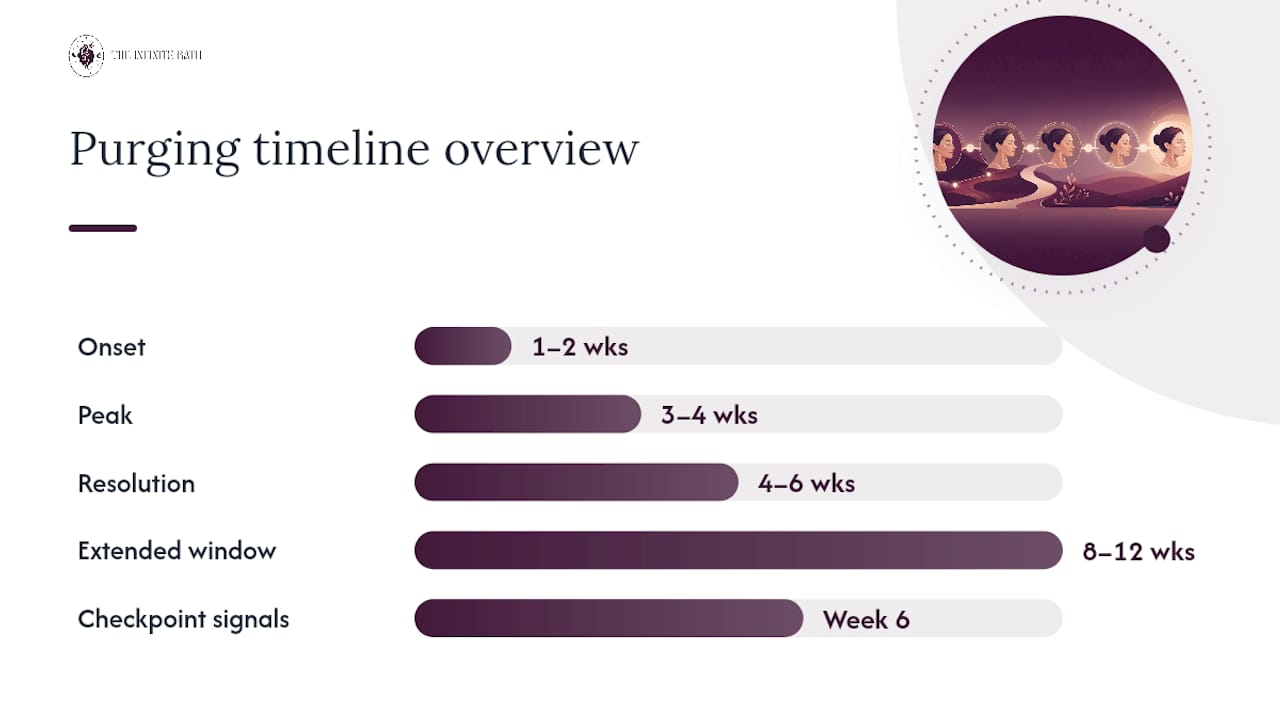
- Weeks 1 to 2: Onset. Small bumps, blackheads, or a few new pimples appear, usually in your normal breakout zones.
- Weeks 3 to 4: Peak. This is often the roughest patch. The backlog of microcomedones is working its way out, so texture may look worse before it looks better.
- Weeks 4 to 6: Resolution. Most people see visible calming here. Redness fades, new bumps stop appearing, and skin starts to feel less reactive.
- Weeks 8 to 12: Extended window for stronger treatments. Retinoid trials are typically read at 10 to 12 weeks for net benefit, which means the full payoff of a prescription retinoid or a strong resurfacing treatment can lag behind the initial purge by quite a bit.
Statistic snapshot: Consumer health coverage commonly reports purging onset within one to four weeks, with resolution by roughly four to six weeks for most people. Clinical retinoid literature, on the other hand, uses 10 to 12 week endpoints to judge whether a treatment actually worked. Both numbers are true. They're just answering slightly different questions, one about visible calming, one about full clinical benefit.
A few things shift this timeline in either direction. Younger skin with faster natural cell turnover sometimes moves through a purge quicker. Oilier skin types, or anyone with a backlog of untreated congestion, may see a longer or more dramatic peak simply because there's more material working its way out. Product strength and frequency matter too.
Here's your practical checkpoint: if you're past week six with zero improvement, or if bumps are spreading into new territory instead of settling in your usual zones, that's your signal this isn't a standard purge anymore. We'll walk through exactly how to make that call in the next section.
Is It Purging or a Breakout? Four Questions to Ask
This is the question that actually keeps people up at night, and fair enough. Nobody wants to keep irritating their skin under the mistaken belief it's "just purging." Dermatologists interviewed on this topic tend to come back to the same marker again and again: purging shows up in your usual acne zones, the same jawline, chin, or forehead spots where you already tend to break out. New territory, like a chest or back that's never given you trouble, points away from purging and toward a reaction.
Lesion type matters just as much as location. Run through these four checks:
- Location: Are the new bumps in your regular breakout zones, or somewhere entirely new?
- Lesion type: Are they small, comedonal bumps and whiteheads, or are you seeing widespread redness, burning, and peeling?
- Progression: Are things staying roughly contained, or getting visibly worse week over week?
- Timing: Is this happening within the first few weeks of a new active, or did it show up out of nowhere after months of stable use?
A practitioner framework built around exactly this kind of four-question check exists precisely because "it's just purging" gets used as an excuse far too often, both by brands and by well-meaning friends giving advice. If you answer even one of those four questions in the direction of "reaction" rather than "purge," take that seriously.
Pro Tip: Take a well-lit photo of your skin once a week, same angle, same lighting. Memory is unreliable when you're anxious about your face. A photo timeline settles the "is this better or worse than last week" argument instantly. For a deeper walk-through of this exact comparison, see our clinician-style purging versus irritation checklist.

Caring for Skin During a Purge (and When to Stop)
Your job during a purge isn't to fix the bumps. It's to keep everything around them calm enough that the process can finish on its own schedule. Think of your skin barrier like the mortar between bricks. Purging loosens things at the surface, and if the mortar crumbles too, you're dealing with two problems instead of one.
Keep your routine simple during this window: a gentle, non-foaming cleanser, a basic moisturizer to support the barrier, and broad-spectrum sunscreen every single morning, since skin actively cycling through cell turnover is more sun-sensitive than usual.
On frequency, start low and go slow. If you're introducing a new acid or retinoid, two to three nights a week is plenty at first. You can build up once your skin tells you it's ready, not before.
A few things to pause entirely while you're mid-purge:
- Strong acids layered on top of your new active
- Physical scrubs or exfoliating brushes
- Mixing multiple actives (retinoid plus AHA plus BHA) in the same routine
The American Academy of Dermatology's guidance on new products is direct about when to stop: burning, severe redness, or symptoms that worsen well beyond the expected timeframe are all reasons to discontinue and reassess. Add to that list: no improvement by six to eight weeks, deep painful cysts, or anything that looks like it's heading toward scarring. Those aren't "give it more time" situations. Those are "call a dermatologist" situations.
Pro Tip: If you're unsure whether to keep pushing through, cut back to every third night for two weeks before quitting the product entirely. Sometimes the fix isn't stopping, it's slowing down. Our guide on layering actives in the right order covers this in more detail.
What Comes After the Purge Clears
Once the backlog empties out, most people notice a real shift, smoother texture, fewer new bumps, and skin that feels calmer to the touch rather than reactive. That's the payoff the whole process was building toward.
The catch is post-inflammatory hyperpigmentation, those flat brown or pink marks left behind after a bump heals. They're common after any inflamed breakout, purge-related or not, and they fade faster with the right care:
- Sun protection first, every day, since UV exposure is what locks pigmentation in place and slows fading
- Gentle brightening actives introduced gradually once active purging has calmed
- Patience, since most marks fade over weeks to months rather than days
If a mark hasn't budged after a couple of months of consistent sun protection, that's when it makes sense to bring in a targeted treatment rather than waiting it out further.
A Gentler Way to Handle the Purge Window
If you're sensitive to retinoids or new to actives altogether, a lactic acid serum tends to be a lower-irritation entry point. Lactic acid is a larger molecule than glycolic acid, so it penetrates more gently while still supporting turnover, which is part of why The Infinite Bath built its lactic acid serum around it instead of a harsher alternative.
Start with two applications a week and build from there. Patch-test on your inner arm for 48 hours before your first full-face use, always.
The three-step approach, gel cleanser, lactic serum, renewal cream, is built around this exact pacing:
- Cleanser removes surface buildup without stripping your barrier
- Lactic serum encourages turnover at a pace sensitive skin can tolerate
- Renewal cream replenishes moisture and supports barrier repair while cell turnover is elevated
Hydration isn't optional here. It's what keeps exfoliation from tipping into irritation.
A Note on Patience From Stella
Watching your skin look worse before it looks better is genuinely hard, and I don't think anyone talks about that honestly enough. Protect your barrier, wear sunscreen without exception, and let the timeline do its work. If anything feels severe or drags on past what's reasonable, see a clinician. Your skin deserves a second opinion, not just your own worry.
— Stella
This article is general information, not a substitute for advice from a qualified doctor. Consult a qualified healthcare professional about your own circumstances before acting on anything here.
Sources
- PMC article (NCBI) — dermatology clinical literature
- WebMD — Skin purging causes, signs, and treatment
- Vogue — A doctor's guide to skin purging
FAQ
How long does skin purging typically last?
Most purging resolves within four to six weeks, with onset often starting in the first one to two weeks. Stronger treatments like prescription retinoids may take 10 to 12 weeks to show their full benefit, even after the initial purge has calmed.
Does skin actually look better after purging ends?
Yes, most people see smoother texture and fewer breakouts once the backlog of microcomedones has fully surfaced and cleared. Any leftover discoloration is usually post-inflammatory hyperpigmentation, which fades separately from the purge itself with consistent sun protection.
Should I pop pimples that appear during purging?
No. Popping increases the risk of scarring and post-inflammatory hyperpigmentation, and it can introduce bacteria that turns a contained bump into a bigger problem. Let the skin surface and shed the material on its own timeline.
How can I tell if my skin is purging or reacting badly?
Purging tends to stay in your usual breakout zones and involves mostly comedonal bumps rather than diffuse burning or spreading redness. If new bumps show up in areas you've never broken out before, or symptoms worsen past six weeks instead of settling, treat it as irritation rather than purging and stop the product.